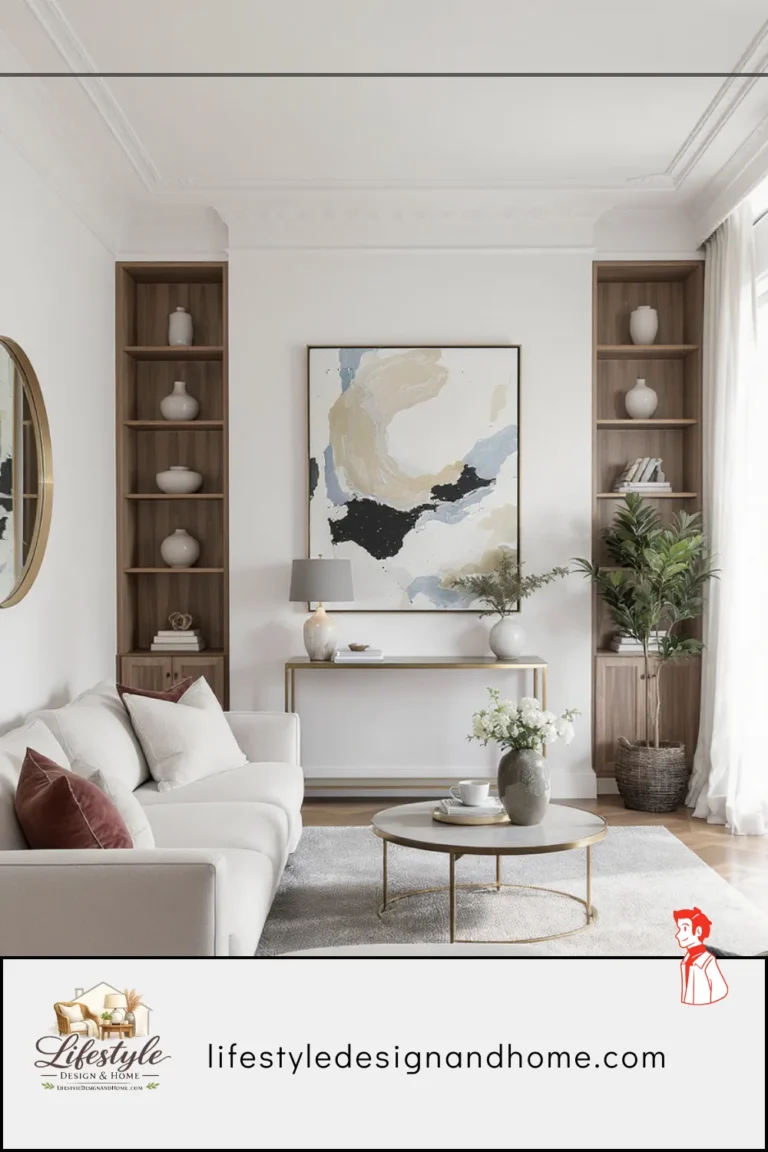
The Television That Moved Four Times
My television has lived in four different positions in my current living room.
Not because I am indecisive, though my partner would contest that characterization. Because the television is the piece of furniture — if you can call it that — that interacts most complexly with every other decision in a small living room, and getting it right requires understanding a set of competing requirements that pull in different directions simultaneously. The right position for viewing comfort conflicts with the right position for room proportion. The right position for cable management conflicts with the right position for natural light. The right position for the seating arrangement conflicts with the right position for the doorway traffic.
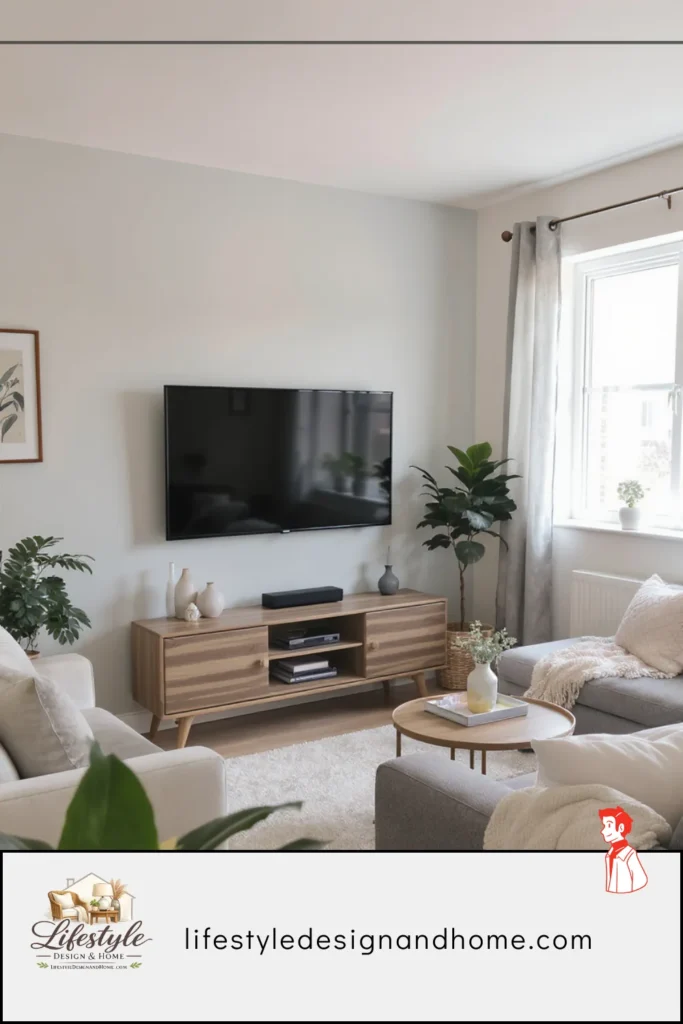
My first position: on a small media console against the short wall opposite the sofa, which put the television at the correct height for the room’s proportions but created a glare problem from the window on the adjacent wall that made afternoon viewing essentially impossible and required closing the curtains whenever I wanted to watch anything, which then made the room feel like a cave.
My second position: on the long wall, which solved the glare problem but created a viewing angle problem — from the sofa, I was watching the television at about 30 degrees off-axis, which is 20 degrees past comfortable and produced neck strain that I attributed to sleeping wrong for about three weeks before I identified the actual cause.
My third position: back to the short wall but with the television mounted higher, which solved the glare and the angle but put the center of the screen at 58 inches from the floor — 14 inches too high for comfortable seated viewing — and I spent an embarrassingly long period of time convinced that the neck discomfort was the result of some other factor before accepting that I had simply mounted it too high.
My fourth position is where it has been for two years. It is correct. It took three wrong positions and approximately 18 months to arrive at it, and every wrong position taught me something specific about why it was wrong.
This article is what I learned — about the constraints that govern television placement in small living rooms and the specific ways to resolve them when they conflict.
Why the TV Question Is Harder in Small Rooms
Television placement in larger rooms is a problem with more degrees of freedom. The room can absorb a television on most walls without the placement creating significant consequences for the rest of the furniture arrangement. The viewing distance can be accommodated. The glare can be managed. Multiple seating positions can be provided at acceptable angles.
Small living rooms remove most of those degrees of freedom and expose constraints that larger rooms absorb. In a 10-by-12-foot room, the television’s position on one wall determines the only viable sofa position, which determines the only viable traffic path, which determines where the other furniture can and cannot go. The television placement is not one decision among many. It is close to the first decision, because everything else follows it.
The constraints that govern television placement in small living rooms — and that must be resolved before any position can be considered correct — are these:
Viewing distance. The distance between the screen and the primary viewing position is determined by screen size and is not a matter of preference — it is an ergonomic requirement with a specific range. Too close produces eye strain. Too far produces the effort of resolving image detail the eye cannot comfortably manage. In a small room, the viewing distance often limits where the television can go: it must be on the wall that puts the sofa within the correct range.
Viewing angle. The screen should be watched from directly in front of it or within approximately 15 degrees of center. Beyond 15 degrees, the image quality on most screens degrades and the neck position required for sustained viewing creates strain. The seating arrangement must face the television within this angular range.
Screen height. The center of the screen should be at approximately seated eye level — roughly 42 to 48 inches from the floor — for comfortable viewing without neck tilt. Most people mount televisions higher than this because it “looks better” with the television standing rather than sitting. It does not look better to the neck of the person watching it.
Glare management. Windows and other light sources create glare on screens that ranges from mildly annoying to viewing-destroying depending on their position relative to the screen. Windows directly behind the viewer create the worst glare (light bouncing directly off the screen into the viewer’s eyes). Windows directly behind the screen create the second-worst condition (contrast between bright window and screen is visually stressful). Windows to the side — neither behind the viewer nor behind the screen — are the manageable condition.
Cable and connection management. The television needs power and signal connections, and in rental apartments the outlet and cable port positions are fixed. This constraint is often the most overlooked and the most stubbornly consequential: a theoretically ideal television position that requires a cord running across the floor or a cable stretched to its limit is not actually ideal.
In my small living room, resolving all five constraints simultaneously took four attempts. In the remainder of this article I will explain how to resolve them without four attempts.
The Viewing Distance Calculation
This is the constraint that most definitively determines which walls in a small living room are viable for the television, and it is the one most people calculate incorrectly because the formula is less intuitive than it seems.
The standard recommendation for television viewing distance is between 1.5 and 2.5 times the screen’s diagonal measurement. This formula exists because it places the viewer at the distance where the eye can comfortably resolve the resolution of the screen — close enough to benefit from the picture detail, far enough that the eye doesn’t need to work to see the whole image at once.
For a 55-inch television (the most common size in a typical living room), the comfortable viewing range is:
- Minimum: 55 × 1.5 = 82.5 inches (approximately 7 feet)
- Maximum: 55 × 2.5 = 137.5 inches (approximately 11.5 feet)
For a 65-inch television:
- Minimum: 65 × 1.5 = 97.5 inches (approximately 8 feet)
- Maximum: 65 × 2.5 = 162.5 inches (approximately 13.5 feet)
In a 10-by-12-foot room, the maximum distance between any two walls is 12 feet — 144 inches. Subtract the depth of the sofa (approximately 36 inches) and the depth of the television and media console or mount (approximately 4 inches), and the available viewing distance in a 12-foot room is approximately 104 inches — just under 9 feet.
A 55-inch television works in this room: 9 feet falls comfortably within the 7-to-11.5-foot range. A 65-inch television also works at the minimum: 9 feet is just within the 8-to-13.5-foot range. A 75-inch television does not work: its minimum comfortable viewing distance of 9.4 feet exceeds the available 9 feet.
This calculation tells you, before any other decision, which screen sizes work in your room. A screen too large for the room’s available viewing distance is not correctable by placement. It is the wrong screen for the room.
I did this calculation after my first position and discovered that my 65-inch television was at the exact minimum of its comfortable viewing range in my small room — workable but leaving no margin. I have since concluded that a 55-inch television would have been the more appropriate size for the room, and that the widespread assumption that larger is always better in televisions is specifically wrong for small living rooms where the viewing distance is fixed by the room’s dimensions.
The Four Wall Options and What Each Costs You
In a rectangular living room with a front door, a window, and potentially a second doorway, there are typically four walls available for the television. Each one costs something. The right choice is the wall whose costs are most manageable for your specific room.
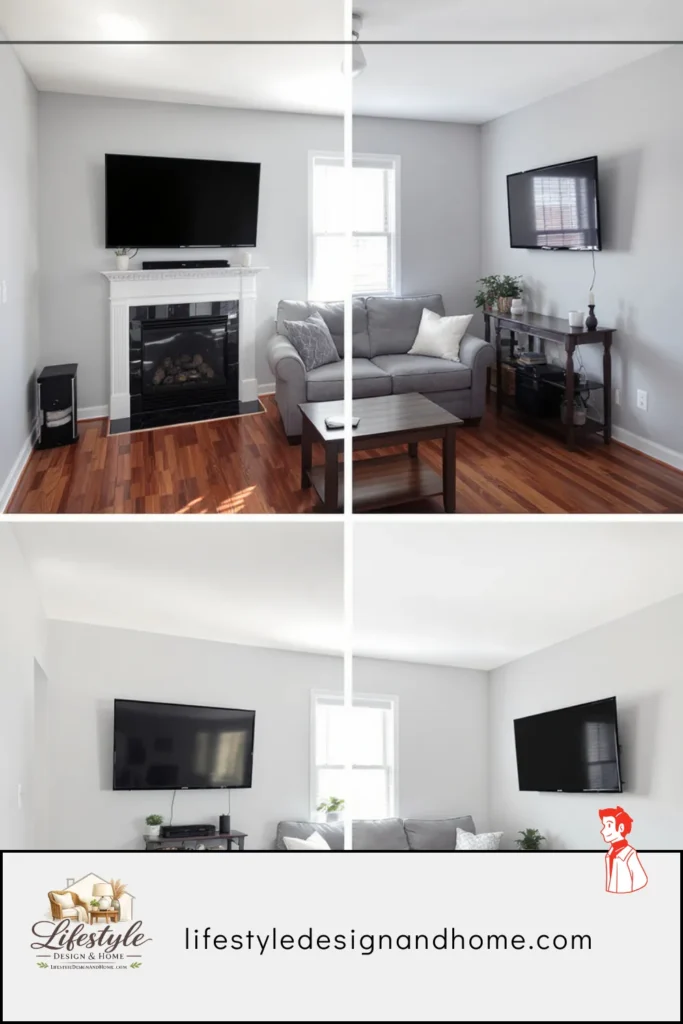
The Short Wall Opposite the Sofa
This is the most natural television position in a rectangular room — the television on the short wall, the sofa facing it along the room’s long axis, the longest viewing distance available. In a 12-foot-wide room with the sofa against the opposite short wall, the viewing distance is approximately 9 feet after accounting for the sofa depth.
What it costs: the short walls are typically where doorways live in small apartments. A television on the short wall is sharing that wall with the entry to the room, which limits the wall space available and creates traffic flow considerations. If the front door is on the short wall, the television is immediately visible from the entrance, which makes the television the room’s first impression — functional but not always aesthetically ideal.
When it works best: when the short wall is uninterrupted by doorways and the opposite short wall has space for the sofa with adequate clearance at each end. When the glare management works — windows on the long walls rather than the short ones.
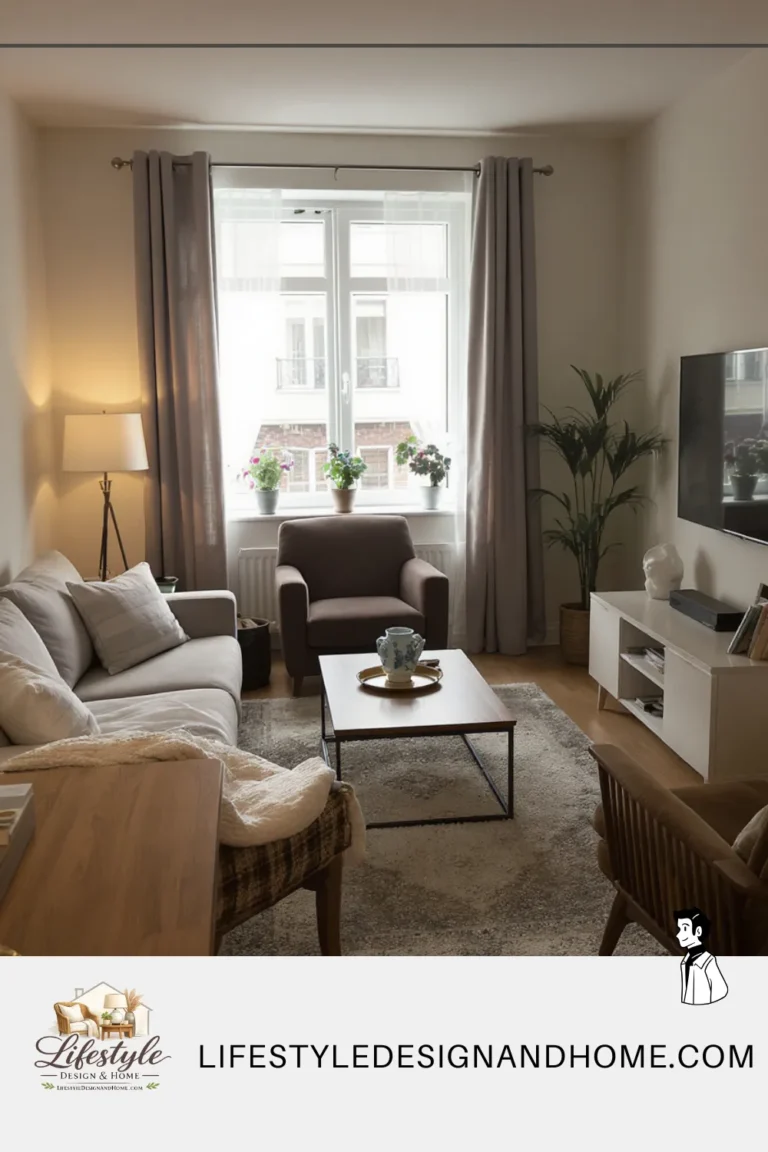
This was my fourth and current position. The television is on the short wall opposite the front door, which means it is visible from the entrance but not on the same wall as the entrance. The viewing distance is 9 feet. The glare is managed because the window is on the long wall, to the side of the viewing position rather than behind the viewer or behind the screen.
The Long Wall
The long wall offers more horizontal space and typically avoids the doorway conflicts of the short walls. It is the position most people try first in a rectangular room because it offers the most apparent options.
What it costs: in a room 10 to 12 feet wide, placing the television on a long wall means the sofa must go on the opposite long wall — which reduces the viewing distance to the room’s shorter dimension (10 to 12 feet minus sofa depth minus TV depth, approximately 7 to 8 feet). This is within the comfortable range for a 55-inch television but at the tight end. It also means the sofa is running parallel to the long wall, which can produce rooms where the arrangement feels like a corridor — sofa on one long wall facing television on the other long wall, traffic squeezed through the ends.
The viewing angle problem I experienced: the long wall position requires the seating arrangement to run the full length of the opposite long wall for the angle to work. If the primary seating position is anywhere off-center — at one end of the sofa, in a chair positioned toward one end of the room — the viewing angle from that position can exceed the comfortable 15-degree limit.
When it works best: in rooms where the short walls are heavily interrupted by doorways and windows, and when the room is wide enough (12 feet or more) that the sofa can be positioned slightly away from the opposite wall and still maintain adequate viewing distance.
The Corner Position
Placing the television in a corner — either on a corner console or mounted at 45 degrees to both walls — is often proposed as a solution to the problem of competing wall constraints. If both short walls and both long walls have problems, perhaps the corners are better.
What it costs: corner television placement requires the seating arrangement to face the corner, which means either a large sectional that wraps the room or all the seating angled toward the corner. Angled furniture is the arrangement my partner described as “chaotic” in the sofa placement article. It can work in the right room. In most rooms, the corner television creates a seating arrangement where no seat has a completely comfortable viewing angle — the positions closest to the television are at extreme angles, and the positions with acceptable angles are too far.
The additional cost: corner mounting typically places the bottom of the television closer to the corner walls than a flat-wall mount, which limits the viewing angle further and can make the television harder to see from positions that are not directly in front of the corner.
When it works: in nearly square rooms where the diagonal sightline across the room is actually the longest available viewing distance and where a sectional can wrap the seating arrangement naturally around the corner focal point. In these rooms, the corner television can be the most natural solution to a geometry that resists orthogonal arrangements.
I considered this for my second attempt and rejected it correctly for my room’s geometry. I have seen it work in a friend’s nearly square living room where the diagonal approach was genuinely the right answer.
The Fireplace Wall
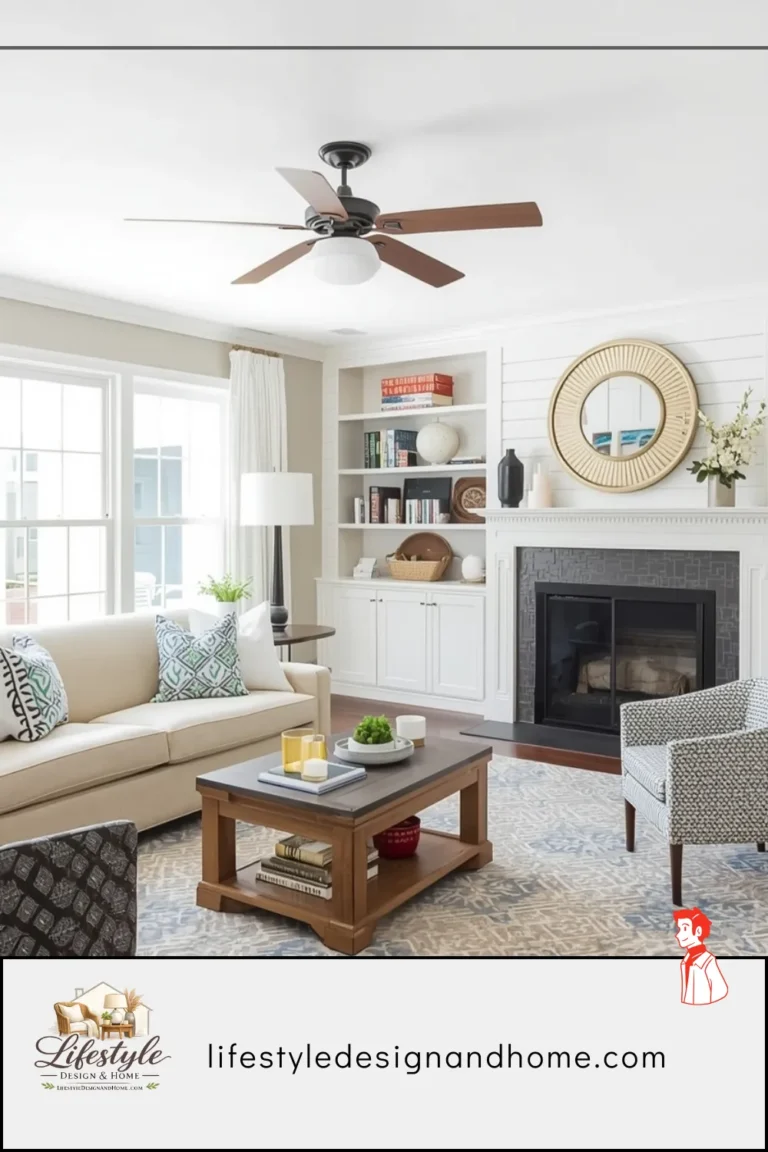
In rooms with a fireplace — even a non-working one — the fireplace wall is the room’s natural focal point and the television competes with it for that status. Many designers argue against putting a television above or beside a fireplace on principle, and I understand the argument aesthetically. The practical reality of small living rooms is that the fireplace wall is frequently the only wall that works for both the television and the seating arrangement.
What it costs: a television mounted above a fireplace is almost always too high. The mantel height plus the fireplace surround height plus any hearth height puts the bottom of the television at 50 to 60 inches from the floor, which puts the center at 60 to 70 inches — 15 to 25 inches above the comfortable seated-eye-level range. Watching a television above a fireplace requires sustained upward neck tilt that becomes genuinely uncomfortable after about twenty minutes.
The solution when the fireplace wall is the only option: build out the fireplace surround so the television can be recessed or positioned at a lower height. This is a renovation-level solution. For renters or those unwilling to renovate, the fireplace wall television is a tradeoff between correct placement (too high, neck strain) and aesthetically acceptable placement (too high, neck strain that has been accepted).
The alternative that avoids the height problem: position the television beside rather than above the fireplace. In a room where the fireplace wall is wide enough, a television mounted to one side of the fireplace at the correct height of 42 to 48 inches to center can share the wall with the fireplace without requiring the above-fireplace height problem. The fireplace remains the wall’s dominant element. The television is a functional companion rather than a competing focal point.
The Height Question — Lower Than You’re Going to Want
I spent three months watching television at a screen height that was causing neck strain before I accepted that the strain was coming from the television height and not from my pillow, my mattress, my sleeping position, or any of the other causes I investigated in preference to accepting that I had made an expensive and annoying mounting mistake.
The correct height: the center of the television screen should be at approximately seated eye level. Seated eye level is typically 42 to 48 inches from the floor, depending on sofa seat height (typically 17 to 19 inches) and the angle at which a person naturally holds their head when seated comfortably.
This height looks wrong when the room is empty and you’re standing looking at the wall. The television seems too low. The bottom of the screen is at approximately 28 to 34 inches from the floor, which puts it below standard table height and makes the television look like it has been installed by someone who didn’t consider aesthetics.
It looks exactly right when the room is in use and you’re watching it from the sofa.
The specific neck mechanics: the head is balanced on the cervical spine in a neutral position when looking straight ahead. Tilting the head back — which is what looking up at a too-high television requires — moves the head’s center of gravity behind the cervical spine and requires the posterior neck muscles to engage continuously to maintain the position. Twenty minutes of this produces muscle fatigue. Two hours produces pain. Two years produces the chronic neck tension that gets blamed on everything except the thing actually causing it.
I moved my television from 58 inches to center to 44 inches to center. This required remounting — the bracket holes were three inches apart and I needed to move the mount down 14 inches, which required new wall anchors. It took about two hours and the mild humiliation of admitting to myself that I had done this wrong twice before getting it right.
The television at 44 inches to center looks, from the sofa, like it is exactly where it should be. From the room entrance, standing, it looks slightly lower than expected. I am at peace with this because I watch television sitting down.
Glare Management: The Practical Guide
Glare is the constraint that most people address last and should address first, because a television positioned perfectly for every other criterion is unwatchable if it has unmanageable glare.
The three glare conditions and how to address each:
Window behind the viewer. This is the worst condition — light from the window is traveling in the same direction as the viewer’s sightline and reflecting directly off the screen. It makes the screen appear washed out and requires either blackout curtains (room becomes a cave) or limiting television viewing to evening hours (not always practical).
If this is your room’s condition, the television is on the wrong wall. The window-behind-viewer condition means the window is on the same wall as the sofa or behind the sofa — move the television to a different wall.
Window behind the screen. The second-worst condition — the viewer is looking toward the window, which creates a high-contrast situation where the bright window behind the dark screen makes both harder to see. This is my first position’s problem: the window was on the wall adjacent to my first television position, close enough to be in my peripheral vision when watching, bright enough to create the contrast problem.
This condition is manageable with light-filtering curtains or blinds that reduce the window brightness without eliminating daylight entirely. Sheer curtains in warm tones reduce glare while maintaining the room’s access to natural light.
Window to the side. The manageable condition. The window is on a wall perpendicular to the screen, and its light falls across the room rather than toward the screen or toward the viewer. This produces some side-lighting of the room and some side-illumination of the screen surface, but neither creates viewing-impairing glare for a standard seated viewing position.
Position the television so that the windows are to the side of the viewing position whenever possible. In my current fourth position, the window is on the long wall to my left when I’m seated on the sofa facing the television on the short wall. The light comes from the left, illuminates the room generally, and creates no glare on the screen.
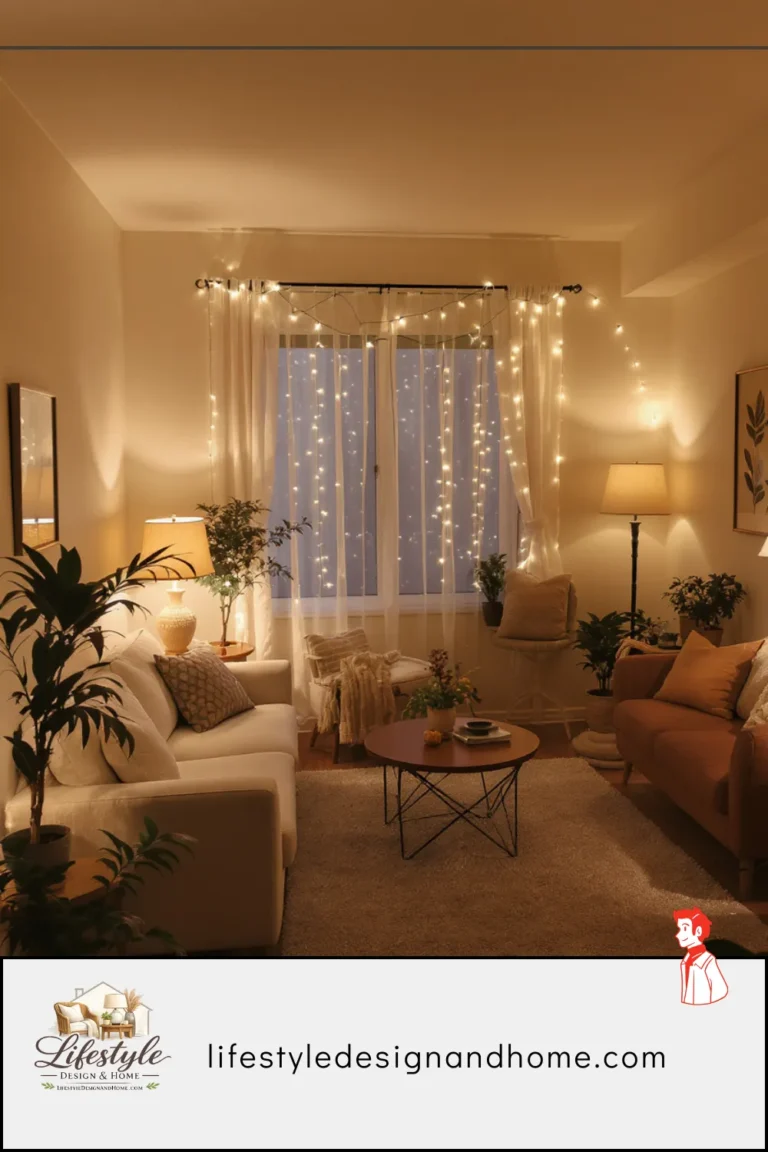
The additional glare management tool that almost nobody uses: bias lighting. A warm LED strip behind the television — adhered to the back of the set, running around its perimeter — provides a soft warm glow that reduces the contrast between the bright screen and the dark surrounding wall. This reduces eye strain during evening viewing and produces a warm, atmospheric halo around the television that improves its integration into the room aesthetically. I installed this in my fourth position and would not return to the unlit television wall. The cost is approximately $15 for an LED strip.
Cable Management: The Constraint Nobody Plans For
The cable management problem is the one that most reliably turns a theoretically correct television position into a practically wrong one, and it is the one I addressed with the least systematic thinking across my first three positions.
The constraints:
Power outlet location. The television needs a power outlet. In rental apartments, the outlet positions are fixed. A television position that requires an extension cord running across the floor or along a baseboard is a television position with a daily irritant that accumulates into genuine aesthetic damage.
Cable or streaming input location. Physical cable connections (cable TV, antenna) require a coaxial port in the wall near the television. Streaming-only setups eliminate this constraint and increase television placement flexibility significantly. If you have moved or are willing to move to streaming-only, you have eliminated one of the most location-specific constraints on television placement.
HDMI and other connections. Game consoles, sound systems, and other devices need connections. These can be run behind the wall or managed with cord covers but require planning before mounting.
The practical cable management solutions for rental situations where in-wall wiring is not possible:
Flat cord covers. Paintable adhesive channels that adhere to walls and baseboards, concealing cords in a profile that is approximately 3/4 inch wide and 3/8 inch deep. When painted to match the wall, they are essentially invisible and eliminate the exposed-cord problem for wall-mounted televisions above the outlet level. I used these in positions two, three, and four. In position four, two cord covers — one running from the television mount down to the outlet, one running from the outlet horizontally to the cable port — eliminated all visible cords in approximately thirty minutes.
The outlet-adjacent constraint. If cord covers are not acceptable or not possible, the television must be within cord length of its power outlet without the cord crossing any floor space or traffic path. This is a genuine constraint and in some rooms it is the binding constraint — the wall that works for every other criterion doesn’t work because the outlet is in the wrong place.
This is not always solvable without an electrician or without accepting a visible cord. In these cases I recommend accepting the cord cover solution and painting it to match. A perfectly placed television with a cord cover is better than a poorly placed television with invisible cords.
The Media Console Question
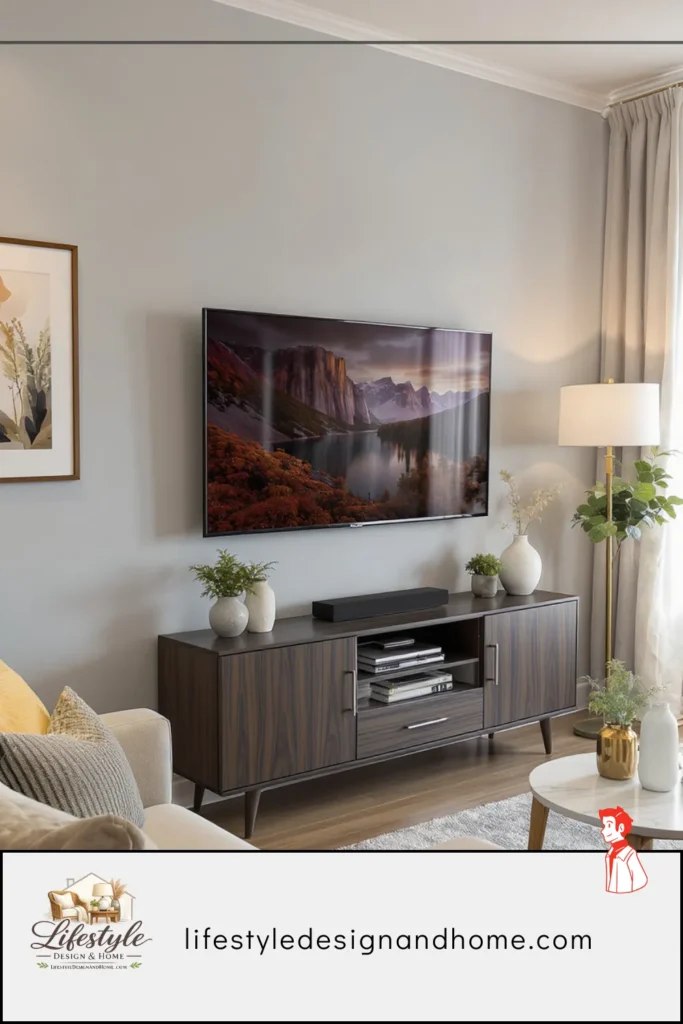
The choice between a media console and wall mounting is partly aesthetic and partly spatial, and in small rooms the spatial argument for wall mounting is significant enough to deserve discussion.
A media console in a small living room consumes floor space, adds furniture mass to the room’s visual field, and typically sits below the television in a way that raises the television higher than the optimal height. The standard media console is 18 to 24 inches tall, which puts the bottom of a wall-mounted television above it at 18 to 24 inches — placing the center of a 55-inch screen at approximately 45 to 51 inches, which is in the correct range.
The floor space a media console consumes — typically 48 to 72 inches wide, 16 to 20 inches deep — is floor space that in a small living room is at a premium. A 60-by-18-inch media console occupies 1,080 square inches — 7.5 square feet — of floor space.
Wall mounting eliminates the console and its floor footprint entirely. The television floats on the wall, the floor beneath it is clear, and the room gains the 7.5 square feet that the console would have occupied.
The practical requirement: wall mounting requires wall anchors in studs or appropriate drywall anchors, which is standard construction work that most renters can do with permission and most homeowners can do themselves. The mount hardware cost is typically $30 to $60. The labor is an afternoon.
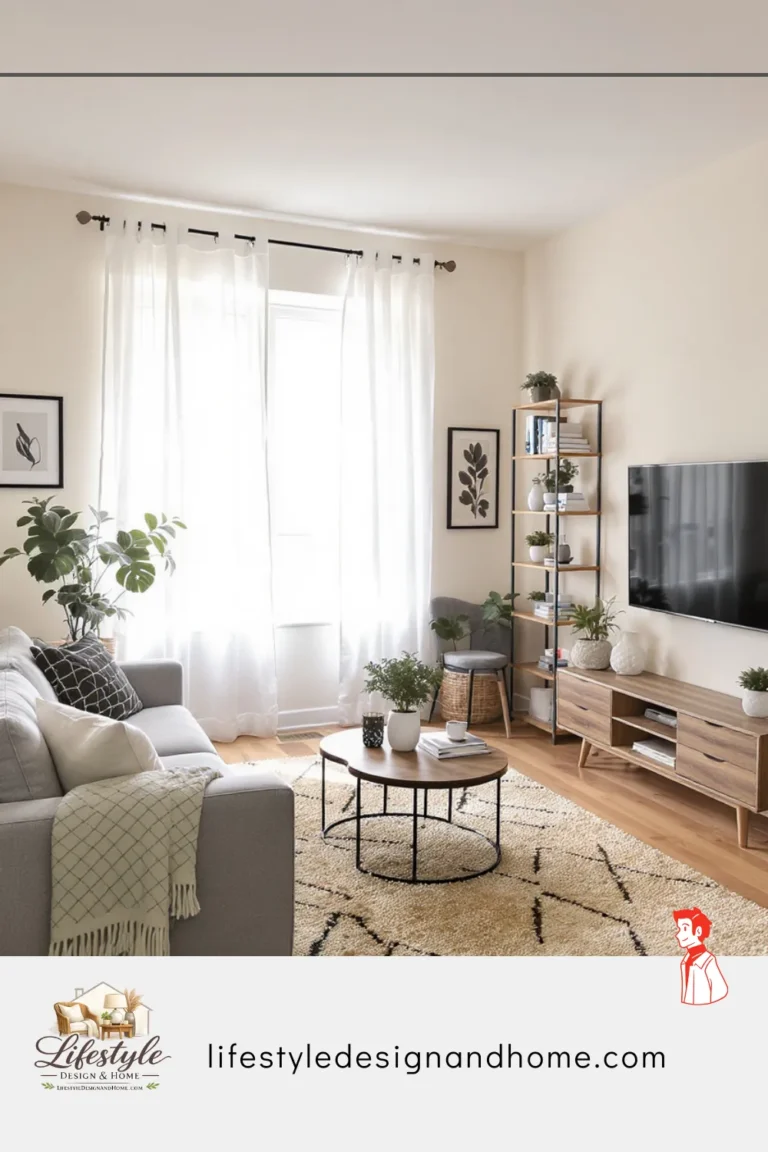
The aesthetic requirement: without a media console beneath it, a wall-mounted television in a small room can look isolated — a black rectangle floating on a wall without context. The solutions: a floating shelf below the television at appropriate height for any equipment (streaming device, sound bar), styled with one or two objects to create a visual anchor for the television. The shelf occupies significantly less floor space than a console (zero, being wall-mounted) and provides the visual grounding the television needs without consuming floor space.
My fourth position uses a wall mount and a small floating shelf — 36 inches wide, 10 inches deep — mounted approximately 6 inches below the television. The shelf holds the streaming device and a small plant. The television is at 44 inches to center. The floor beneath is clear. The arrangement consumes no floor space and provides the visual context the television needs.
When None of the Walls Work
I want to address this honestly because there are small living rooms where none of the four walls is optimal for the television and the best available position is a compromise rather than a solution.
In these rooms — rooms with windows on multiple walls, rooms with doorways that fragment every available wall, rooms where the viewing distance requirements conflict with the glare management requirements — the question shifts from “where is the correct position?” to “which compromise is most livable?”
The compromise hierarchy I would apply:
Prioritize viewing distance and angle above all else. A television in a position with manageable glare but excellent viewing geometry produces a room you can actually use. A television in a perfect glare-free position with awkward viewing geometry produces a room you can’t watch television in comfortably. Glare is manageable with curtains and positioning. Viewing geometry is not manageable once the television is mounted.
Accept the height constraint. Mount at the correct height (42 to 48 inches to center) even if it looks too low from a standing perspective. The neck pain from incorrect height is not worth the aesthetic preference for a higher mount.
Solve glare with window treatments rather than the television position. If the only viable television position has a glare problem, address the glare with appropriate curtains rather than moving the television to a geometrically inferior position.
Accept cord covers. If the best position requires cord management, use cord covers rather than compromising the position to eliminate the cord. A painted cord cover is invisible after a week. A bad viewing angle is uncomfortable every time you watch television.
The Fourth Position
My television has been in its fourth position for two years. I have not thought about moving it.
The specific conditions of the fourth position: mounted on the short wall opposite the front door, center of screen at 44 inches from the floor, viewing distance from the sofa of 108 inches (9 feet), viewing angle from all sofa positions within 10 degrees of center, window to the left side producing no glare, wall mount with floating shelf below, bias lighting behind the television, two cord covers painted to match the wall and invisible since approximately a week after installation.
It took three wrong positions to understand what those conditions needed to be. Position one taught me about glare. Position two taught me about the viewing angle. Position three taught me about mounting height. Position four applied all three lessons simultaneously.
I am not recommending four attempts as the methodology. I am recommending understanding the constraints before attempting the first position — knowing what viewing distance the screen size requires, knowing which wall has manageable glare, knowing the correct height before the mount goes into the wall.
That knowledge produces the fourth position without the first three.
It is, like most things worth understanding properly, much easier to do correctly the first time than to fix after doing it wrong.
Your TV Placement Checklist
Before Mounting:
- [ ] Viewing distance calculated — screen size × 1.5 (minimum) to × 2.5 (maximum)
- [ ] Screen size verified as appropriate for room’s available viewing distance
- [ ] Window positions mapped — wall with windows to the side identified as primary option
- [ ] Outlet and cable port positions noted — cord management plan established
The Mount:
- [ ] Height confirmed — center of screen at 42 to 48 inches from floor
- [ ] Wall studs located — mount anchored to studs or appropriate drywall anchors
- [ ] Tilt angle if adjustable — set to maintain correct eye-level viewing from sofa
The Position:
- [ ] Primary viewing position within comfortable distance range
- [ ] Primary viewing position within 15 degrees of screen center
- [ ] No window directly behind viewer or directly behind screen
- [ ] All secondary seating positions at acceptable viewing angles
The Integration:
- [ ] Cord management solved — cord covers, in-wall routing, or outlet adjacency
- [ ] Media console or floating shelf below television for visual grounding
- [ ] Bias lighting installed behind television — warm LED strip, 2700K
- [ ] Television position in correct relationship with sofa — not requiring sofa to be against wall
A Note on the Television as Furniture
I want to end on something that has taken me years to fully accept.
The television is furniture. Not furniture in the sense of having legs and a cushion, but furniture in the sense of being a large, permanent, visually dominant object that shapes the room’s arrangement and character in every room that contains one. The decision about where the television goes is a furniture layout decision with the same weight as the sofa placement decision or the rug size decision.
It took me a long time to treat it this way. For most of my adult life I treated the television as a functional object that needed to be accommodated — found somewhere that it would fit, pointed it at the seating, and considered the question answered. The arrangement of the room responded to the television as an afterthought rather than as a primary element.
The rooms where I made this mistake felt slightly off in ways I attributed to other things — the sofa placement, the lighting, the rug — when the actual problem was that the most visually dominant object in the room had been placed without adequate consideration and everything else had organized itself imperfectly around it.
Getting the television right first — choosing the wall, establishing the height, managing the glare, solving the cables — and then arranging the rest of the room around a correctly positioned television is the sequence that produces rooms that work. Not approximately. Actually.
Four positions to learn this. Worth it, in the end, because the learning was specific and the result was permanent.not just this decision but every subsequent living room arrangement they make.