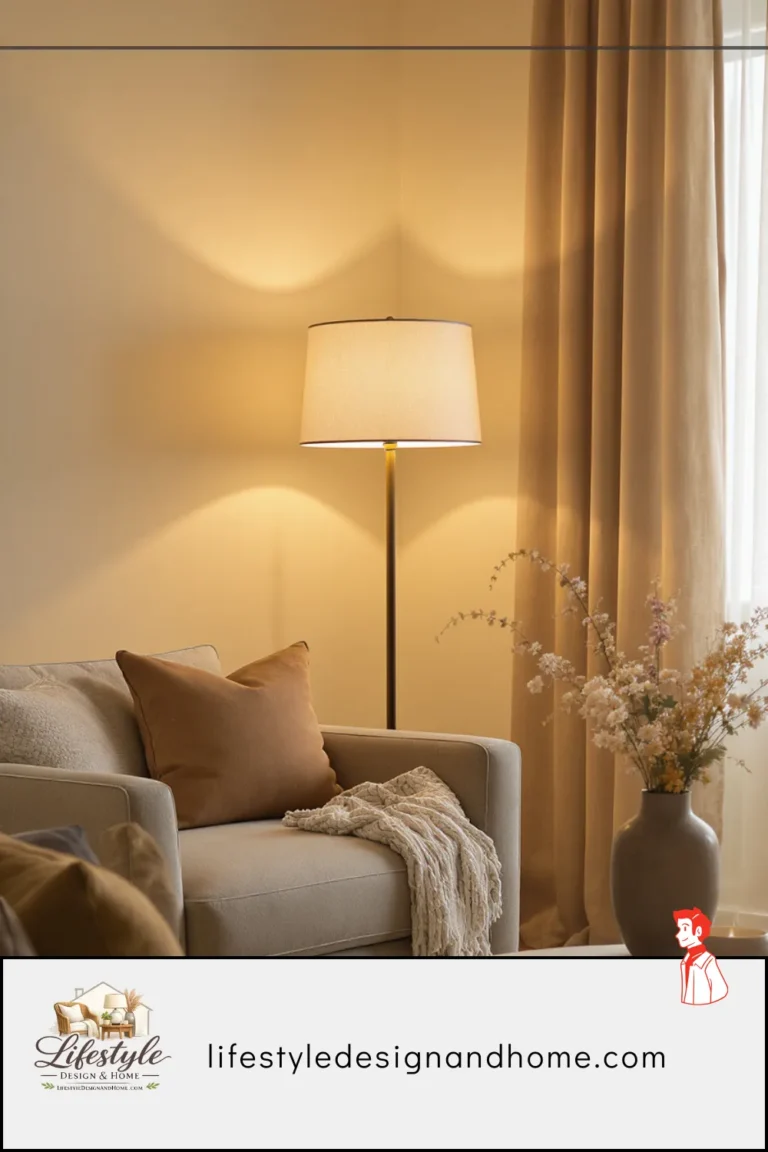
The Evening I Stopped Hating My Living Room
For about fourteen months, I actively disliked my living room.
Not in a dramatic way — not the kind of dislike that sends you to Pinterest at midnight, redesigning everything from scratch. A quieter dislike. The specific feeling of walking into a room and not quite wanting to be there, of sitting on a sofa that was fine and looking at walls that were fine and feeling a persistent vague wrongness that I couldn’t locate precisely enough to fix.
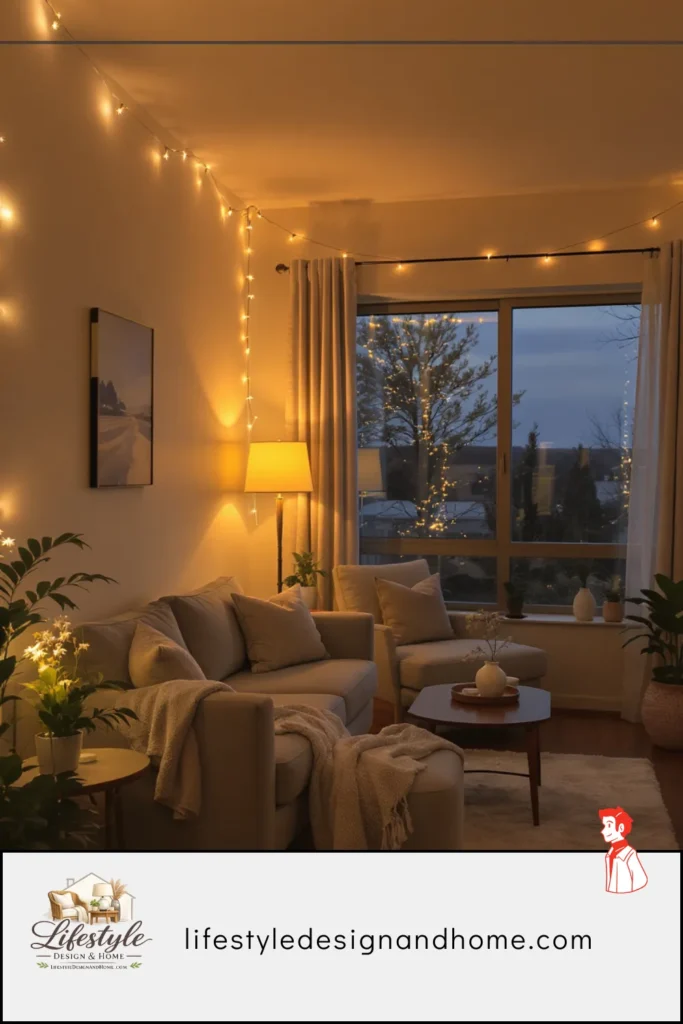
I blamed the sofa for a while. Too stiff, I thought. I sat forward in it rather than sinking back, and I attributed this to the sofa’s construction rather than to the room’s quality. I blamed the color of the walls — a landlord off-white that wasn’t quite any color — and spent three weekends researching paint samples before remembering I wasn’t allowed to paint. I blamed the size of the room, which was 11 by 13 feet, because blaming the size of a room is the most available explanation when you can’t find a more specific one.
Then one evening my upstairs neighbor came down for dinner and brought a small lamp. She was carrying it under her arm when I opened the door and I asked her why she’d brought a lamp and she said she found my living room “a bit clinical” and thought it might help.
I was mildly offended and did not show it.
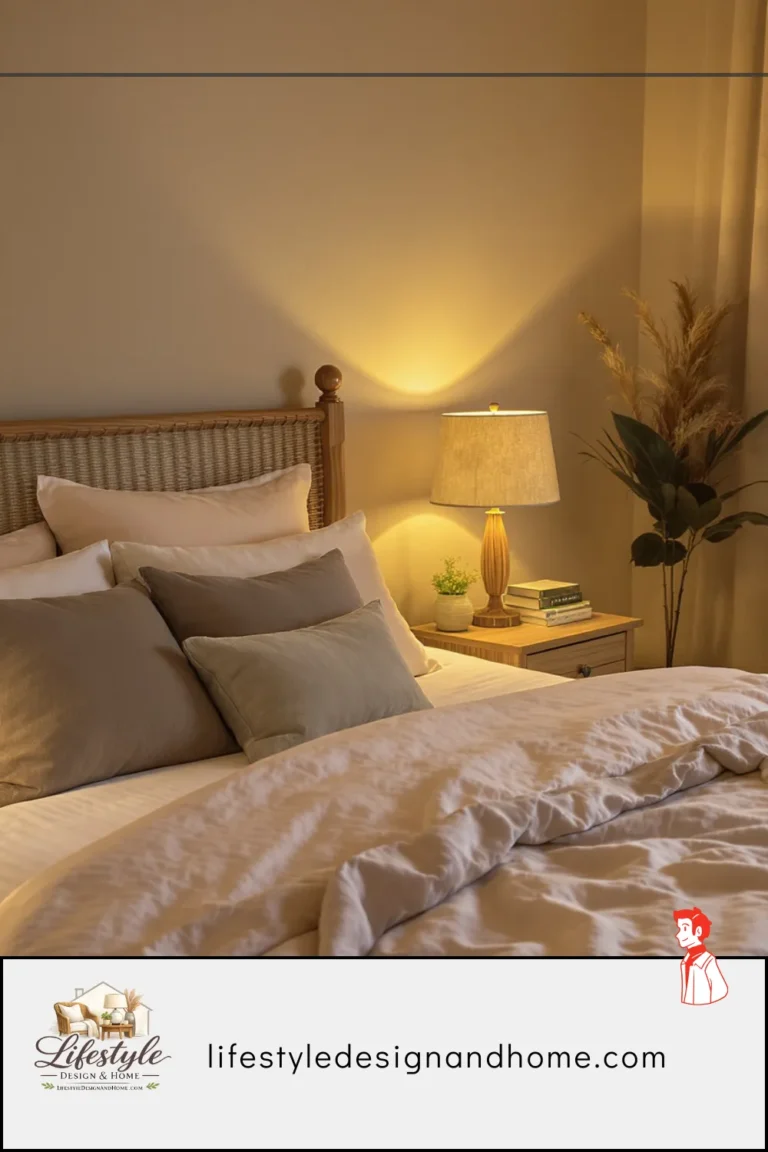
She put the lamp — a small table lamp with a cream linen shade and a warm-toned bulb — on my side table, which until that moment had held only my phone charger and a glass of water. She turned off my overhead light. She turned on the lamp and a floor lamp she’d noticed in the corner that I’d been using irregularly.
The room changed.
Not the furniture. Not the walls. Not the sofa I’d been blaming. The light changed and the room changed and I sat back in the sofa — that same stiff sofa — and felt that I was somewhere rather than nowhere, and the somewhere felt warm and habitable in a way the room hadn’t felt in fourteen months.
My neighbor, who had studied interior design for two years before changing careers, said: “You were using the room as a workspace. The light was treating you like you were working.”
She was right. The overhead fixture — a standard flush mount at 4000K — was producing the light of a functional room rather than the light of a room for living in. The room knew it was lit for work and communicated that to everyone in it. Including me, fourteen months of evenings.
This article is everything I learned after that evening — about how lighting changes mood in small living rooms, specifically, and the specific ideas that work when the room is small enough that every lighting decision affects every other one.
The Mood-Light Connection: Why Small Rooms Are More Sensitive
Before the ideas, a short explanation of why lighting affects mood as directly as it does — and why small rooms are particularly sensitive to it.
The human brain processes light as environmental information before it processes it as illumination. When you walk into a room, your visual system is not just registering the brightness level. It is reading the light’s color temperature, its direction, its distribution across surfaces, and its relationship to shadow — and translating all of those qualities into an environmental assessment that happens below conscious thought.
Bright, cool, overhead light — the light of offices and hospitals and the overhead fixtures in most apartments — produces a specific neurological response: alertness, readiness, mild vigilance. The body reads it as midday light, which means it is time to be active. The body is correct about this reading. That light is designed for activity spaces and it does its job, which is to keep people alert and functional.
Warm, low, multi-source light — the light of restaurants chosen for ambiance, of living rooms designed for relaxation, of the hour after dinner when the day is winding down — produces the opposite response: the body reads it as evening, the nervous system downregulates, the shoulders drop, the breath slows. Not dramatically, not always consciously. But measurably and consistently.
Small rooms are more sensitive to this dynamic because there is less room for competing light sources to cancel each other out. In a large room, a bad overhead fixture is partially mitigated by the room’s other sources — additional lamps, light bouncing from multiple surfaces, the distance between sources creating gradients. In an 11-by-13-foot room, the overhead fixture dominates everything. Its color temperature is the room’s color temperature. Its quality is the room’s quality. Fix it and the room is fixed. Don’t fix it and nothing else you do matters very much.
This is both the challenge and the opportunity of small room lighting: the leverage is extraordinary in both directions. Bad lighting in a small room is very bad. Good lighting in a small room is very good.
Idea 1: The Bulb Replacement That Changes Everything Before You Buy Anything
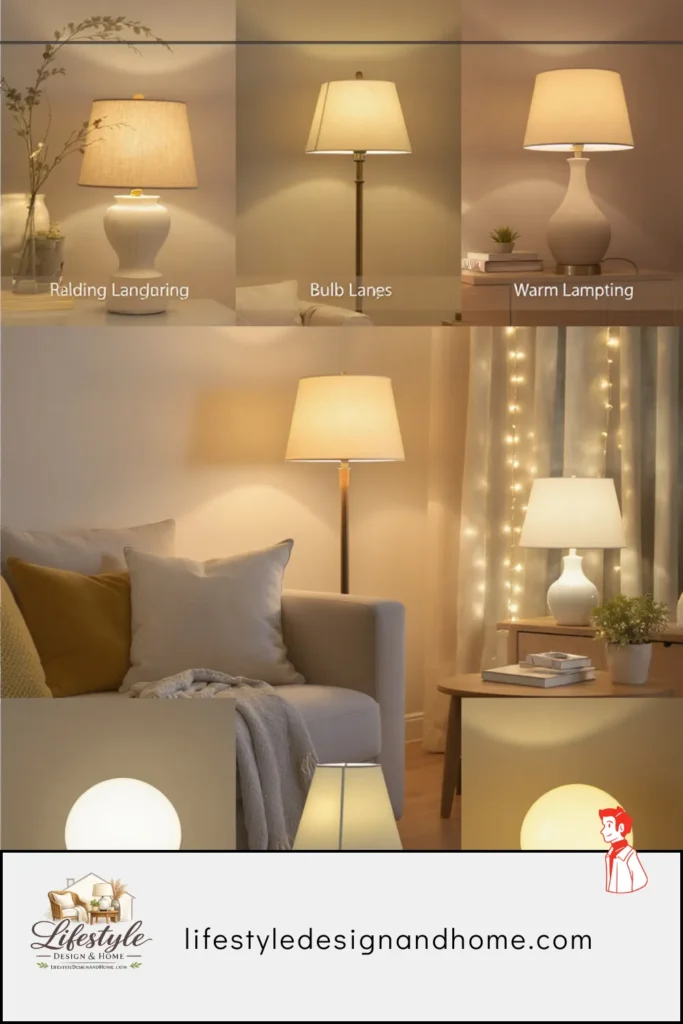
I have said this across many articles in this series and I will say it here again at the top because it is the highest-return, lowest-cost, most universally applicable lighting intervention available to any small living room: replace every bulb with a 2700K warm white LED.
Not 3000K. Not 4000K. 2700K.
The difference between 2700K and 4000K is the difference between amber candlelight and fluorescent office light, applied to a spectrum that includes both within its range. 4000K is neutral cool — functional, flat, slightly institutional. 2700K is warm amber — the color of old incandescent bulbs, of fire, of the light that the human nervous system interprets as evening and rest.
My overhead fixture was at approximately 4000K when my neighbor came to dinner. She didn’t replace the fixture. She brought a lamp with a 2700K bulb. The contrast between the two — the cool overhead still on in the background — was enough to demonstrate the difference and confirm which one the room needed to be.
I replaced the overhead bulb with 2700K the following day. The room was different that evening before I had made any other change.
The additional specification worth understanding: CRI, or Color Rendering Index, which measures how accurately a bulb represents colors on a scale of 1 to 100. Most cheap LEDs have CRIs in the 70s and 80s, which means they produce a warm-looking light that still somehow misrepresents colors in a slightly off way — flesh tones slightly greenish, neutrals slightly flat. Bulbs with CRI 90 and above produce warm light that also represents colors accurately, which makes the room not just feel warmer but look more alive.
Spend slightly more on CRI 90+ bulbs at 2700K. The difference from CRI 80 bulbs is visible and immediate.
Idea 2: The Floor Lamp in the Dead Corner — Non-Negotiable
Every small living room has a dead corner. The corner that the overhead doesn’t reach, that sits in relative shadow every evening, that the eye drifts toward and finds nothing. In an 11-by-13-foot room, a dead corner is not a minor issue — it is approximately 15 percent of the room’s visual field, sitting in a state that communicates incompleteness.
A floor lamp in the dead corner does three things simultaneously that nothing else can do with one purchase:
It eliminates the shadow that makes the corner read as the room’s edge rather than the room’s extent. When the corner is lit, the room extends to its actual boundaries. When it is unlit, the room feels like it ends before the walls do.
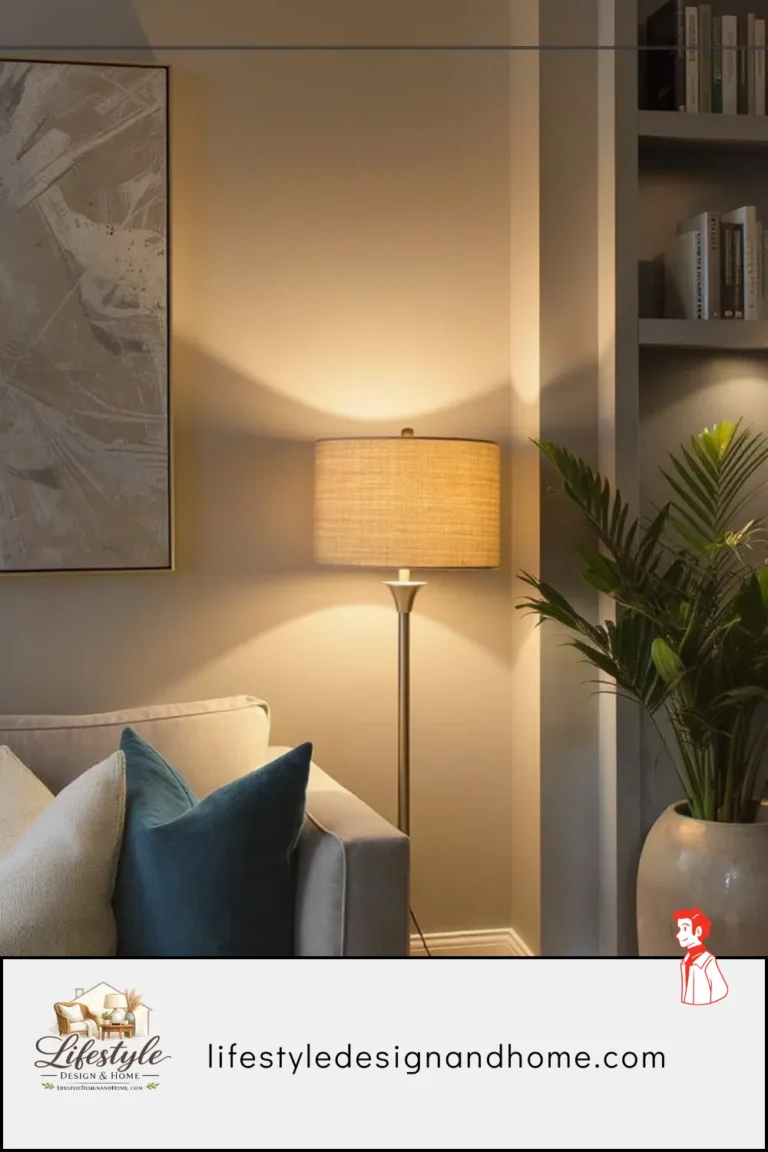
It adds a warm light source at height — a torchiere-style floor lamp bouncing light off the ceiling and both corner walls creates what amounts to three secondary light sources (the two walls and the ceiling) from one lamp. The corner that was a void becomes a warm zone that contributes to the room’s overall ambient quality.
It creates depth through distance from the primary seating. A light source in the far corner of a small room, seen from the sofa near the opposite wall, creates a visual depth — the eye travels from near to far and reads the distance as space. A room lit only from the center or from the sofa’s immediate vicinity has no such depth. The far corner lamp is the depth signal the room needs.
The type of floor lamp that works best in a small living room corner: a torchiere with an upward-facing shade, warm-toned material (cream, linen, natural) rather than opaque or dark.
How to Choose the Right Sofa Size for Your Living Room
The Sofa I Bought Without Measuring
I want to start with the most expensive mistake I have made in interior design, which is also one of the most common mistakes people make in interior design, which is also a mistake so simple that I am still slightly embarrassed to have made it.
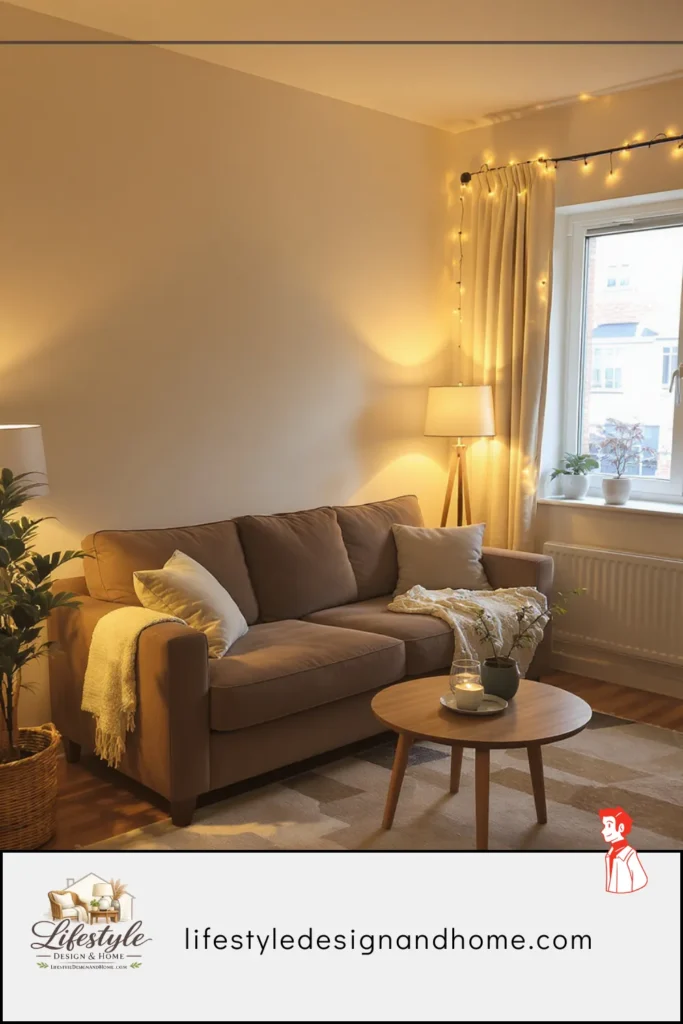
I bought a sofa without measuring the doorway it needed to come through.
Not without measuring the room — I had measured the room. I knew the sofa was 90 inches long and I knew the room was 14 feet wide and I had confirmed, with a tape measure and a reasonable degree of confidence, that 90 inches would fit in 14 feet with appropriate clearance on both sides. The room measurement was correct. The room fit the sofa.
The doorway did not fit the sofa.
The delivery team spent forty-five minutes attempting to navigate a 90-inch sofa through a 78-inch doorway before concluding that it was not possible. They left the sofa in my building’s lobby with a politeness I did not deserve given that this was entirely my fault, and I spent the following three days arranging a return, waiting for a refund, remeasuring everything I should have measured the first time, and sitting on a folding chair in a living room that had been designed around a sofa that was no longer in it.
The replacement sofa was 78 inches. It fit through the doorway. It also fit the room, though in slightly different proportions than I’d planned, and those proportions taught me something I hadn’t understood when I bought the first sofa: the difference between a sofa that fits a room dimensionally and a sofa that is right for a room is not just length. It is the relationship between the sofa’s length, depth, height, and visual weight and the room’s scale, proportion, and function — a set of relationships that measuring the room tells you almost nothing about without knowing what to measure and what the measurements mean.
This article is what I’ve learned about choosing the right sofa size — not just what fits, but what works.
Why Sofa Sizing Is Harder Than It Looks
The sofa is the largest piece of furniture in most living rooms. It is the piece that the room’s spatial logic responds to first and that every subsequent decision is made in relation to. Getting the sofa size right is the foundational decision of the living room, and it is consistently underestimated in difficulty because the difficulty is not dimensional — it is relational.
Dimensional difficulty is: will it fit through the door and in the room? This is measurable, checkable, and solvable with a tape measure and attention.
Relational difficulty is: does this sofa’s size produce the right relationship between the sofa and the coffee table, between the sofa and the room’s traffic paths, between the sofa and the room’s other furniture, between the sofa and the room’s overall scale? These relationships are not directly measurable. They are the product of understanding how sofas interact with rooms — knowledge that takes time and sometimes expensive mistakes to acquire.
The relational problems I have seen most consistently in poorly sized sofas:
A sofa that is the right length but the wrong depth — usually too deep — that makes the room feel consumed even when the sofa technically fits. The standard sofa depth is 34 to 38 inches. A sofa at 40 to 44 inches depth in a 12-foot-wide room leaves only 100 inches of remaining width — 8 feet, 4 inches — for all other furniture, traffic paths, and floor space. That remaining space, distributed across the room, is not enough.
A sofa that is the right size for the room but the wrong size for the rug — specifically, a sofa that extends well beyond the rug’s width, which produces an arrangement where the sofa and rug seem unrelated to each other and the room’s floor plane is incoherent.
A sofa that is the right size for the room but wrong in height — typically too high a back — that makes the room feel lower and more enclosed than the ceiling height would otherwise suggest.
A sofa that is sized for the room it is in rather than for the people who will use it — specifically, a small sofa in a small room that seats two people when the room is regularly used by four.
Understanding each of these relationships — and measuring for all of them, not just the room’s dimensions — is what choosing the right sofa size actually requires.
The Four Dimensions That Actually Matter
When most people size a sofa for a room they measure the room and the sofa’s length. There are four dimensions that matter, and all four interact with the room in specific ways.
Dimension 1: Length
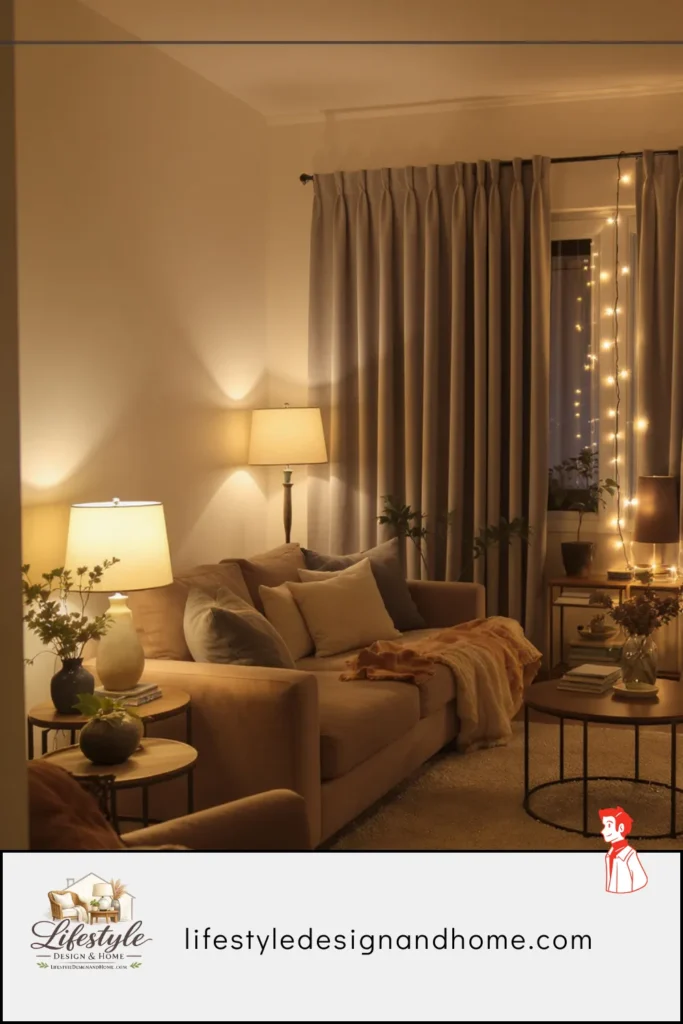
Length is the most obvious dimension and the one most reliably measured, so I will address it quickly before moving to the dimensions that receive less attention.
The standard guidance: the sofa should be approximately two-thirds of the room’s shorter dimension in length. In a 12-by-14-foot room, that is 8 feet — 96 inches. In a 10-by-13-foot room, that is approximately 80 inches. These are starting points, not absolutes, but they produce sofa lengths that feel proportional to the room — present without dominating, sized for the space without being lost in it.
The doorway check that I failed to perform: measure the doorway width, the stairwell width at its narrowest point, the elevator interior dimensions if applicable, and any corner turns the delivery route requires. A sofa can be disassembled by some manufacturers for delivery; check before purchasing whether the model you are considering has this option, as it resolves most doorway conflicts. If it does not disassemble, the sofa’s diagonal measurement — which determines whether it can be tilted through a doorway — is the relevant number, and it requires a specific calculation that the manufacturer can usually provide.
Dimension 2: Depth
Sofa depth — the measurement from the front of the seat cushion to the back of the sofa — is the dimension most consistently underweighted in the sizing decision and the one that most consistently produces rooms that feel consumed by the sofa despite the sofa’s length being technically appropriate.
Standard sofa depths range from 32 to 40 inches, with most mainstream sofas in the 34-to-38-inch range. The difference between 32 and 40 inches is 8 inches of floor space. In a 10-foot-wide room, 8 inches is the difference between adequate and inadequate traffic clearance behind the sofa when it is floated from the wall.
The depth decision is also a comfort decision, and comfort preferences vary significantly. A very deep sofa — 38 to 40 inches — is physically comfortable for people who like to sit back and curl up, but produces problems for people of shorter stature (feet don’t reach the floor without lumbar support) and for rooms where the sofa needs to be positioned close to other furniture. A shallower sofa — 32 to 34 inches — is more spatially efficient, more comfortable for shorter people, and better suited to small rooms where every inch of depth has spatial consequences.
My recommendation for rooms under 150 square feet: a sofa of 32 to 34 inches depth. The spatial gain is significant. The comfort tradeoff is manageable with appropriate cushioning. The room’s traffic clearances, coffee table distances, and overall spatial quality benefit measurably from the shallower profile.
Dimension 3: Height
Sofa height — specifically the back height — is the dimension that most affects the room’s perceived ceiling height and the overall proportional quality of the space.
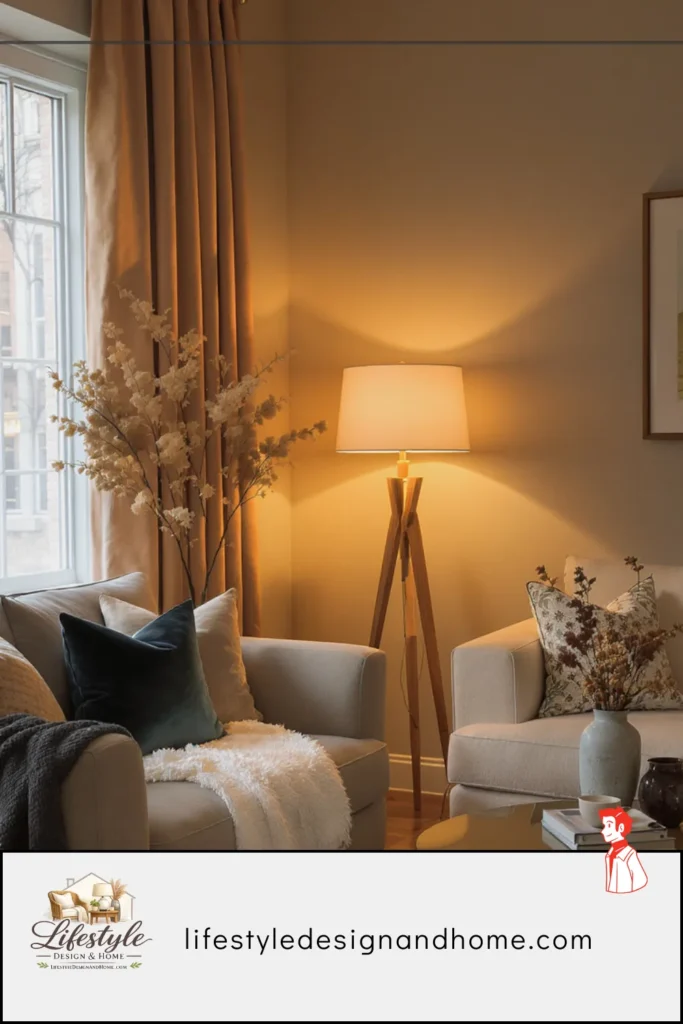
High-back sofas — backs at 36 to 40 inches — are visually heavier and more dominant than low-back sofas. They create a strong horizontal line in the room that can make the ceiling feel lower and the room feel more enclosed. In rooms with standard 8-foot ceilings and modest square footage, high-back sofas can make the room feel compressed in a way that the sofa’s length and depth do not account for.
Low-back or mid-back sofas — backs at 28 to 34 inches — are visually lighter. The room continues above the sofa back, the ceiling is more visible, and the proportional relationship between the sofa and the room’s vertical dimension is more generous. In small rooms, this visual lightness has a meaningful effect on how spacious the room feels.
The seat height — typically 17 to 19 inches from the floor — affects comfort and the sofa’s relationship to the coffee table. Seat height should match the coffee table height within one to two inches for the most comfortable and proportionally coherent relationship between the two pieces.
Dimension 4: Visual Weight
Visual weight is not a dimension that appears on a spec sheet and cannot be measured with a tape measure. It is the impression of mass and heaviness that a sofa creates in a room, and it is determined by the combination of the sofa’s physical dimensions, its upholstery material and color, its leg style, and its profile.
A sofa with a solid base that sits to the floor has more visual weight than the same sofa on legs, because the base-to-floor sofa reads as a continuous mass from the top of the cushion to the floor, while the legged sofa reveals floor beneath it and reads as lighter and more spatially considerate.
A sofa in a dark, heavy upholstery — dark grey, deep navy, black — has more visual weight than the same sofa in a light linen or natural tone, because dark colors advance and light colors recede, which is a perceptual fact about how the eye processes color rather than a stylistic preference.
A sofa with thick, prominent arms has more visual weight than a sofa with narrow or armless profiles, because the arm mass contributes to the sofa’s overall visual presence in the room.
In small rooms, visual weight should be a primary consideration in sofa selection. A physically correctly sized sofa with high visual weight can make a small room feel consumed. A slightly larger sofa with low visual weight — legs, light upholstery, clean lines — can make the same room feel spacious.
The Standard Sizes and When Each Works
Sofas come in a range of standard sizes, and understanding what each size is designed for helps match the sofa to the room’s actual requirements.
The loveseat (48 to 72 inches): Designed for two people, occasionally three at close quarters. Works in rooms too small for a standard sofa — under 120 square feet — or as a secondary seating piece in larger rooms. In rooms where the primary social function involves two people regularly and larger gatherings occasionally, a loveseat with additional occasional seating (a chair, a bench, floor cushions) is often the more spatially intelligent choice than a standard sofa that consumes more floor space than the room’s regular use requires.
The mistake I see with loveseats in small rooms: choosing a loveseat to be spatially conservative and then buying secondary seating that collectively takes more floor space than a standard sofa would have. The loveseat makes sense when the secondary seating is mobile and stored elsewhere when not needed — floor cushions, a folding bench, stackable stools. When the secondary seating is permanent, the sofa may have been the more efficient choice.
The standard sofa (72 to 90 inches): The most common sofa size, designed for three to four people. Works in rooms from approximately 130 to 300 square feet, depending on the sofa’s depth and the room’s configuration. The 84-inch sofa — 7 feet — is the size I most consistently see working correctly in small to medium living rooms: long enough to seat three comfortably, short enough to fit rooms where a 90-inch sofa would be slightly oversized.
The two-thirds-of-room rule applied: an 84-inch sofa works in rooms where the shorter room dimension is at least 126 inches — 10.5 feet. In rooms narrower than this, the 84-inch sofa starts to dominate.
The large sofa (90 to 108 inches): Designed for four to five people. Works in rooms of at least 200 square feet, more comfortably in 250 or above. In smaller rooms, the large sofa creates the consumed feeling that comes from a single piece occupying too large a proportion of the room’s visual field.
The exception: a large sofa in a small room with very low visual weight — light upholstery, slim profile, visible legs, low back — can work in rooms where a conventional-looking large sofa would not. The visual weight reduction compensates partially for the dimensional excess.
The sectional (variable, typically 100 to 160 inches on the primary axis): Sectionals are the most spatially demanding sofa type and the most commonly oversized in small rooms. The two-part measurement that most people miss: the primary section’s length must fit the room’s available wall, and the secondary section’s depth must fit the remaining room depth after accounting for traffic clearances.
In a 12-by-14-foot room, a sectional with a 90-inch primary section and a 60-inch secondary section requires those 60 inches to fit within the remaining depth of the room after the primary section’s depth. In a 12-foot dimension: 60 inches of secondary section plus the sofa’s own depth (34 to 38 inches) plus minimum traffic clearance (24 inches) equals 118 to 122 inches — 10 to 10.2 feet. A 12-foot room technically accommodates this. In practice, the remaining 22 to 24 inches between the secondary section’s end and the wall is the corridor that everyone will walk through for the life of the sofa.
I recommend against sectionals in rooms narrower than 13 feet unless the secondary section is very short — 48 inches or less — and the primary section is sized accordingly.
The Measurements You Need Before You Buy
This is the list I should have had before I bought the sofa that didn’t fit through the doorway. It is organized in the order in which the measurements should be made and verified.
The delivery route measurements:
- Front door width (the interior measurement, not the frame to frame)
- Any hallway width at its narrowest point between the entrance and the room
- Stairwell width and landing dimensions if the room is above the ground floor
- Elevator interior dimensions (width and depth) if a service elevator is available
- The door to the room itself if it is different from the front door
The diagonal calculation: a sofa can be tilted diagonally to navigate through a door narrower than the sofa’s length. The formula for whether this works is complex and I recommend asking the furniture retailer for the sofa’s “delivery diagonal” measurement, which accounts for the sofa’s height and depth and tells you the minimum opening width the sofa can navigate through. If the retailer cannot provide this, the general calculation is: square root of (length squared plus height squared), divided by 2 — but this is approximate and I recommend confirmation from the manufacturer.
The room measurements:
- Room length and width at their widest points
- The length of the specific wall where the sofa will be positioned, minus any interruptions (doorways, windows, radiators) that limit available wall space
- The distance from that wall to the opposite wall, which determines the maximum sofa depth plus coffee table plus clearance
- The position of electrical outlets on the sofa wall (relevant for floor lamps beside the sofa)
The rug relationship measurement:
- The width of the rug you have or intend to buy
- The sofa should be within approximately 12 inches of the rug’s width on each side — a sofa significantly wider than the rug looks disconnected from the rug; a rug significantly wider than the sofa looks like the rug is trying to accommodate a larger sofa than is present
The coffee table relationship measurement:
- The sofa’s intended distance from the coffee table (14 to 18 inches from cushion edge to table edge)
- The coffee table’s length relative to the sofa’s length (coffee table should be approximately two-thirds of the sofa length)
- Confirm these two measurements produce a coffee table size that works for the remaining room dimensions
The Tape Test I Now Do Before Every Purchase
After the doorway disaster, I developed a ritual for sofa purchases that has prevented two subsequent mistakes and confirmed three correct decisions.
I tape out the sofa’s footprint on the floor of the room before purchasing.
Not approximately — exactly. Using painter’s tape, I mark the sofa’s full footprint: length, depth, and an approximation of where the arms will be. I then tape out the coffee table at the correct distance (14 to 18 inches from the sofa tape). I mark the traffic paths I need to maintain (30 inches minimum on the sides, 36 inches on the primary path).
Then I live with the tape for a day.
I walk through the room at normal speed, not carefully and deliberately. I carry things from the kitchen. I navigate around the coffee table tape. I stand where guests would stand and look at where the sofa will be. I consider whether the taped footprint, if it were a sofa, would feel like the room had the right relationship between furniture and space.
This process has revealed, twice, that sofas I was considering were the wrong size — not dramatically wrong, but wrong enough that the tape made it visible before the purchase made it expensive. Both times the tape showed me traffic clearances that were technically meeting the minimum but felt tight in actual navigation. I chose smaller sofas in both cases and have not regretted either decision.
The tape test costs nothing and takes about thirty minutes. It is the most reliable sofa-sizing tool I have found, more reliable than any formula, because it converts the abstract calculation of dimensions into the physical experience of being in a room with a sofa of that size.
The Specific Cases: Small, Medium, and Unusual Rooms
The very small room (under 120 square feet):
In a room under 120 square feet, the sofa decision is the room’s primary architectural decision. Everything else responds to it. The sofa in this room should be: a loveseat (48 to 72 inches) or a compact sofa (72 to 80 inches), shallow depth (32 to 34 inches), low back (28 to 32 inches), on legs, in light upholstery. Visual weight should be as low as possible. Additional seating should be mobile and stored when not in use.
The one thing I would not sacrifice in this size room: sofa length. A loveseat that is too short for the primary users to sit comfortably is not spatially efficient — it fails at the sofa’s primary function. Size down in depth before sizing down in length.
The medium room (120 to 200 square feet):
The medium room is where most standard sofas work correctly. A sofa of 80 to 90 inches with a depth of 34 to 36 inches in standard configuration fits this room with room to spare for appropriate traffic clearances, a correctly sized coffee table, and one additional seating piece.
The most common mistake in medium rooms: choosing the sofa for the room’s maximum capacity rather than its regular use. A medium room used daily by two people and occasionally by six does not need a sofa sized for six. It needs a sofa sized for two with additional occasional seating that stores efficiently when not needed.
The long narrow room:
The long narrow room — longer than twice its width — has a specific sofa sizing challenge: the sofa sized for the room’s width looks small relative to the room’s length, and the sofa sized for the room’s length is too wide for the room.
The solution: size the sofa for the room’s width (two-thirds of the narrow dimension), orient it perpendicular to the room’s long axis if possible, and accept that the long axis of the room will not be filled by the sofa. The empty length at one end of a long narrow room is better addressed with a secondary seating zone — a reading chair, a small desk — than with an oversized sofa.
The nearly square room:
The nearly square room — proportions within 15 percent of a square — poses the specific challenge that the two-thirds rule produces a sofa length that works on both axes, which makes it unclear which wall the sofa should face and which direction the room should be organized.
In square rooms, the sofa decision should be made after the focal point decision: identify the focal point first (window, television, fireplace), orient the sofa toward it, and then size the sofa for the distance from that wall to the opposite wall. The square room’s uniformity, which makes the sofa sizing decision feel ambiguous, also gives the room unusual flexibility in orientation — the focal point choice, more than any dimensional calculation, determines how the square room works.
What the Right Size Feels Like
I want to end with something that measurement cannot capture but that I have come to recognize as the clearest signal that a sofa is correctly sized for its room.
When the sofa is the right size, it disappears.
Not literally — it is the largest piece of furniture in the room and it is visible. But it stops being something you notice and becomes part of the room’s background logic. You sit on it and the room feels complete rather than consumed. You stand at the doorway and the sofa is present without dominating. The traffic paths feel natural. The coffee table is at the right distance. The other furniture has appropriate relationships to it. The room works.
When the sofa is the wrong size — too large, most commonly — it is what you see when you walk in. The room is a sofa with some other things around it. The traffic paths feel like navigation rather than movement. The coffee table is either too close or too far because there wasn’t room to place it correctly. The other furniture is arranged around the sofa’s dominance rather than in conversation with it.
The tape test will tell you which of these the room will have before you make the purchase. The measurement of depth will tell you whether the traffic paths will be adequate. The visual weight assessment will tell you whether the room can absorb the sofa’s presence without being consumed by it.
Get all of these right and the sofa disappears into the room, which is exactly where it belongs.
The Folding Chair
I sat on the folding chair in my empty living room for three days while I waited for the refund and remeasured everything I should have measured the first time.
The folding chair was uncomfortable in the specific way that folding chairs are uncomfortable — designed for temporary use and communicating that clearly to everyone who sits in it. The room around it was designed around a sofa that was no longer in it. The space where the sofa would have been was visible as potential — the right amount of floor space, the right relationship to the window, the right distance from the opposite wall for a coffee table that wasn’t there yet.
I measured the doorway. 78 inches. I ordered a 78-inch sofa with confirmed diagonal measurement, confirmed delivery route clearance, confirmed depth that would produce the traffic clearances I needed, and confirmed visual weight that would let the room breathe.
It arrived the following week. The delivery team had it in the room in fifteen minutes.
It disappeared into the room immediately. The room that had been a floor plan around a potential sofa became a living room with a sofa in it. The relationships were right. The space worked.
I have not moved the sofa since.
That is what the right size does. It arrives and the room is done.