The Three Coffee Tables I Got Wrong
My current coffee table is the fourth one I have owned in this apartment.
Not because I have expensive tastes or a habit of redecorating. Because the first three were wrong in ways that took me time to understand, and the fourth is right in a way I recognized immediately when I put it in position — the specific quality of a piece that fits its context so naturally that you stop seeing it and start using it.
The first was too small. A round table, 24 inches in diameter, that I’d chosen because it seemed appropriately modest for the room — a small table for a small room, the logic of restraint applied to furniture selection. The table looked, in the context of the 90-inch sofa it was supposed to serve, like a dinner plate placed in front of a park bench. The disproportion was immediately obvious and I couldn’t unsee it after the first day. The table was not the room’s coffee table. It was an object near the sofa that people could technically put drinks on.
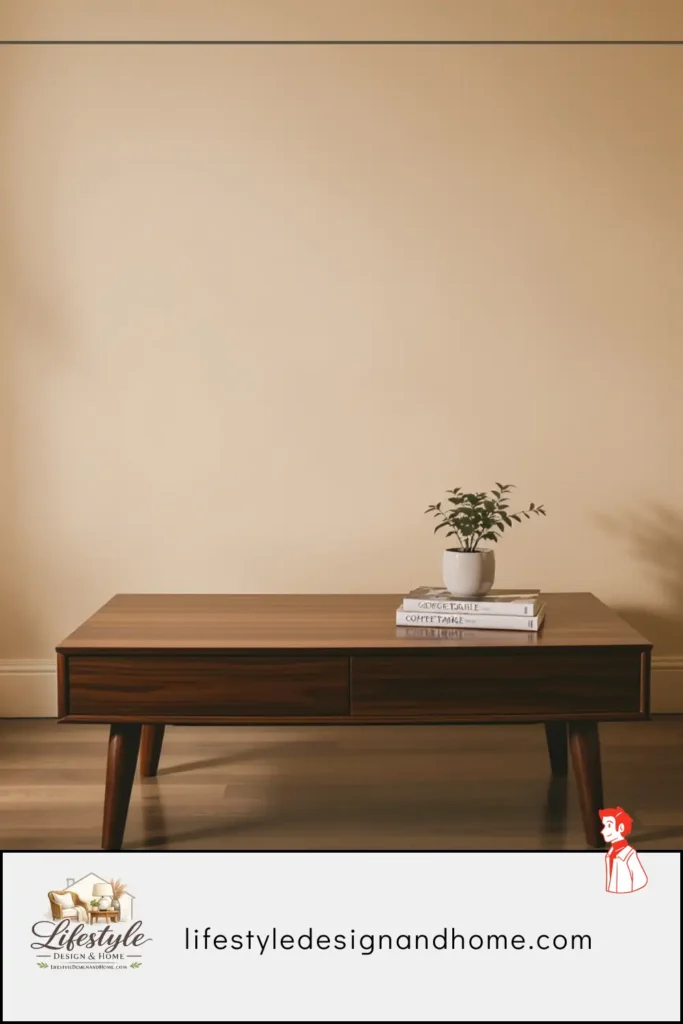
The second was too large. A rectangular table, 60 inches long and 30 inches wide, that I had over-corrected into after the first failure. It was a substantial table that looked correctly scaled in the showroom where I’d bought it — a showroom with 14-foot ceilings and 40-foot sightlines — and overwhelming in my 11-by-13-foot living room. The table filled the conversation zone so completely that moving between seated and standing required conscious choreography, and reaching across its width from the sofa required either standing up or leaning forward in a way that I noticed happening dozens of times a day.
The third was the right length but the wrong height. Forty-eight inches long — correctly two-thirds of the sofa — but only 13 inches tall, which put the table surface 5 inches below the sofa seat and produced the specific ergonomic frustration of reaching slightly downward for everything you put on it. A small thing. A daily thing. A thing that accumulated into genuine low-grade irritation over the three months I lived with it.
The fourth table is 52 inches long, 24 inches wide, 17 inches tall — within one inch of my sofa’s seat height, at the correct two-thirds length proportion, at a width that allows reaching from the sofa without difficulty and crossing in front of it without choreography. I have had it for two years and I have not thought about replacing it once.
The four tables taught me everything I know about coffee table sizing. This article is that knowledge organized into a system you can apply before buying the fourth table.
Why Coffee Table Size Is More Consequential Than It Seems
The coffee table sits at the center of the living room’s primary seating arrangement. It is the room’s most used surface — the surface where drinks are placed and remote controls live and books are set down and feet occasionally rest and guests instinctively reach for things. It is the room’s visual center — the element the eye finds when it arrives at the seating arrangement. And it is the room’s primary determinant of traffic flow within the conversation zone — how easily people move between seated and standing, how accessible the room’s paths are.
A coffee table that is wrong in size creates problems in all three of these functions simultaneously. Too small: the room’s visual center is undersized for the arrangement around it, the useful surface is inadequate for the number of people using it, and the proportional wrongness affects how the whole room reads. Too large: the room’s center is blocked, movement through the conversation zone is compromised, and the table’s visual dominance overwhelms the seating pieces it should be serving.
The wrongness of a coffee table is also among the hardest types of wrongness to diagnose without knowing what to look for. The room feels slightly off. The arrangement feels slightly cramped or slightly sparse. The table is noticed when it shouldn’t be. But the specific cause — the table is three inches too long, or one inch too high, or four inches too narrow — is not visible without measurement and without understanding what the measurements should be.
Understanding what they should be is the whole article.
The Length Rule: Two-Thirds of the Sofa
The single most important coffee table sizing rule — the one that resolves the most consistent failures and produces the most consistent correct results — is the length relationship between the coffee table and the sofa it serves.
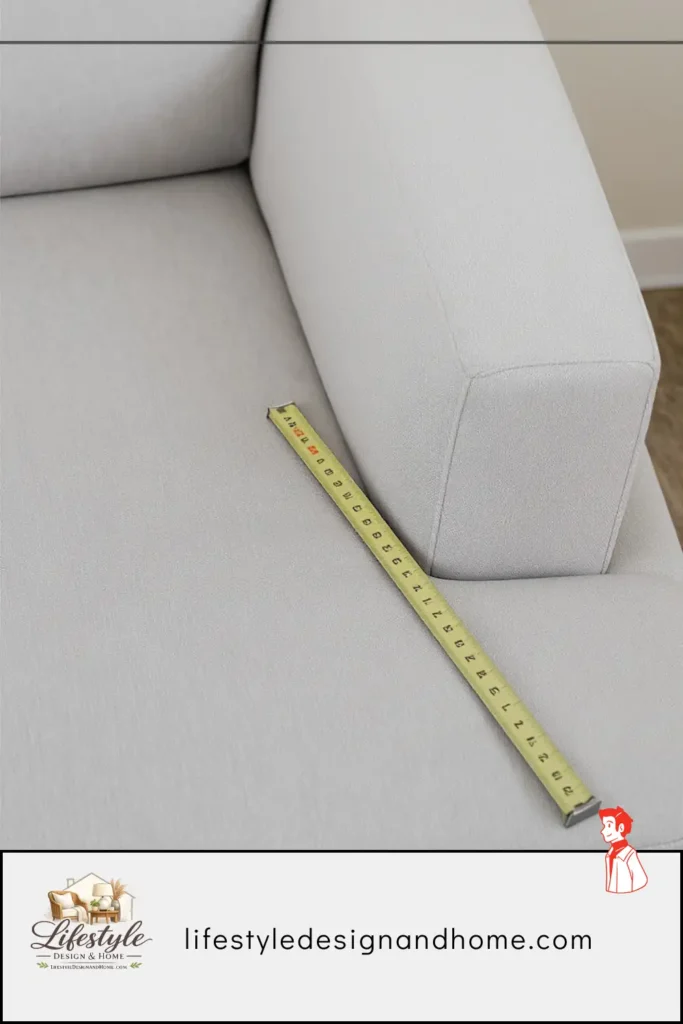
The rule: the coffee table should be approximately two-thirds of the sofa’s length.
For a 90-inch sofa: 60 inches. For an 84-inch sofa: 56 inches. For a 72-inch sofa: 48 inches.
These are approximations. The workable range is roughly 60 to 75 percent of the sofa’s length — the table can be slightly shorter than two-thirds or slightly longer without producing a proportional problem. What it cannot be is significantly shorter or longer than this range.
Why two-thirds specifically:
A coffee table at the sofa’s full length creates a visual barrier — a table that runs the entire length of the sofa produces a blockade rather than a companion piece. The sofa and table read as two horizontal pieces of equal weight competing for the same visual territory. The arrangement feels confrontational rather than composed.
A coffee table significantly shorter than two-thirds — say, half the sofa’s length or less — reads as undersized. The table appears to belong to the end of the sofa rather than to the sofa as a whole. People sitting at the end of the sofa without access to the table either reach across an uncomfortable distance or receive nothing, which produces the practical problem that a coffee table that only serves part of the sofa is failing part of its function.
Two-thirds is the proportion at which the table reads as belonging to the sofa without dominating it — present enough to anchor the center of the arrangement, restrained enough to let the sofa remain the primary seating element.
The multi-sofa arrangement:
When the coffee table serves more than one sofa — a face-to-face configuration with two sofas, or a U-shaped arrangement with a sofa and two chairs — the two-thirds rule applies to the longest sofa in the arrangement. The table is sized for the primary piece. The secondary pieces adapt to the table’s presence rather than the table being sized for the whole arrangement, which would typically produce a table too large for the room.
The sectional exception:
Sectionals complicate the two-thirds rule because the relevant length is ambiguous — the primary section only, or the total of both sections? The correct application: measure the primary seating section (the longer straight portion) and apply the two-thirds rule to that measurement. The secondary section (the chaise or return) typically has its own side table or end table rather than depending on the primary coffee table. A coffee table sized for the full sectional length would be too long for most rooms.
The Height Rule: Match the Sofa Seat
This is the rule I violated with my third coffee table — the one at 13 inches — and the violation was immediately and continuously felt even though I could not initially name the cause.
The rule: the coffee table height should be within one to two inches of the sofa’s seat height.
Standard sofa seat heights range from 17 to 19 inches from the floor, with most mainstream sofas sitting between 17.5 and 18.5 inches. The coffee table height should fall within this range — ideally at the same height as the sofa seat, or at most two inches below it.
Why this range specifically:
When the coffee table is at approximately sofa seat height, the reach from a seated position to the table surface is natural and effortless — the arm extends horizontally, or at a very slight downward angle, to reach the table. No leaning required. No stretching. The table and the sofa are at the same level and communicate with each other as equal elements.
When the coffee table is significantly lower than the sofa seat — as with my 13-inch table in front of an 18-inch seat — the reach requires a visible downward angle. For occasional items this is merely slightly awkward. For frequent items — the drink you reach for a dozen times in an evening — the accumulated downward reach is genuinely fatiguing over the course of a few hours and produces the irritation I lived with for three months.
When the coffee table is higher than the sofa seat — a less common error but one I have observed — the table reads as a barrier rather than a surface. The visual line of the table top is above the line of the sofa seat, which creates a slightly oppressive quality in the seating zone. The table feels like it is containing the sofa rather than serving it.
The measurement you need:
Before buying any coffee table, measure your sofa’s seat height. Sit on the sofa naturally and measure from the floor to the top of the seat cushion at the front edge. This number — not the sofa’s listed seat height, which is often measured to the seat frame rather than the top of the cushion — is what you are matching.
Most furniture websites list coffee table heights but not sofa seat heights, which requires either measuring your existing sofa in person or contacting the retailer for the specification. This is the measurement most people don’t make and most tables get wrong as a result.
The Width Rule: Function Within Reach
Coffee table width — the measurement from the sofa-facing edge to the far edge — is the dimension that most directly affects the table’s functional accessibility and that is most frequently either ignored in the selection process or violated in the name of aesthetics.
The rule: the coffee table should be between 18 and 26 inches wide.
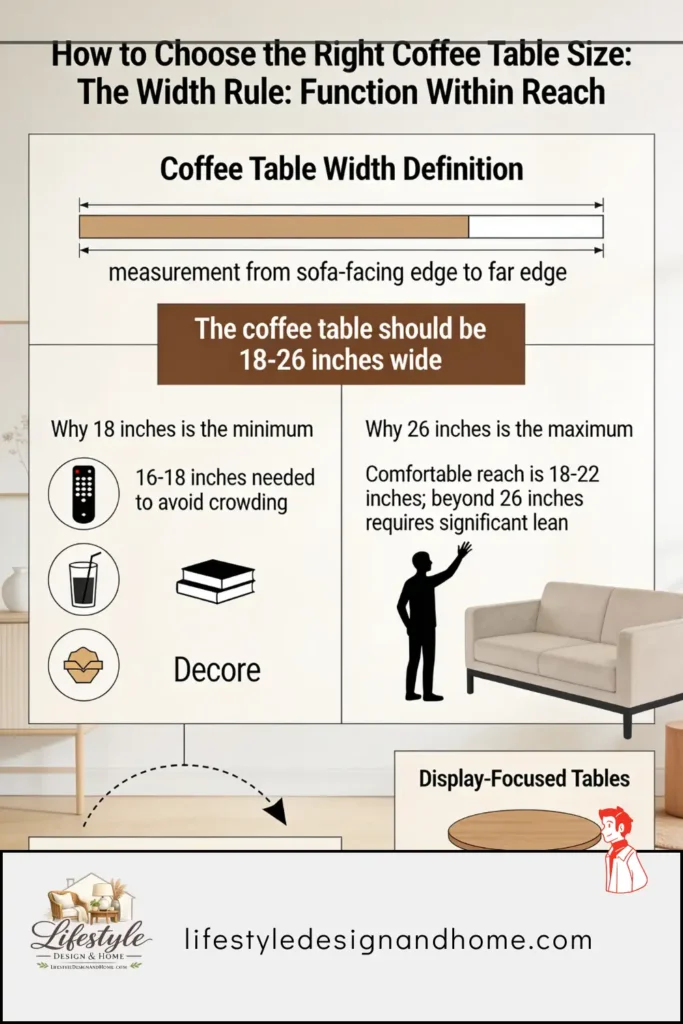
Why 18 inches is the minimum:
A coffee table narrower than 18 inches lacks sufficient surface area for the objects that reasonably belong on it. A remote control, a drink, a book, and a small decorative object — the typical complement of a coffee table in use — require approximately 16 to 18 inches of surface depth to sit without crowding. Below 18 inches, the table is being used as a drinks stand rather than a coffee table, which is a different and more limited function.
Why 26 inches is the maximum for standard reach:
A coffee table wider than 26 inches requires leaning forward or standing up to reach objects on the far side. A person sitting normally on the sofa, in the position they would naturally maintain while relaxing, can comfortably reach approximately 18 to 22 inches in front of them. Beyond 22 inches, the reach becomes a lean. Beyond 26 inches, the lean becomes a significant forward movement that most people will avoid unless strongly motivated.
The consequence of an overly wide table: items placed on the far side of the table become inaccessible from the sofa without effort, which means they migrate to the near side over time, which means the far side of the table becomes a display zone rather than a functional zone, which means the table is effectively narrower than it is while creating the spatial consequences of its full width.
The exception: tables used primarily as display surfaces — a large round table where the styling is the primary function and drinks are placed on the near edge — can be wider than 26 inches if the display is deliberately designed for viewing rather than reaching. But even in these cases, the additional width adds to the room’s spatial consumption without adding functional benefit.
The Distance Rule: 14 to 18 Inches From the Sofa
The distance between the coffee table and the sofa is not a coffee table sizing specification — it is a placement specification. But it is so directly related to the coffee table’s size (a table placed at the correct distance needs to be the right length and width to feel correct at that distance) that it belongs in this article.
The rule: 14 to 18 inches between the front edge of the sofa cushion and the nearest edge of the coffee table.
I have covered this in the coffee table distance article earlier in this series, but the short version:
Below 14 inches: the table is inside the space that the sofa occupant’s shins and feet occupy when seated naturally. Crossing legs becomes impossible. Standing from the sofa requires conscious navigation. The table contact that happens multiple times a day accumulates into genuine irritation.
Above 18 inches: the reach from the sofa to the table becomes a lean — a small lean, manageable, but present. Over a long evening, the accumulated reaching is noticeable. Drinks end up on the floor because the lean isn’t worth making. The table becomes functionally farther than it is physically.
The 14-to-18-inch range: the table is close enough to reach without leaning, far enough that seated movement is unimpeded. The sofa and table coexist without conflict.
The interaction between this distance and the table’s width: a table 20 inches wide at 14 inches from the sofa is effectively 34 inches of depth from the sofa occupant’s perspective — 14 inches of air plus 20 inches of table. The far edge of the table is 34 inches from the seated position, which is within comfortable reach. A table 26 inches wide at 18 inches from the sofa places the far edge 44 inches from the seated position — at the outer edge of comfortable reach. These calculations matter when choosing between width options: the table’s effective functional depth is the sum of its distance from the sofa and its own width.
Shape and What It Changes
Coffee table shape — round, rectangular, oval, square — affects the room in ways beyond aesthetics, and the shape choice should respond to the room’s configuration and the arrangement’s requirements rather than solely to stylistic preference.
Rectangular tables:
The most versatile shape for standard sofa configurations. A rectangular table aligns naturally with a sofa’s horizontal line, creates clear zones for styling and functional use, and provides the maximum surface area per unit of visual weight. The length-to-width proportion of a rectangular table should be approximately 2:1 to 2.5:1 — a 48-inch table at 22 to 24 inches wide, a 60-inch table at 24 to 28 inches wide. Tables significantly more square than 2:1 read as awkward rectangles rather than as intentional rectangles.
Round tables:
The best shape for U-shaped or circular conversation arrangements where the table serves multiple sides simultaneously. A round table has no long axis and therefore no preferred orientation relative to the seating — it serves every position equally, which makes it the natural choice when the seating arrangement wraps around it from multiple sides. The diameter for a round table serving a single sofa should be approximately half the sofa’s length — a 90-inch sofa works with a 42-to-48-inch diameter round table.
Oval tables:
The best shape for rooms that need a rectangular table’s length but where a rectangular table’s corners create traffic or visual problems. An oval has the length of a rectangle without the sharp corners that catch clothing, create visual hardness, and occasionally cause physical contact during movement. In small rooms where the corners of a rectangular table would narrow the traffic paths uncomfortably, an oval of the same length adds length without the corner penalty.
Square tables:
The best shape for nearly square rooms and for sectional configurations where the seating wraps around two sides of the table. A square table serves both sides of an L-shaped sectional with roughly equal functionality, while a rectangular table privileges one side over the other. The standard dimensions for a square coffee table in a sectional arrangement: 36 to 48 inches per side, depending on the sectional’s scale.
The visual weight consideration by shape:
Round and oval tables have lower visual weight than rectangular and square tables of equivalent surface area, because their absence of corners reduces the impression of mass. In small rooms or rooms with a lot of rectangular geometry already present, a round or oval table adds the surface area needed without the visual weight that a rectangular table of equivalent size would add.
The Material Choice and Its Scale Implications
Coffee table material affects perceived scale as directly as physical dimensions — sometimes more so — and should be chosen with the room’s spatial requirements in mind rather than purely for aesthetic preference.
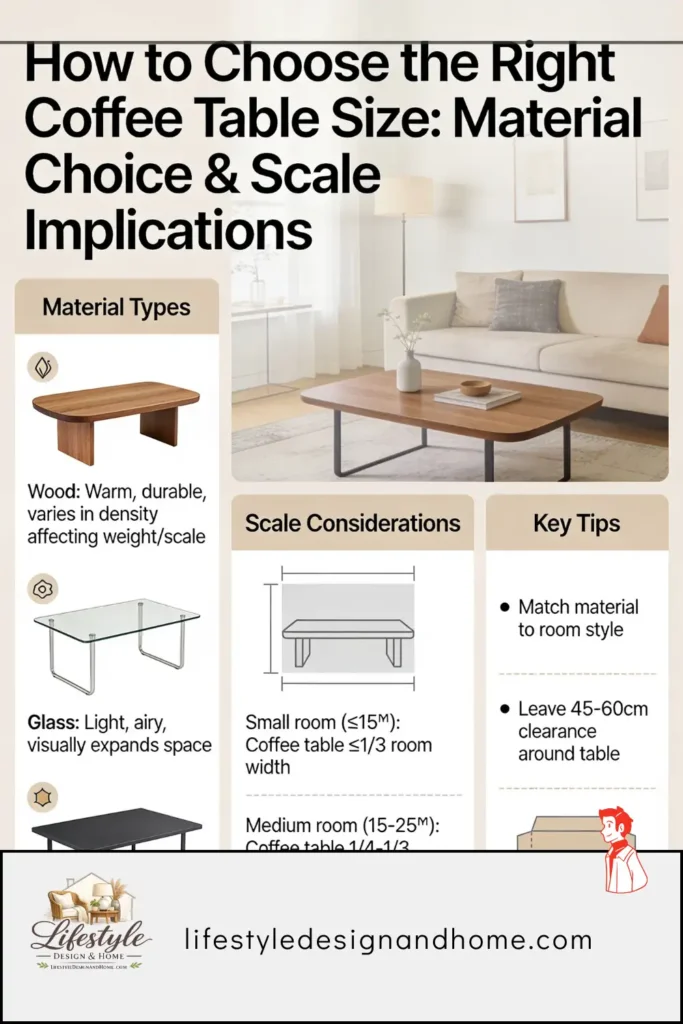
Glass and transparent materials:
A glass-topped coffee table appears significantly smaller than a solid table of identical dimensions because the eye can see through it to the floor beneath. The table’s visual footprint is the frame and legs rather than the top surface, which makes the room’s floor seem to continue beneath the table. In small rooms where every square foot of apparent floor space contributes to perceived room size, a glass-topped table is one of the most effective tools for maintaining surface area while minimizing visual weight.
The practical tradeoff: glass surfaces show fingerprints, water rings, and smudges more immediately than most other materials, which means they require more frequent wiping to maintain their visual quality. In homes with children or frequent entertaining, this maintenance burden may outweigh the spatial benefit.
Solid wood:
The most common coffee table material and the most variable in terms of visual weight. A dark, heavy solid wood table — thick top, solid base, minimal leg clearance — has significant visual weight. A pale, lighter solid wood table with substantial leg clearance and a thinner top profile has much lower visual weight despite potentially identical physical dimensions. In small rooms, the wood tone and profile matter as much as the dimensions: a pale oak table with visible leg clearance is spatially less demanding than a dark walnut table of the same size.
Metal and mixed materials:
Metal-framed tables — hairpin legs, thin steel frames, wire bases — have among the lowest visual weights of any coffee table type. The frame is visible but occupies minimal visual space, and the floor beneath the table is largely visible despite the table’s physical presence. In small rooms where the coffee table dimensions are constrained by the room’s size rather than by preference, a metal-framed table can be sized slightly larger than a solid table would allow, because its visual weight compensates for its physical scale.
Two Tables Instead of One
This is the configuration that most people don’t consider and that frequently produces better results than a single table — particularly in rooms with unusual dimensions, sectional sofas, or conversation arrangements that a single table can’t serve well.
Two smaller tables used in place of one standard coffee table allow the arrangement to flex: the tables can be pushed together to create a larger surface when needed and separated to create clearer traffic paths or to serve different zones of the conversation area independently.
The most effective two-table configurations:
Two round tables of different sizes. A 30-inch and a 24-inch round table, pushed together, create an irregular combined surface that is visually interesting and functionally generous. Separated, they serve different parts of the conversation area independently. The asymmetry of the different sizes reads as considered rather than as an inability to decide.
Two matching rectangular tables side by side. Two 24-inch square or 20-by-30-inch rectangular tables positioned end to end create the equivalent of a 48-inch rectangular table that can be separated. This configuration is particularly useful when the correct table length for the room is larger than what is typically manufactured as a single piece.
One large and one small. A standard coffee table supplemented by a smaller side table or an ottoman beside it — a hybrid approach that acknowledges that a single table rarely provides enough surface for gatherings while also acknowledging that a single table large enough to provide sufficient surface for gatherings is typically too large for the room.
The two-table approach does add visual complexity — more objects in the room’s center rather than one. In rooms where visual simplicity is the priority, the single table is the more appropriate choice. In rooms where functional flexibility is the priority, two tables provide options that no single table can match.
The Measurement Sequence Before Buying
Based on the failures of my first three tables and the corrective understanding those failures produced, here is the measurement sequence I now follow before purchasing any coffee table.
Measure the sofa’s length. The physical measurement of the sofa, not the listed specification, which is often measured to the outside of the arms rather than the inside or varies by measurement method. The usable length of the sofa — the length of the seat cushions — is the relevant number. Calculate two-thirds of this number. This is the target length for the coffee table.
Measure the sofa’s seat height. Sit on the sofa normally and measure from the floor to the top of the seat cushion at the front edge. This is the target height for the coffee table — ideally within one inch, certainly within two.
Measure the available floor space. In the area where the coffee table will be positioned: the distance from the sofa cushion edge to the opposite seating or wall, minus the 14-to-18-inch clearance required between the sofa and the table. This remaining distance is the maximum table width that still allows comfortable access from the opposite side.
Tape out the table. Using painter’s tape, mark the table’s footprint on the floor at the correct distance from the sofa. Include the 14-to-18-inch clearance in the tape — the table tape begins where the sofa-clearance zone ends. With the table taped, walk through the room’s traffic paths and confirm that the 30-inch minimum clearance around the conversation zone is maintained.
Live with the tape for a day. The tape test reveals spatial problems that the measurements don’t. A table that is dimensionally correct but creates a traffic path awkwardness — a corner that narrows a passage, a length that interrupts a path — is still wrong, and the tape reveals it before the purchase makes it expensive.
What the Right Size Looks Like in the Room
I want to describe what the right coffee table looks like in the room — not as a specification, but as an experience — because the specification produces the table and the experience confirms it.
When the coffee table is correctly sized, it anchors the conversation area without dominating it. The sofa and chairs are the seating — the coffee table serves them rather than competing with them. The table’s surface is accessible from every seating position in the arrangement without requiring effort. The traffic paths around the table are clear without requiring conscious navigation. The table reads as part of the arrangement rather than as an obstacle in the center of it.
The proportional correctness of the length relationship — two-thirds of the sofa — produces the visual quality of the table and sofa seeming to belong together. Not the same piece, not the same material necessarily, but related in scale in a way that the eye reads as intended.
The height match — table at seat height — produces the functional quality of the table and the sofa occupying the same horizontal plane. Items placed on the table are at the same height as items in the sofa occupant’s lap. The reach is horizontal rather than downward. The table and the sofa feel like a coordinated pair.
The width within reach — 18 to 26 inches — produces the functional quality of every part of the table being usable without effort. The far side of the table is as accessible as the near side. The table’s full surface area is available, not just the front edge.
All three of these qualities together produce the specific experience of a coffee table that has disappeared into the room — that is present and useful without being noticed. That is the right size.
My fourth table has that quality. It has had it for two years, which is the strongest evidence I have found for what the right size actually is.
The Fourth Table
I put the fourth table in position on a Saturday afternoon and immediately knew it was right.
Not because I stood back and evaluated it against a checklist. Because I sat down on the sofa and reached for the glass I’d brought with me and it was there, at exactly the right height, at exactly the right distance, without any reaching or leaning or conscious thought about the reaching or leaning. The table was just there, doing what it was supposed to do, invisibly.
That invisibility — the specific quality of a piece that has ceased to be a problem and become part of the room’s background logic — is what the first three tables didn’t have and what the measurements ensure.
The first table was noticed because it was too small. The second was noticed because it was too large. The third was noticed because the reach was wrong. The fourth is not noticed, which means it is right.
Measure the sofa. Calculate two-thirds. Check the seat height. Tape the footprint. Live with the tape for a day.
Then buy the fourth table first.