Everyone Has an Opinion. Most of Them Are Wrong.
Ask a designer whether you should put a sectional in a small living room and you’ll get one of two answers delivered with complete confidence.
The first answer: “Never. A sectional will overwhelm the space. You need a standard sofa.” This advice comes from a reasonable place — sectionals are large, small rooms are small, and large things in small rooms cause problems. The logic tracks.
The second answer: “A small sectional can actually work beautifully. It maximizes seating and eliminates the need for extra chairs.” This is also reasonable. A well-chosen sectional can anchor a room in a way a sofa alone cannot.
Both answers are incomplete. And the fact that confident, well-intentioned people give opposite advice on this question tells you something important: the sectional-versus-sofa decision isn’t really about the furniture. It’s about the room, the layout, the way you live, and whether you’re making the decision based on what your specific situation actually requires — or based on what looked good in someone else’s apartment.
This article is going to give you a framework for making the right call. Not the trendy call, not the safe call — the right one for your room, your life, and your square footage.

First: What We’re Actually Comparing
Before the debate makes any sense, let’s define the terms precisely, because “sectional” gets used loosely and that looseness causes confusion.
A standard sofa is a single-unit piece of upholstered seating, typically between 72 and 96 inches long, designed to seat two to four people. It works as a standalone piece or in combination with armchairs, a loveseat, or additional seating to form a complete arrangement. It has a defined front, back, and two sides. It can be placed against a wall, floated in a room, or positioned as a room divider.
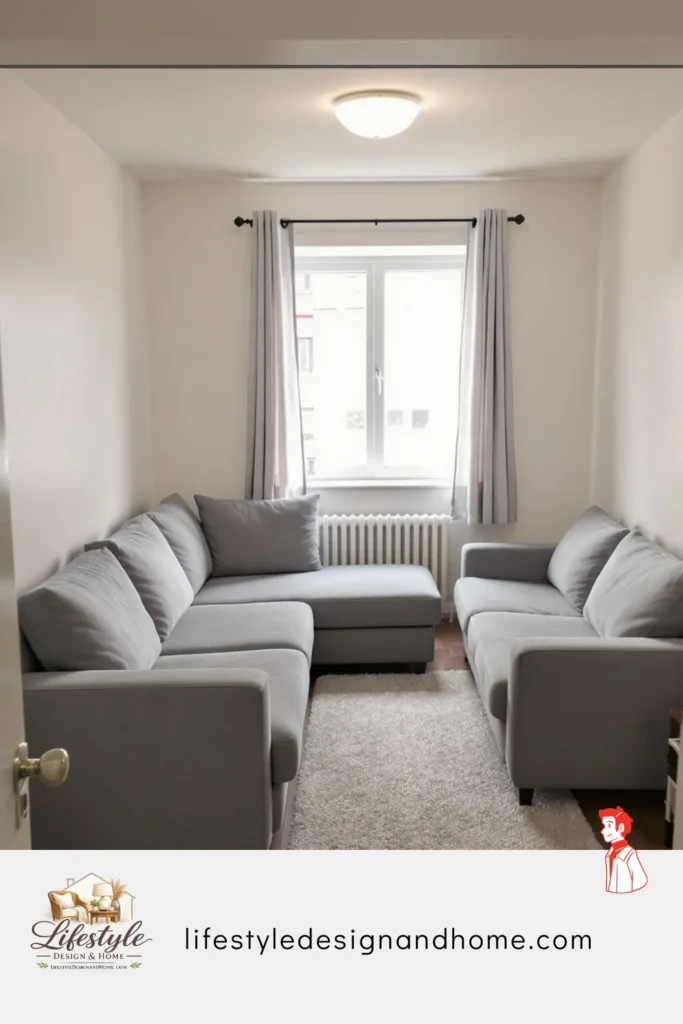
A sectional sofa is a modular or connected seating piece made of two or more sections that join together — most commonly in an L-shape or U-shape. Sectionals range from compact two-piece configurations (a sofa plus a chaise, often called a “apartment sectional” or “small sectional”) to enormous five-piece arrangements that fill rooms in their entirety. The key characteristic: a sectional wraps around itself, occupying two walls’ worth of space rather than one.
This distinction matters because “sectional” doesn’t mean one thing. A 100-inch-by-60-inch apartment sectional and a 140-inch-by-110-inch U-shaped sectional are both technically sectionals, but they have almost nothing in common in terms of what they do to a small room. When someone tells you “sectionals don’t work in small rooms,” they usually mean the second kind. And they’re right about that kind. But writing off all sectionals based on the behavior of the largest ones is like saying “cars don’t fit in parking spaces” because you tried to park a semi-truck.
Throughout this article, when I say “sectional,” I mean the full range — and I’ll specify size when it matters.
The Case for a Standard Sofa in a Small Living Room
Let’s start here, because for most small living rooms, a standard sofa is the right choice — and understanding why makes the exceptions clearer.
Flexibility Is the Sofa’s Superpower
A standard sofa can be placed almost anywhere in a room. Against a wall, floated in the center, used as a room divider, angled at 45 degrees, positioned perpendicular to a fireplace. It can be paired with two armchairs to create a U-shaped conversation grouping, with a loveseat for parallel seating, with a bench for a more modern arrangement. It adapts.
A sectional, by contrast, is committed. It has a shape baked into it — an L or a U — and that shape either works in your room or it doesn’t. There’s no way to reconfigure a sectional when the arrangement stops working. The sofa can be repositioned in an afternoon. The sectional requires either a renovation-level rethink or a new purchase.
In small rooms, where the margin between a layout that works beautifully and one that completely fails is often a matter of inches, flexibility matters enormously. The sofa gives you that flexibility. The sectional takes it away.
Sofas Leave Room for Other Pieces
A standard sofa occupies one line of the room — one wall’s worth of depth and length. This leaves the opposite wall, the side walls, and most of the floor plan available for other furniture: armchairs that can be moved for entertaining, a bookshelf on the far wall, a console that doubles as storage, side tables that earn their place functionally.
A sectional, especially an L-shaped one, eats two walls. The long side goes against one wall and the chaise side goes along an adjacent wall. In a small room, this typically means two of your four walls are consumed by a single piece of furniture. What remains for everything else — the coffee table, the television setup, the storage, the places for guests to sit — is a much smaller and more constrained floor plan.
For rooms that need to multitask — and most small living rooms do — the sofa’s smaller physical footprint preserves the optionality that makes multifunctional rooms work.
Visual Lightness
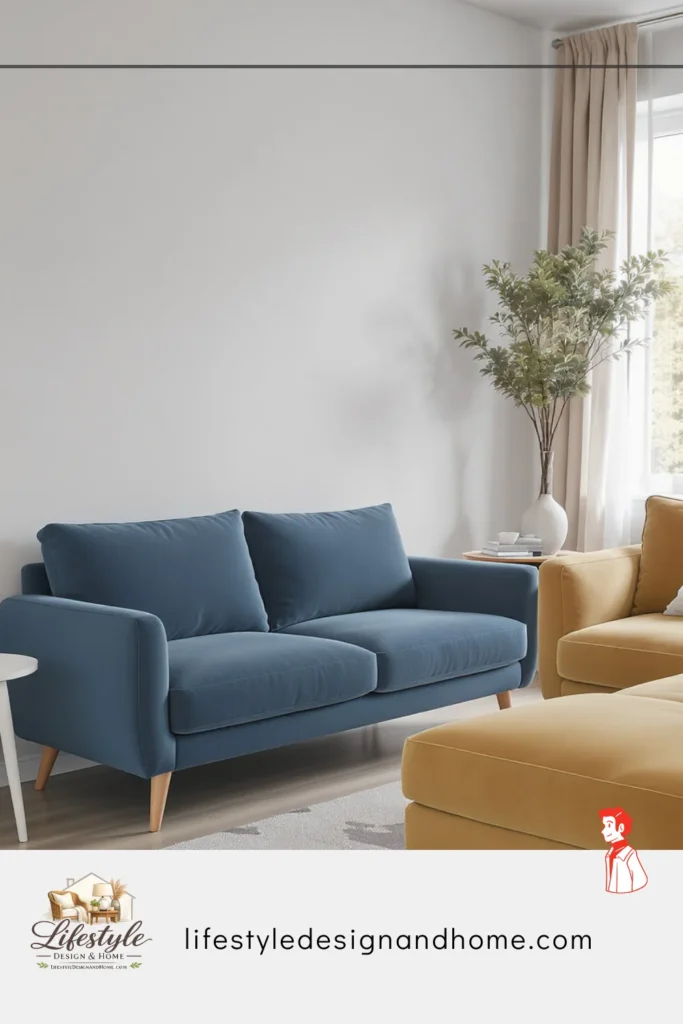
A standard sofa, properly chosen, can feel airy in a small room. Sofas with visible legs, slim profiles, and tight upholstery read as visually lighter than they are. A sofa on tapered wooden legs elevates itself off the floor and reveals the floor plane beneath, which makes the room read as more open.
A sectional, by definition, is more furniture. More upholstery, more visual weight, more mass in the room. This isn’t automatically disqualifying — but it’s a real consideration in rooms where you’re already managing limited space and trying to keep the visual field from feeling crowded.
The Case for a Sectional in a Small Living Room
Now here’s where I’m going to push back on the conventional wisdom, because it deserves pushing.
A Well-Chosen Sectional Can Solve Problems a Sofa Creates
Consider the small living room with an awkward corner — a room where one corner is essentially unusable because there’s no logical way to place furniture in it without blocking traffic or creating dead space. A sofa leaves that corner empty and purposeless. An L-shaped sectional, configured to wrap into that corner, converts dead space into functional seating. The sectional doesn’t waste the corner; it activates it.
This is the sectional’s specific genius: it fills corners. In a room where corners are going to waste anyway, a sectional can actually improve the efficiency of the floor plan rather than reduce it — it transforms unusable geometry into seating.
Similarly, consider the small living room that hosts people regularly. A standard sofa seats three comfortably. Add two armchairs and you’ve got seating for five — but those chairs need space, and the small room is now managing five separate pieces of furniture instead of two. A compact sectional might seat five within a single, unified piece that takes up less combined floor space than the sofa-plus-chairs arrangement would require. The sectional wins on seating per square foot.
The Compact or Apartment Sectional Changes the Equation Entirely
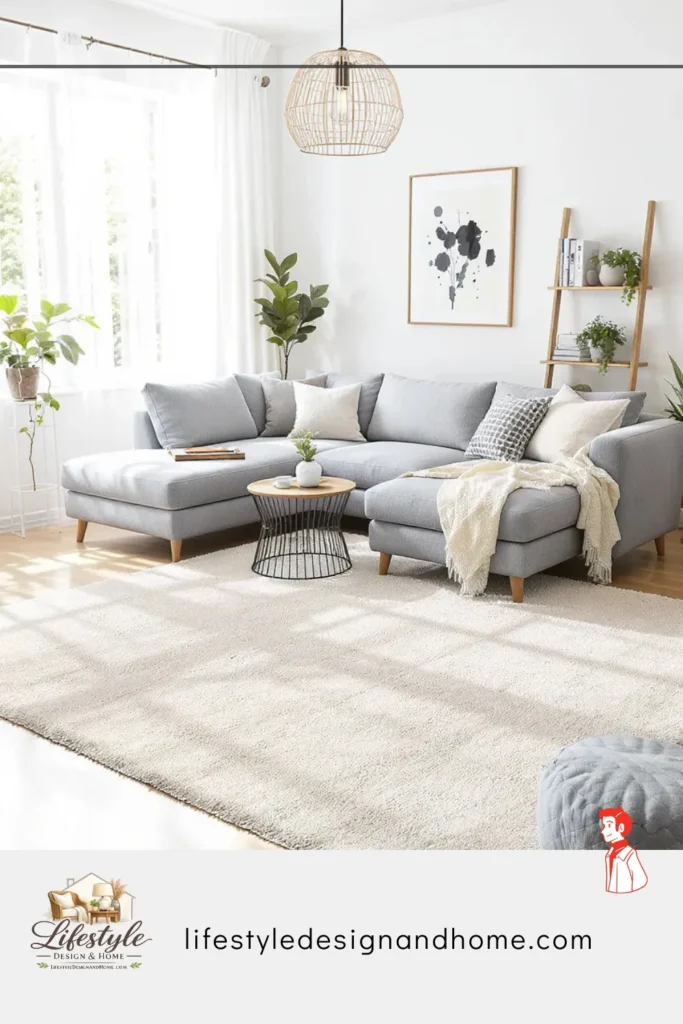
The furniture industry responded to small-home living by developing what’s variously called the compact sectional, apartment sectional, or small-space sectional. These pieces — typically in the 90-to-110-inch range on the long side and 55-to-65 inches on the short side — are fundamentally different from their larger counterparts.
An apartment sectional can fit in a 12-by-14-foot living room. It can be the room’s anchor piece without consuming its entire floor plan. It can provide a chaise for lounging and a full sofa for seating while taking up less combined space than a sofa plus a separate chaise would require. And it can look genuinely designed — intentional and properly scaled — rather than like a large piece of furniture that someone forced into a room that couldn’t hold it.
If you’ve ruled out sectionals for a small room based on the large-sectional experience, compact sectionals deserve a second look. The category has evolved.
Modular Sectionals Offer Real Flexibility
Modern modular sectionals — pieces where the individual sections can be reconfigured and reconnected in different arrangements — offer a solution to the sectional’s primary weakness. If your room changes, or you move, the modular sectional moves and reconfigures with you. The L becomes a sofa-plus-ottoman. The U becomes a large sofa for a bigger room. The commitment is reduced.
This is not an inexpensive solution — quality modular sectionals tend to cost significantly more than equivalent-sized sofas. But for someone who moves frequently or knows their room configuration will change, the flexibility premium can be worth it.
The Decision Framework: Six Questions That Tell You Which to Choose
Enough theory. Here’s how to actually decide for your room.
Question 1: What are your exact room dimensions?
Measure your room. Write down the dimensions. Now consider this general guideline: in a room smaller than 12 feet by 15 feet, a standard sectional (130-plus inches on the long side) is going to be very difficult to make work. A compact sectional (90-to-110 inches on the long side) may work if the room configuration supports it. A standard sofa almost certainly works.
In a room larger than 12 by 15, the range of options expands. A compact sectional works comfortably. A standard-sized sectional may work depending on the room’s shape and the placement of doors and windows.
The specific dimensions of your room are not just one factor — they’re the primary factor. If someone recommends a sectional for a room they haven’t measured, their advice is incomplete.
Question 2: What is your room’s shape?
Square rooms and L-shaped rooms are the friendliest to sectionals. An L-shaped sectional in an L-shaped room feels almost architecturally inevitable — the furniture echoes the geometry of the space, the corner gets activated, and the floor plan flows naturally around the arrangement.
Long, narrow rooms are the hardest cases for sectionals. In a room that’s 10 feet wide and 18 feet long, an L-shaped sectional forces the chaise into the room’s width and may reduce a 10-foot-wide room to a 4 or 5-foot walkway. Narrow rooms almost always benefit from a standard sofa that runs along the long wall, preserving the width of the room.
Rectangular rooms are in the middle — they can work with either, depending on where the doors, windows, and television connection points fall.
Question 3: Where are your traffic paths?
Walk the room and trace every route someone might take through it: from the entry to the seating, from the seating to the kitchen or dining room, from one end of the room to the other. Now imagine a sectional’s L-shape in that room. Does it accommodate those paths, or does it block them?
A sectional that cuts across a natural traffic route is a sectional in the wrong room — or at least in the wrong configuration. Before you commit, sketch the sectional’s footprint on your room plan and trace your traffic paths through the resulting floor plan.
Question 4: How do you actually use this room?
If your living room is primarily a relaxed, casual space — movie nights, lounging, hanging out on weekends — a sectional’s sprawl is a feature, not a bug. The chaise becomes a nap station. The corner becomes the coveted seat. The whole piece invites the horizontal, comfortable way you actually use the room.
If your living room is frequently used for entertaining multiple people in conversation — dinner parties that spill into the living room, gatherings where people want to talk and face each other — a sectional is less ideal. Its L or U shape puts some people at angles to others, creates a “corner” of the sofa that people tend to avoid, and makes flexible conversation arrangements harder than a sofa-plus-chairs setup does.
If it’s both, weigh which use is primary.
Question 5: Is this your forever home or are you likely to move?
A sectional that works perfectly in your current apartment may not work at all in your next one. If you move frequently, or know you’ll be leaving this space in the next few years, the sofa’s portability and adaptability have real financial value. A great sofa moves with you. A great sectional may become a liability.
If you’re in a long-term home where the living room’s dimensions aren’t going to change, this concern disappears.
Question 6: What is your budget — honestly?
A good sofa can be found at almost every price point from budget to luxury. A good compact sectional starts somewhat higher — because you’re buying more furniture — and the quality variance at lower price points in sectionals tends to be more dramatic. A cheap sofa and a cheap sectional may both look fine for the first year, but sectionals receive more stress on their connectors and joints, and cheaper construction shows this faster.
If your budget is limited, a well-chosen sofa plus one quality armchair will almost always produce a better room than a budget sectional. Save the sectional for when you can buy it well.
Side-by-Side: What Each Choice Gets You
Standard Sofa — Best For:
- Rooms under 12 feet by 15 feet where every inch counts
- Long, narrow rooms where width must be preserved
- Rooms used primarily for conversation and entertaining
- Renters or frequent movers who need flexibility
- Multifunctional rooms that need floor space for other activities
- Budgets where quality matters more than size
Compact Sectional — Best For:
- Rooms with awkward corners that a standard sofa leaves as dead space
- Households that prioritize lounging and casual, relaxed use
- Rooms used frequently for movie watching and horizontal comfort
- Rooms that are roughly square or L-shaped in footprint
- Owners who want maximum seating within a single unified piece
- Spaces where a chaise or dedicated lounging surface is genuinely needed
Standard or Large Sectional — Best For:
- Rooms 14 feet by 16 feet or larger (in most configurations)
- Open-plan spaces where the sectional can define a zone without boxing it in
- Households with multiple people or frequent guests who need substantial seating
- Rooms with generous ceiling height that can absorb a large piece without feeling crushed
The Mistakes People Make With Each Choice
Sofa Mistakes in Small Rooms:
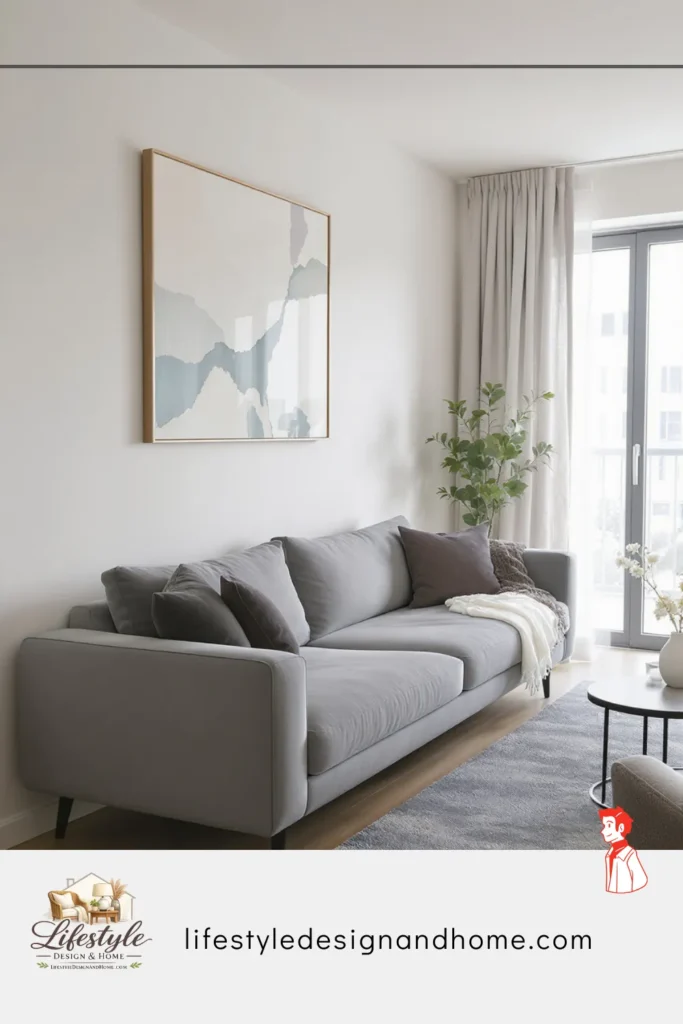
Buying a sofa that’s too small in an attempt to “save space.” A 72-inch sofa in a room that could accommodate 84 inches looks hesitant and undersized — which, paradoxically, makes the room feel smaller. Scale up to the largest sofa the room can comfortably hold.
Pairing the sofa with too many additional seating pieces. A sofa plus two armchairs plus a loveseat in a small room is too much seating. Choose the sofa’s companion pieces selectively — one or two pieces that complete the arrangement without crowding it.
Ignoring the sofa’s leg situation. A sofa with thick, solid legs that sit flush with the floor reads as heavy and room-consuming. A sofa on slim, visible legs reveals floor and reads as lighter. In small rooms, this detail matters more than most people realize.
Sectional Mistakes in Small Rooms:
Buying a sectional that’s too large. This is the classic mistake, and it’s usually made because the sectional looked right in the showroom — where the showroom floor is vast. Always measure your room first, then determine which sectional dimensions will actually fit within your constraints. If the showroom doesn’t have your dimensions marked on the floor, bring tape and measure yourself.
Placing the sectional against two walls. The instinct to push the L-shape into a corner with both sides against the walls is almost always wrong. It eliminates the breathing room behind the furniture, makes the room feel like the sectional was stored there rather than designed there, and removes the floating quality that makes furniture look intentional. Pull the sectional away from the walls — yes, even the sectional. Even six to eight inches of space between the back of the sofa section and the wall changes the feel of the room.
Buying a sectional that blocks traffic. If the chaise end of the sectional reduces the walking path between the sofa and the opposite wall to less than 30 inches, you’ve bought the wrong size. This isn’t something to adapt to — it’s a layout failure.
The One Scenario Where the Answer Is Definitively Sofa
If your living room is under 11 feet wide in its shortest dimension, buy a sofa.
Not a compact sectional. Not an apartment sectional. A sofa.
In a room narrower than 11 feet, even a compact sectional’s chaise — typically 55 to 65 inches deep — will consume the majority of the room’s width and leave either no meaningful traffic path or a traffic path so narrow that living in the room becomes a daily exercise in careful navigation. The room will feel like a furniture showroom staging area rather than a place anyone actually wants to be.
A standard sofa in a room that narrow, placed against the long wall and floated 8 to 10 inches out, still leaves a functional floor plan. Add one armchair on the opposite wall and the room works beautifully. The sectional won’t.
Narrow rooms want sofas. Square rooms can go either way. L-shaped rooms often want sectionals. These are the generalizations that hold up most consistently.
A Note on Hybrid Approaches
The either/or framing of this debate sometimes obscures a middle path worth considering: the sofa-plus-chaise configuration, where a standard sofa is paired with a standalone chaise lounge rather than a connected sectional.
This arrangement gets you most of what a sectional provides — a dedicated lounging surface, more total seating, the visual weight of a larger arrangement — without the commitment and inflexibility of a sectional. The chaise can be moved. The sofa can be repositioned without the chaise following it. If the arrangement stops working, you have two separate pieces to work with rather than one connected piece that only does one thing.
It’s not the right answer for everyone. A connected sectional has a unified, intentional quality that a sofa-plus-separate-chaise can sometimes lack — the gap between them can look provisional if not managed carefully, and connecting pieces need the right rug and layout to read as an intentional arrangement rather than two pieces that happen to be near each other.
But if you love the idea of a sectional’s function and are nervous about its commitment, a sofa-plus-chaise is the audition. Try the arrangement, live with it, and then decide whether the upgrade to a connected piece is worth the investment.
The Honest Answer
The sectional-versus-sofa debate doesn’t have a universal answer. Anyone who tells you definitively that sectionals never work in small rooms, or always work in small rooms, is selling you a rule that doesn’t account for the specificity of actual spaces.
What works is a decision based on your room’s exact dimensions, its shape, its traffic patterns, and the way you actually live in it — followed by execution with correctly scaled furniture, thoughtful placement, and the willingness to float your furniture off the walls regardless of which direction you go.
The sofa is the safer bet for most small rooms. It’s more flexible, lighter on the floor plan, and adapts to a wider range of arrangements.
But the right compact sectional, in the right room, configured the right way, floated off the walls and anchored a well-defined zone — that room can be extraordinary.
Measure first. Decide second. Then commit fully to whichever direction you choose and make it exceptional.
Quick Decision Checklist
Lean toward a SOFA if:
- Your room is narrower than 11 feet at any point
- Your room is primarily long and narrow rather than square
- You entertain frequently and need flexible conversation seating
- You move often or your living situation is likely to change
- Budget is a real constraint (invest in fewer, better pieces)
- Your room needs to serve multiple functions and floor space is precious
Lean toward a COMPACT SECTIONAL if:
- Your room is roughly square or has an underused corner
- Your primary use is relaxed, casual lounging and movie watching
- You need maximum seating capacity in a single unified piece
- Your room is at least 12 by 14 feet with clear traffic paths
- You’re a long-term resident and the room’s layout is unlikely to change
- You’ve measured and confirmed a compact sectional fits with 30+ inch traffic clearances
In either case:
- Measure before you buy — showroom scale lies
- Float the furniture off the walls — even sectionals
- Verify traffic paths are 30+ inches clear
- Choose the largest correctly-scaled piece over the smallest “safe” one