The Night I Slept on My Own Floor (And What It Taught Me About Bedroom Layout)
I’m not proud of this story, but it’s true.
A few years ago I moved into a new apartment with a bedroom so small I genuinely didn’t know what to do with it. I’d measured the room before I signed the lease — I wasn’t that naive — but somehow I had not accounted for the fact that the door swung inward, the only window sat on the worst possible wall, and the single closet door needed a clear arc of space that ate directly into the only viable spot for the bed.
I spent the first three nights sleeping on a mattress on the floor while I figured it out because every arrangement I tried left me either unable to open the closet, unable to walk around the bed, or lying there looking directly at the wall from eight inches away.
I tried seven different configurations before I found one that worked. And what I discovered during those seven failed attempts taught me more about small bedroom layout than any article I’d ever read — because the solutions that actually worked were almost always counterintuitive. The arrangement that used more of the room felt more spacious than the one that tried to conserve space. The bed that floated away from the wall felt better than the one shoved into the corner. The layout that looked wrong on paper felt right the moment I stood in it.
That’s what this article is about. Not the pretty arrangements that photograph well in staged bedrooms. The ones that actually work when you’re living in a really small room, with a really small door that swings the wrong way and a closet in an inconvenient place.
Before You Move Anything: The Three Things That Determine Every Decision
I learned this the hard way across seven failed arrangements: you cannot plan a small bedroom layout without answering three questions first. Skip them and you’ll spend a weekend moving furniture in circles.
Question 1: Where does your body need to go first thing in the morning?
This sounds obvious until you realize most bedroom layouts are designed around how the room looks in a photograph, not around the sequence of movements you actually make when you wake up at 6 AM half-asleep. You get out of bed. You go to the bathroom, or the closet, or maybe the window. You have a specific path you walk every single morning. Your layout needs to make that path natural — not an obstacle course.
In my small apartment, I eventually realized the reason every arrangement felt wrong was that I kept putting the bed between myself and the closet, which meant I was climbing over furniture every morning before I was fully awake. The arrangement that finally worked put the closet accessible within three steps of the bed. That single decision resolved the room.
Question 2: What does this room actually need to do?
Bedroom, yes — but what else? Does it need a desk for working from home? A reading chair? A place for a child to play? Small bedrooms that try to do too many jobs usually fail at all of them. In my opinion, the single most common small bedroom mistake is trying to make the room function as a home office, a dressing room, a reading nook, and a sleep sanctuary simultaneously — and producing a space that works as none of those things particularly well.
Decide what the room’s primary and secondary functions are. Primary: sleeping. Secondary: one thing, maybe two. Everything else gets solved somewhere else in the home, or doesn’t get solved at all.
Question 3: Where are your fixed constraints?
Walk the room and mark everything immovable: the door and the arc it sweeps through, the window and which direction it faces, the closet and the clearance its door needs, electrical outlets, any radiators or vents. These are your skeleton — the constraints that remain true regardless of what furniture you choose or how you arrange it.
I now do this before I touch a single piece of furniture, and I do it on paper. A rough sketch, five minutes, marks for all fixed elements. Those marks eliminate roughly half the possible arrangements immediately, which is actually a relief — it narrows the problem down to something manageable.
Layout Idea 1: The Diagonal Bed Placement
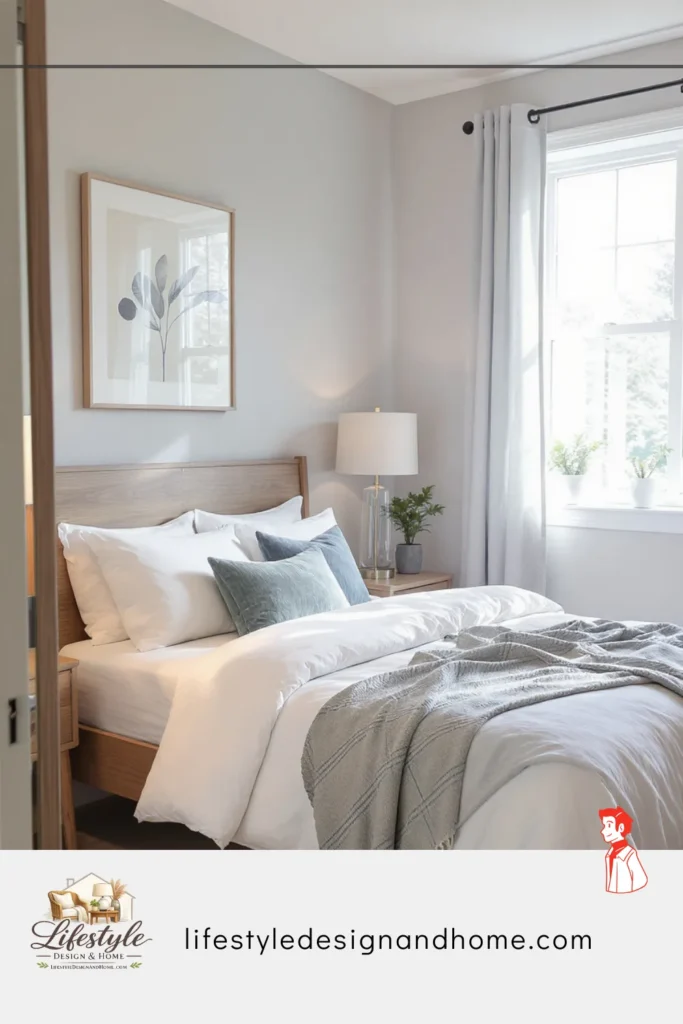
This is the one that surprises people the most, and in my experience it’s also the one that works best in rooms with genuinely difficult geometry — square rooms, rooms with multiple doors, rooms where every straight wall placement creates a problem of some kind.
Placing the bed at a 45-degree angle to the room’s walls sounds like it would waste enormous amounts of space. In practice, it creates something unexpected: the room suddenly has a clear diagonal sight line from the doorway that makes it read as significantly longer than it is. The corner behind the bed becomes a natural zone for a lamp and small table. The space on either side of the bed, while triangular, often fits a narrow nightstand better than the awkward rectangular gap you’d get from a straight wall placement.
I tried this in my difficult small apartment almost as a last resort, not really believing it would work. It was the only arrangement that solved all three of my problems simultaneously — closet accessible, door clearance maintained, bed not directly against any wall. And the room felt bigger, not smaller, which I still find slightly remarkable.
The practical requirement: diagonal placement works best in rooms where the bed can truly float in a corner zone, with one corner of the room as the backdrop rather than a full wall. The space behind the headboard — the triangular gap between bed corner and room corner — can be filled with a small shelf unit or left as negative space. Both work. I personally left mine open and put a single tall lamp there. The effect was dramatic and good.
Layout Idea 2: Float the Bed Off the Wall
If there’s one piece of advice in this entire article I’d want you to actually follow, it’s this one — because it’s the arrangement I resisted the longest and the one that made the biggest difference when I finally tried it.
The instinct in a small bedroom is to push the bed against the wall. Wall on one side means more open floor space on the other, which means more room to move, which means the room feels bigger. This logic is completely sound and almost entirely wrong.
A bed pushed against a wall does two things that work against you. First, it makes the bed asymmetrical — one side is accessible, one side is a crawl — which creates practical frustration every single day you have to make it, adjust the pillows, or retrieve anything that falls behind it. Second, and more importantly, it makes the room feel like a furniture storage unit rather than a bedroom. The bed pushed to the wall reads as defensive, as if the furniture is trying to get out of the way of the room rather than being the reason the room exists.
Floating the bed — pulling it at least 18 to 24 inches from the wall on its accessible sides, ideally centered on the main wall — transforms the room in a way that feels disproportionate to such a small physical change. The bed becomes the intentional anchor of the space. The room organizes itself around the bed rather than around the edges. Two nightstands become possible, which creates the symmetry that makes bedrooms feel finished and calm.
The objection I always hear: “but I don’t have room to float the bed.” In most small bedrooms, you do — because the space you “lose” by floating the bed was never really usable floor space anyway. A 12-inch gap between bed and wall isn’t wide enough to walk through or use for anything. Floating the bed converts it from a dead zone to a visual and functional breathing room. Try it before you decide it won’t work.
Layout Idea 3: The Corner Headboard Configuration
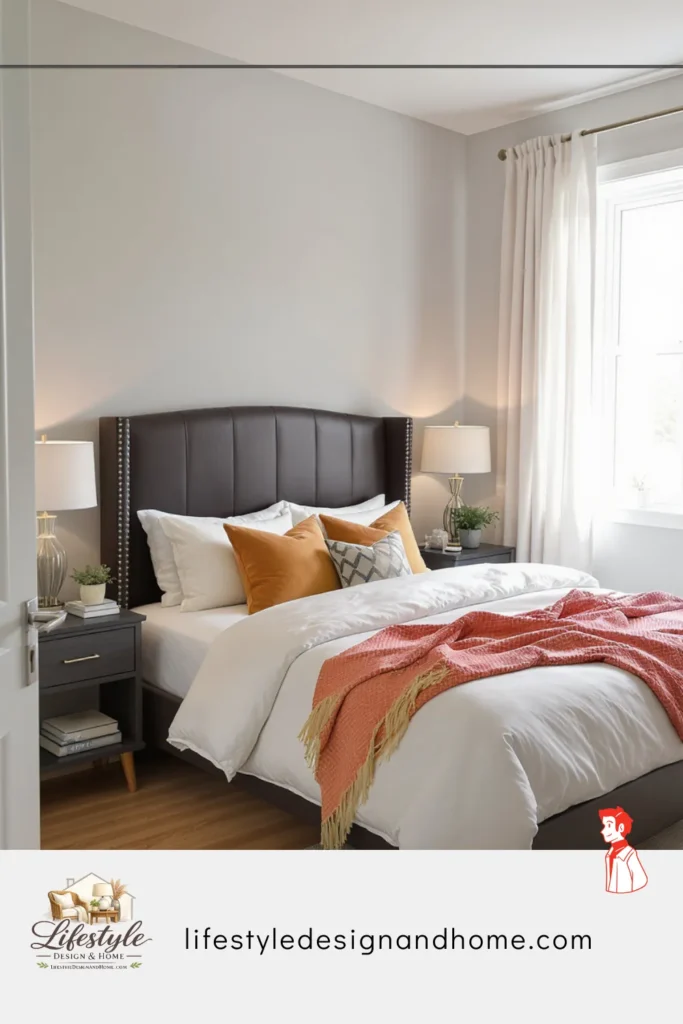
This is my personal favorite for very small square rooms, and I discovered it entirely by accident during failed arrangement number four.
The corner headboard configuration places the bed in the corner with the head of the bed pushed into the corner — both walls behind the headboard, essentially. This is different from pushing the bed against one wall: here, the headboard occupies the corner, and both bed sides run along both room walls before jutting out into the room.
What this achieves: the bed takes up the least possible footprint in terms of its projection into the room, because it’s using the corner rather than a single wall. The two walls become a natural backdrop that makes the bed feel like it’s designed into the room rather than deposited in it. And — this was the part that surprised me — the room in front of the bed suddenly has a generous open expanse that makes the square footage feel used intelligently rather than fought against.
The practical consideration: corner headboard placement requires a specific approach to nightstands. You can’t have a traditional nightstand on the corner side because there’s no room. What works instead: a small floating shelf mounted directly to each wall at nightstand height, one on each side of the corner. These take up zero floor space, provide surface area for a lamp and a book, and read as built-in rather than added-on. In a small room, that distinction matters.
One thing I genuinely love about this configuration: it makes the bed feel like a destination rather than an obstacle. You walk into the room and the bed is framed by its corner backdrop, and the whole arrangement communicates that this is a room designed for rest. That psychological quality — the room reading as intentional — affects how you feel in it in ways that are real even if they’re hard to articulate.
Layout Idea 4: Centered on the Main Wall With Symmetry
This is the most traditional bedroom layout, and there’s a reason it has persisted — when done correctly in the right room, it is simply excellent.
The bed centered on the main wall, flanked by matching nightstands, facing the doorway. Clean, symmetrical, organized. The challenge in small bedrooms is that this layout requires the main wall to actually be wide enough to accommodate the bed plus meaningful nightstand space, which means it typically requires a room width of at least 10 feet for a queen bed to work without feeling wedged.
What most people don’t do is think about the proportional relationship between bed size and nightstand size. In small bedrooms, this relationship matters enormously. Oversized nightstands make a well-proportioned bed look crowded. Undersized ones look like afterthoughts. For a small bedroom with a queen bed, I’ve found that nightstands between 18 and 22 inches wide feel right — wide enough to be genuinely useful, narrow enough to not eat the flanking wall space.
The other decision most people get wrong in this layout: what goes on the opposite wall — the wall you face from the bed. In a small bedroom, that wall is real estate. If it’s just blank wall or generic dresser placement, the room feels unfinished. The best small bedrooms I’ve been in treat that opposite wall as the room’s visual anchor — a piece of art hung at exactly the right height, a low dresser with something considered on it, a small gallery. Something that rewards being looked at during the time you spend lying in bed.
Layout Idea 5: The Storage-First Layout
This one changed how I think about small bedrooms fundamentally, and I wish someone had explained it to me before I furnished my first apartment.
In most small bedrooms, the biggest quality-of-life problem isn’t where the bed goes. It’s where everything else goes. Clothes, books, shoes, extra bedding, the various accumulated objects of a daily life — in a small room, storage failure creates visual chaos that makes the room feel smaller and more stressful than any furniture arrangement problem ever could.
The storage-first layout starts with a completely different question: instead of “where should the bed go?”, ask “where can I maximize storage, and how does the bed fit around that?”
In practice this usually means one of two things. The first is built-in storage along an entire wall — floor-to-ceiling wardrobes or shelving that turns one full wall into storage, and then the bed and remaining furniture are placed in relation to that storage wall. This is the approach that makes even very small bedrooms feel intentional and organized, because the storage is architectural rather than furniture-level. It reads as part of the room, not added to it.
The second is under-bed storage prioritized by choosing a bed frame with substantial drawer storage or a platform with lift-up access. I made this switch several years ago, and it solved approximately 40 percent of my small bedroom storage problems overnight. Every box, bin, and seasonal item that had previously lived in awkward floor-level storage disappeared under the bed. The room floor cleared. The room immediately felt larger.
The mental shift required: in a small bedroom, storage is not secondary to layout. Storage is laid out. The decisions are inseparable, and treating them separately produces rooms with either good arrangement and chaotic clutter or organized storage and awkward furniture placement. The storage-first layout solves both simultaneously.
Layout Idea 6: The Long Narrow Room Solution
Long, narrow bedrooms are, in my experience, the most complained-about room shape in residential interiors — and also the most solvable once you understand the one rule that governs them.
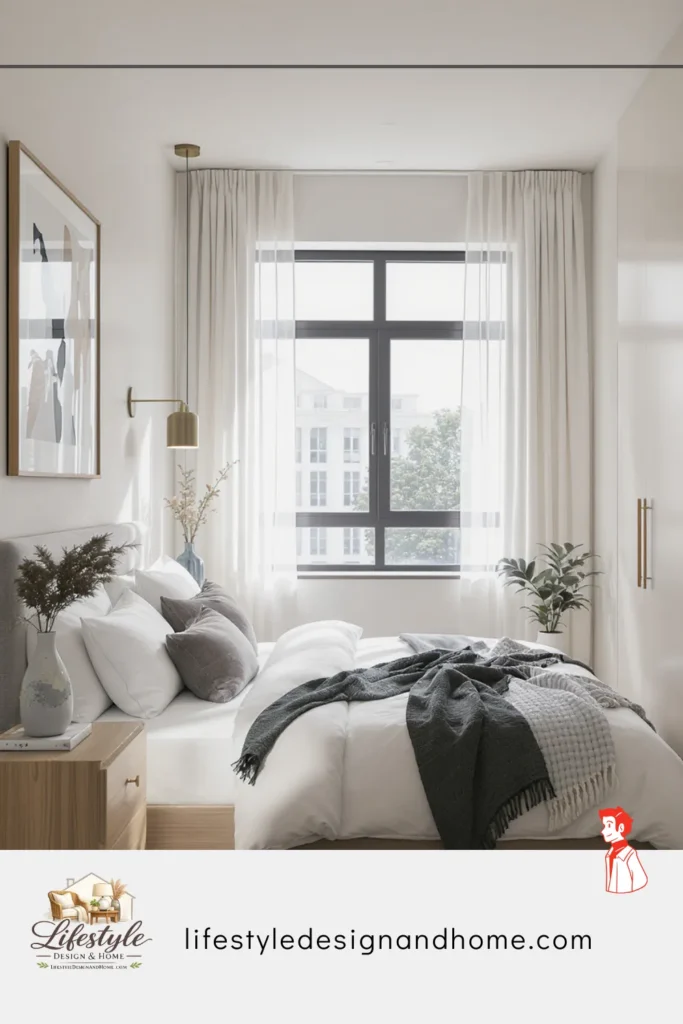
The rule: place the bed on the short wall, not the long wall.
This sounds counterintuitive. The long wall has more space. Putting the bed there feels efficient. But when you put the bed on the long wall of a narrow room, you turn the room into a corridor — a narrow passage on one side of the bed, and a narrow passage on the other. Every movement in the room is channeled along the length of the space, which emphasizes how long and how narrow it is.
Place the bed on the short wall — headboard centered on the wall at the far end — and the entire proportion of the room changes. You now walk into the long dimension of the room toward the bed, which reads as a destination rather than an obstacle. The long walls on either side become real estate for storage, art, or furniture placement. The room feels purposefully shaped rather than awkwardly proportioned.
I discovered this layout in a rental that had a bedroom I genuinely hated — long, narrow, one window on the long wall, door on the opposite long wall. I had the bed on the long wall for eight months and never felt comfortable in the room. Moved it to the short wall on a Saturday afternoon as an experiment. Walked back in afterward and genuinely said out loud, to nobody, “oh.” That was it. That was the room I’d been trying to find for eight months.
The secondary moves that complete the long-narrow layout: floating shelves or a low bookcase along one long wall to create horizontal visual interest, a tall lamp or tall plant in the corner beyond the bed to draw the eye to the room’s full depth, and curtains hung at ceiling height on the window — even if the window is small — to add vertical emphasis that counteracts the horizontal narrowness.
Layout Idea 7: The Multifunctional Bedroom
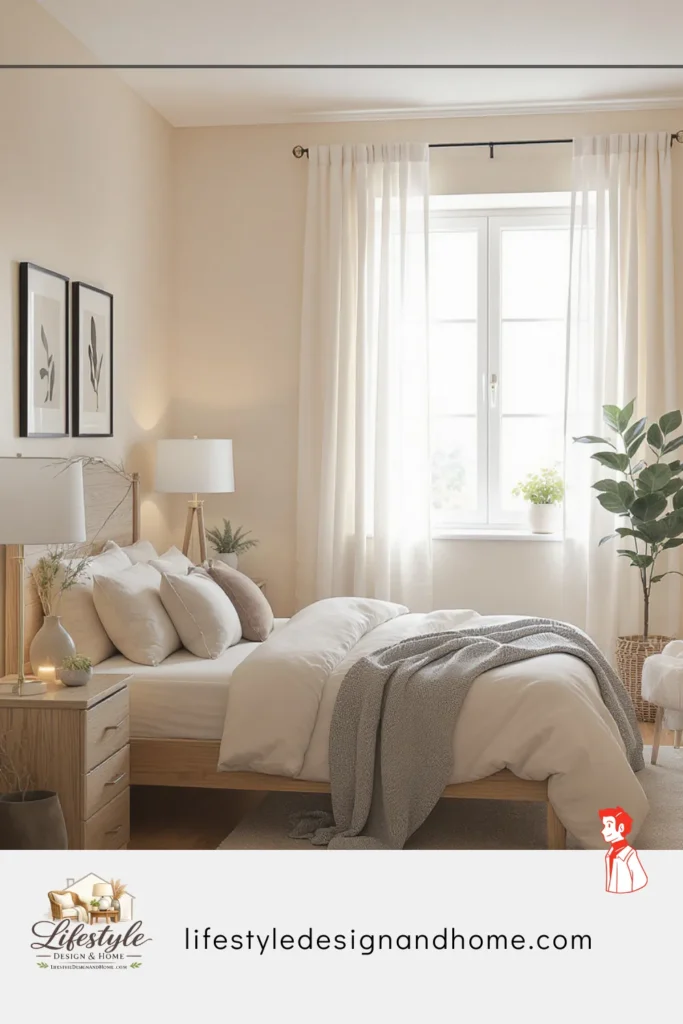
For many people — students, city renters, anyone living in a studio or one-bedroom apartment — the bedroom isn’t only a bedroom. It needs to accommodate a desk, or a reading chair, or sometimes a workout area. This is genuinely difficult and requires thinking about the room in zones rather than in individual furniture pieces.
Here’s my approach after living in a bedroom-office hybrid for two years: the sleep zone and the work zone need to be as visually separated as possible, even in a small room. The brain makes associations between spaces and activities, and a desk visible from the bed actively disrupts sleep quality because the work zone stays activated even when you’re trying to rest. This isn’t anecdotal — it’s well-established in sleep research.
The most effective separation techniques I’ve used, in order of effectiveness:
Positioning: Put the desk on the wall perpendicular to the bed rather than directly visible from it. When you’re lying down, you shouldn’t be able to see your desk without actively turning your head. Out of sightline, out of mind — genuinely.
Room dividers: A bookshelf used as a room divider, placed perpendicular to the wall between the bed zone and the desk zone, creates a visual and physical separation without requiring additional square footage. The bookshelf does double duty — storage plus spatial definition. I used this in a 10-by-12 bedroom-office for about eighteen months and it worked remarkably well.
Curtains as dividers: A ceiling-mounted curtain track with a linen curtain that can be drawn at night to conceal the desk is the most flexible option — the desk is fully accessible during the day and completely hidden at night. This was my second-favorite solution and the one I’d recommend to anyone whose room geometry doesn’t allow perpendicular desk placement.
Ritual separation: The least architectural solution but sometimes the most practical — the habit of deliberately “closing” the workspace at the end of the day. Stack papers, close the laptop, turn the chair toward the wall. Physical rituals that signal to your brain that work is over. Less effective than physical separation but better than nothing, and free.
The Details That Make or Break Every Small Bedroom Layout
Once the layout is established, there are four finishing decisions that have an outsized effect on how the room actually feels to live in. I’ve made mistakes on all four of these at various points, so these come from experience rather than just theory.
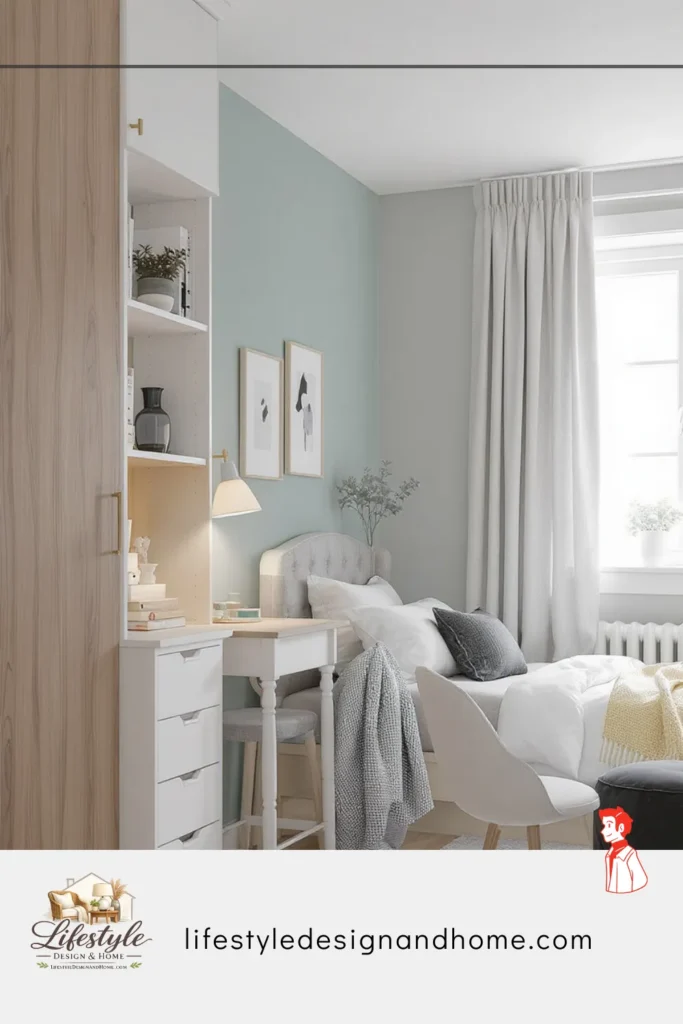
Bedside lighting, not overhead. The single most common lighting mistake in small bedrooms is relying on an overhead light as the only source. Overhead lighting in a bedroom creates the wrong kind of illumination — bright, flat, directionless, identical to the lighting in a hallway. What bedrooms need is warm, low, directional light that signals rest. Wall-mounted sconces on either side of the bed are ideal — they free up nightstand surface and put light at exactly the right height. Plug-in sconces exist for renters and require no electrical work. I switched to these in my last two bedrooms and the improvement was immediate and significant.
Mirror placement for perceived space. A mirror on the wall opposite or adjacent to the window doubles the apparent depth of the room by reflecting the light source and creating the impression of continuation beyond the wall. In small bedrooms, a large mirror — leaned against the wall or mounted — is one of the most effective single purchases for perceived space. The mistake I see most often is small decorative mirrors that are beautiful but too small to do any spatial work. Go large or don’t bother.
Curtains at ceiling height. I’ve said this in other contexts but it’s worth repeating specifically for bedrooms: curtains hung at window height make the room feel lower and smaller. Curtains hung four to six inches below the ceiling — with panels falling to the floor — make the room feel taller and more finished. The difference in perceived ceiling height is dramatic. In a small bedroom, that vertical emphasis is genuinely valuable.
Ruthless editing of the floor. Every item on the floor of a small bedroom — the stack of books, the laundry basket, the pile of shoes that didn’t make it into the closet — reads as visual clutter that makes the room feel smaller and more chaotic. Clear floor is the fastest, cheapest way to make a small bedroom feel larger. I do a floor audit in my bedroom every week or two and remove anything that doesn’t have a clear reason to be on the floor. It takes ten minutes and the room consistently looks better afterward.
The Small Bedroom Layout Checklist
Before You Start:
- Identified the path you walk every morning — layout serves that path
- Decided the room’s primary and secondary functions (maximum two)
- Mapped all fixed constraints: door arc, window, closet clearance, outlets
- Sketched the room on paper before moving anything
Bed Placement:
- The bed floated from the walls by at least 18 inches on accessible sides
- Headboard against the main wall or in the corner — not blocking the window
- Clearance of at least 24 inches on both sides if possible (18 minimum)
- Door arc is completely unobstructed — open fully without hitting the bed
Storage:
- Under-bed storage is used if the bed frame allows
- Vertical storage prioritized — tall rather than wide
- Closet door clearance is fully maintained
- Floor kept clear of anything without a defined place
Finishing Details:
- Warm lighting at bed level — sconces or bedside lamps, not only overhead
- One large mirror placed to reflect the window or the light source
- Curtains mounted at ceiling height, falling to the floor
- Opposite wall from bed treated as a visual anchor — art, dresser, something considered
If It’s a Multifunctional Room:
Desk positioned out of sightline from bed
Visual separation is created between sleep and work zones
End-of-day ritual established to “close” the workspace
One Final Thing
Here’s what I know after seven failed arrangements and many bedrooms since: there is no universally correct small bedroom layout. There is only the layout that works for your specific room, your specific morning routine, and your specific relationship to sleep, rest, and space.
What I can tell you is that the layout you’re looking for almost certainly requires doing something that feels wrong before it feels right. Floating the bed away from the wall. Moving it to the short wall of a narrow room. Putting it diagonally in a corner as a last resort. These moves feel risky on paper. In practice, they are often the ones who transform the room.
The seven failed arrangements in my first small apartment weren’t wasted time. They were elimination rounds. Every layout that didn’t work told me something about what the room needed. By the seventh, I’d run out of wrong answers, and the right one was the only one left.