The Living Room That Stopped Me Mid-Sentence
I was in the middle of a story — something about work, something I can’t even remember now — when I walked into my friend’s living room for the first time and completely lost the thread.
I just stopped talking.
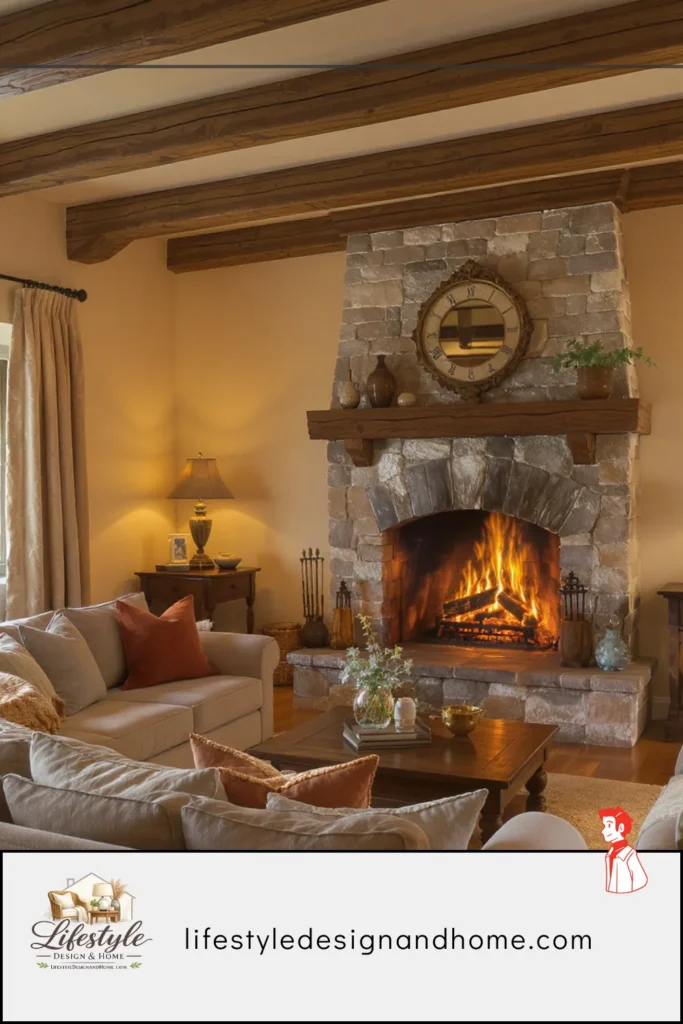
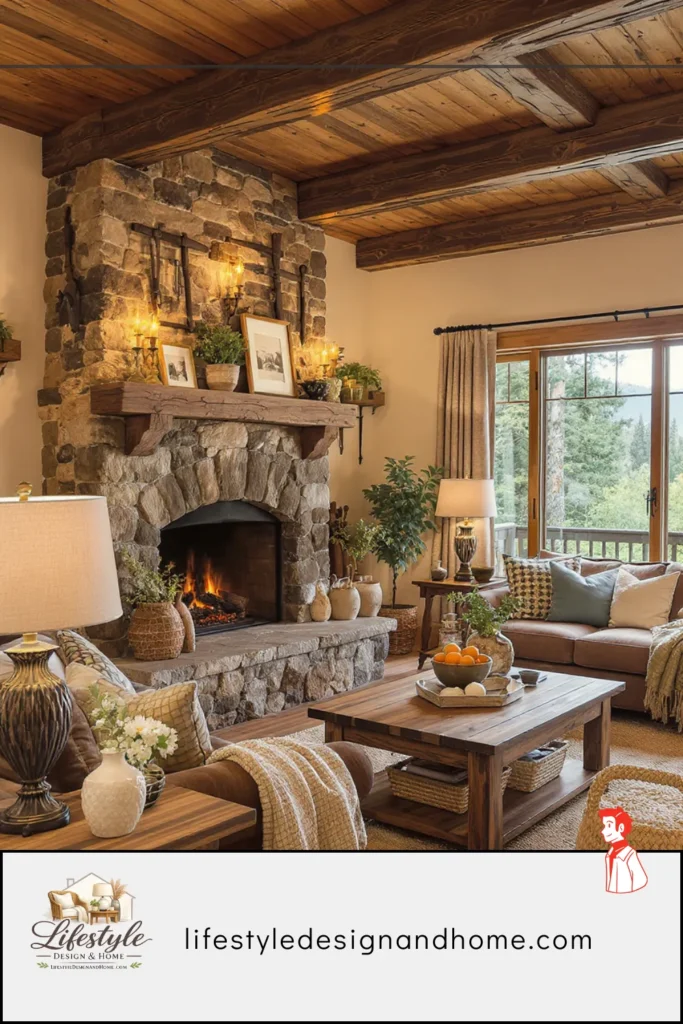
The room had exposed ceiling beams, dark and slightly rough, the kind that look like they were cut from actual trees rather than milled to perfect uniformity. The sofa was oversized and covered in worn leather that had clearly spent years being sat on. There was a stone fireplace on the far wall — not a decorative insert, a real one, with actual ash marks — and a thick wool rug in front of it that looked like it had been woven somewhere cold. The coffee table was a slice of tree trunk, sealed but not perfectly smooth, with the rings still visible. On the mantle: a few simple objects, a piece of driftwood, a clay pot, a candle that had been burning long enough to have dripped.
Nothing matched. Everything belonged.
I stood in the doorway for long enough that my friend asked if I was okay. I was fine. I was just experiencing something that happens rarely in designed spaces: the room felt like it had always been there. Like it had accumulated over decades rather than been assembled in an afternoon. Like the objects in it had histories.
That quality — the feeling of genuine accumulation, of a room that seems to have grown rather than been purchased — is what rustic design is actually trying to achieve. Not the distressed furniture and mason jar accessories that pass for rustic in furniture catalog photography. The real thing. The version that stops you mid-sentence.
This guide is about how to create that.
What Rustic Design Actually Is (And What It Keeps Pretending to Be)
Here’s the honest version of this conversation, because I think it needs to be had before we talk about anything practical.
Most of what gets labeled “rustic design” online and in retail stores is not rustic design. It is the visual vocabulary of rustic design — reclaimed wood textures, wrought iron hardware, mason jars, chalkboard paint, signs with inspirational phrases in distressed fonts — applied to mass-produced objects with no actual history, no actual material honesty, and no actual connection to the tradition they’re referencing.
I call this catalog rustic, and I’ve spent time in enough of these rooms to tell you exactly how they feel: like a theme park version of a farmhouse. Visually coherent in the way that a costume is coherent — all the right elements, none of the right quality. You recognize what it’s trying to be. You don’t feel what it’s trying to feel.
Real rustic design, the kind that stops you in a doorway, is built on different principles. It starts with material honesty — wood that genuinely has a history, stone that genuinely has texture, leather that genuinely has age. It embraces imperfection not as a decorative choice but as a consequence of using real materials. It accumulates rather than assembles — objects arrive in the room over time because they have meaning or usefulness, not because a stylist decided the coffee table needed three things on it at a 45-degree angle.
In my experience, the gap between catalog rustic and genuine rustic is not primarily a budget gap. I have seen genuine rustic rooms assembled almost entirely from antique markets, estate sales, and salvage yards for less money than a single room of retail rustic furniture. The difference is in the philosophy — in whether you’re buying the idea of a material or the material itself.
Everything in this guide is about the material itself.
The Foundation: Materials That Make It Real
Rustic design lives or dies on its materials. Get the materials right — genuinely right, not visually approximate — and the room begins to create its own atmosphere. Get them wrong, and no amount of styling will produce the feeling you’re after.
Wood — The Defining Material
Wood is to rustic design what marble is to classical design: the material that everything else responds to, the choice that sets the tone for every subsequent decision.
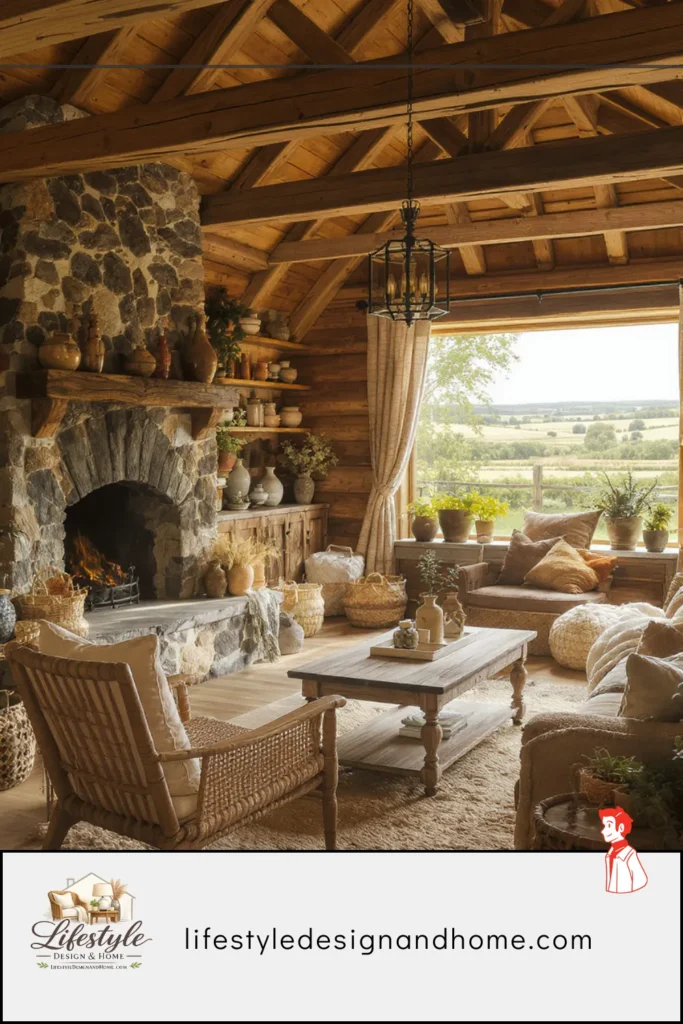
In genuine rustic interiors, wood is specific. It has a species, a grain, a history. It is not “brown wood” or “reclaimed-looking wood” — it is oak with open grain and a slightly silvered patina, or walnut with dark heartwood and light sapwood visible at the edges, or pine with knots and resin pockets that add character rather than being sanded away.
The characteristics to look for in rustic wood: visible grain — ideally open grain that you can feel as well as see. Natural color variation across the surface rather than uniform staining. Imperfections — knots, checks, small cracks, saw marks — that tell the story of how the material was processed and used. Weight — genuinely solid wood has a presence and gravity that veneer and engineered products can approximate visually but never quite match in person.
Reclaimed wood specifically is worth seeking. Barn boards, salvaged floor joists, timbers from demolished buildings — these materials carry actual history that changes how they read in a room. A coffee table built from floor joists salvaged from an 1890s warehouse is not just visually distinctive. It is materially specific in a way that the room feels even if the viewer doesn’t consciously know the provenance. Age changes how wood looks and how it feels and how it smells, and those changes are not reproducible.
I have a small side table made from what the maker told me was heart pine salvaged from a textile mill demolished in the 1980s. I cannot verify this. I also cannot replicate the specific quality of that wood — the density, the particular orange-amber color, the tight grain pattern of old-growth timber — in any new material. The table is the best piece of furniture I own, not because of its design (it is very simple) but because of what it is made of.
Stone — Presence and Weight
Stone in a rustic living room does something that no other material can do: it grounds the room. Literally. Stone is heavy, cold to the touch, permanent in a way that wood and fabric and ceramics are not. A stone fireplace or stone-faced wall communicates that the room has roots, that it sits on the earth rather than floating above it.
The fireplace is the most significant stone application in most rustic living rooms, and if you have one — real or decorative — it is the room’s anchor. Everything else organizes around it. In my opinion, a fireplace is to a rustic living room what a focal painting is to a formal one: the thing you design toward rather than around.
If you don’t have a fireplace, stone can still appear in smaller applications: a stone-topped coffee table, a slate tile hearth surround, a river rock collection displayed in a simple bowl, a stone vessel used as a vase. These are smaller gestures but they introduce the material and its specific weight and texture into the room.
What to avoid: stone veneer that looks like stone from across the room but is thin enough to see the drywall edge where it terminates. The reveal — the moment when you see the edge and understand the material is not what it appeared to be — breaks the spell that rustic design depends on. If real stone isn’t possible, the honest alternatives (poured concrete, textured plaster, genuine tile) are better than thin veneer pretending to be something it isn’t.
Leather — Age Is the Point
Leather in a rustic room should look like it has been lived in. New, perfect, unblemished leather is beautiful in a contemporary interior and wrong in a rustic one. The cracks, the darkening at the arms, the slight compression of a cushion that has been sat on thousands of times — these are not signs of wear, they are signs of value. The leather is telling you it has been somewhere.
I made the mistake in my first apartment of buying brand new leather furniture for a room I was trying to make feel rustic. The leather looked fine. The room looked like a new furniture showroom. The leather was too perfect, too uniform, too clearly without a past.
The sources I now recommend for rustic leather furniture: antique stores and estate sales, where well-made older pieces have acquired the patina that new leather takes years to develop. If buying new, look for full-grain leather with natural markings and color variation rather than top-grain or corrected-grain leather that has been sanded and coated to uniformity. Full-grain leather aged beautifully. Corrected leather just looks worn.
The Fireplace: Building the Room Around Its Anchor
I want to spend more time on the fireplace than most design guides do, because in a rustic living room it is not just a feature — it is the organizing principle. Every decision in the room should, in some sense, be a response to the fireplace.
The arrangement of seating around a fireplace follows a logic that is almost prehistoric: people gather facing the fire. The primary sofa faces it. Secondary seating — armchairs, a bench, floor cushions — angles toward it. The conversation area is defined by the fireplace as its fourth wall. This is not a design choice. It is how human beings have always organized themselves around heat and light, and rustic design simply acknowledges and accommodates that impulse.
The mantle is the fireplace’s gallery — the display surface that the room’s focal point offers up for considered arrangement. And considered arrangement, in a rustic room, means restraint. Not five objects symmetrically placed. Not a seasonal vignette with exactly the right mix of textures. Something more like: a few objects with genuine meaning, arranged with breathing room between them, that you would not remove because you would miss them.
On my friend’s mantle — the room that stopped me mid-sentence — there were five things: a piece of driftwood about 18 inches long, a clay pot with a slightly uneven rim, a candle that had been burning for a while, a small framed photograph turned slightly at an angle, and a rock that was clearly just a beautiful rock someone had picked up somewhere. Nothing matched. Everything had been chosen. The difference between that mantle and a catalog rustic mantle is that every object on it had a story, even if only the owner knew the story.
The fire itself, when lit, is the room’s primary light source — and in rustic rooms it should be treated that way. When the fire is burning, every electric light in the room should be dimmed or off. The fire should be what lights the room, and everything else should recede to let it. This requires having other light sources available for when the fire isn’t lit — floor lamps and table lamps at warm settings — but the fireplace evening, with all artificial light suppressed and only the fire and a few candles for illumination, is one of the best experiences a well-designed rustic living room offers.
The Six Essential Rustic Living Room Ideas
Idea 1: Exposed Beams — Real, Faux, or Forgotten
Ceiling beams are perhaps the single most iconic element of rustic living room design, and also the most complicated to advise on because the right answer depends entirely on your situation.
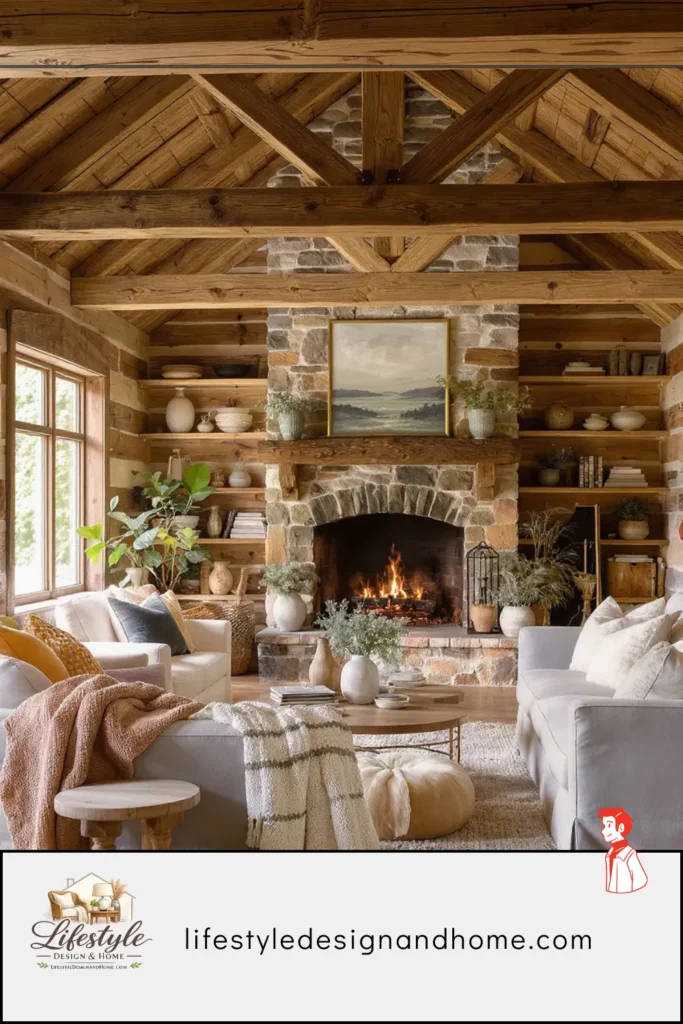
Real structural beams — exposed and left in their natural state or treated to enhance rather than conceal their character — are magnificent. If your home has them hidden behind drywall, investigating whether they can be exposed is worth a consultation with a contractor. The process varies from straightforward to complex depending on what’s been done to the ceiling, but the result is almost always worth it. Genuine structural beams carry the weight of the house, and that function gives them an authority that decorative elements can’t replicate.
Faux beams — hollow boxes, usually made of wood, installed to suggest beams that don’t exist — are a middle-ground option that I have complicated feelings about. Done well, with genuinely textured wood and appropriate scale and spacing, they can be convincing enough that the room reads correctly even though the beams are decorative. Done poorly — with smooth wood, uniform color, or spacing that doesn’t follow the logic of actual framing — they look like exactly what they are.
My honest opinion: if you cannot do real beams or genuinely convincing faux beams, don’t do beams at all. A rustic room without beams is still entirely achievable. A rustic room with obviously fake beams is a room where a design decision calls attention to its own inauthenticity, which works against everything rustic design is trying to do.
Idea 2: The Layered Textile Approach
Rustic living rooms are warmer than almost any other residential design aesthetic — not just in color temperature but in tactile warmth, in the literal comfort of materials that invite touch. This warmth comes primarily from textiles, and the layered textile approach is how you build it without the room feeling overwrought.
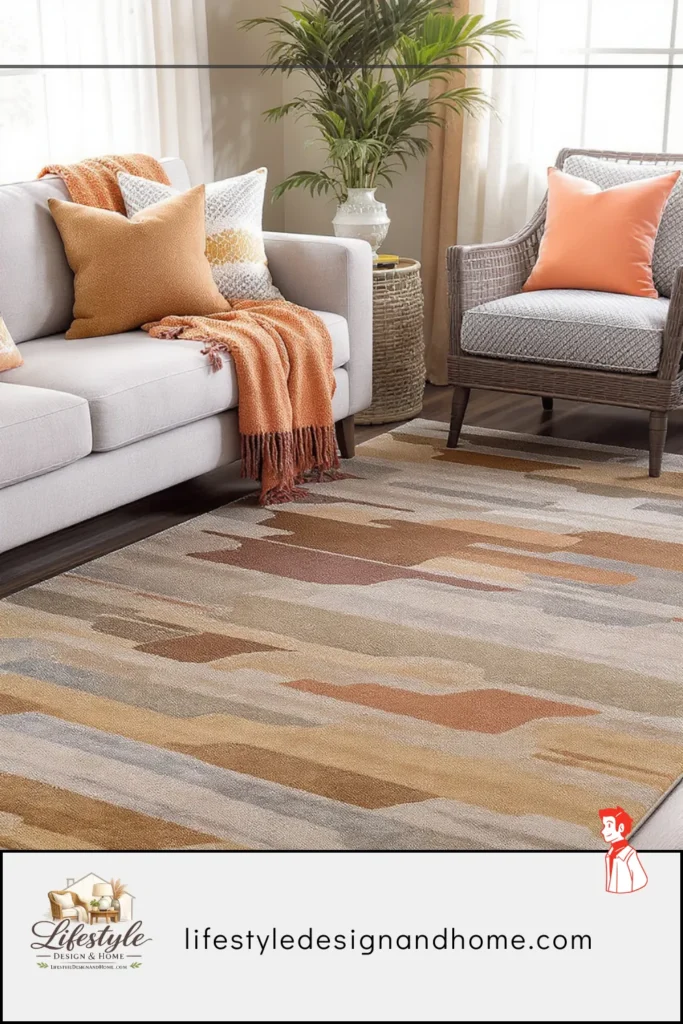
The layers work from the floor up:
The base layer: a large, substantial rug in natural fibers — wool, jute, sisal, or a combination. The rug should be large enough to anchor the seating arrangement completely (front legs of all seating pieces on the rug, ideally) and thick enough to have genuine presence underfoot. Thin, flat rugs in rustic rooms look like afterthoughts. The rug should be something you notice when you walk across it.
The sofa layer: cushions and throws that add visual and tactile warmth to the primary seating. Wool, chunky knit, worn cotton, vintage kilim fabric. In my experience, the most effective rustic sofa styling is slightly undone — cushions that have been rearranged by actual sitting, a throw that’s folded loosely rather than precisely. The tidy version looks staged. The slightly lived-in version looks like people actually sit there, which is what you’re trying to achieve.
The accent layer: a sheepskin draped over an armchair, a small woven blanket folded over the arm of a sofa, a textile wall hanging that adds warmth to a bare wall. These are the pieces that complete the texture story and prevent the room from reading as sparse even when the overall design is relatively restrained.
The color palette for rustic textiles: warm neutrals — oatmeal, cream, warm grey, the brown of aged wool — with occasional earthy accents in rust, sage, deep forest green, or faded navy. Colors that feel like they came from natural dyes and natural sources, because historically they did.
Idea 3: Collected Rather Than Matched
This is the principle that most clearly separates genuine rustic rooms from catalog rustic rooms, and it is also the hardest to execute deliberately because collecting takes time and patience that assembling does not.
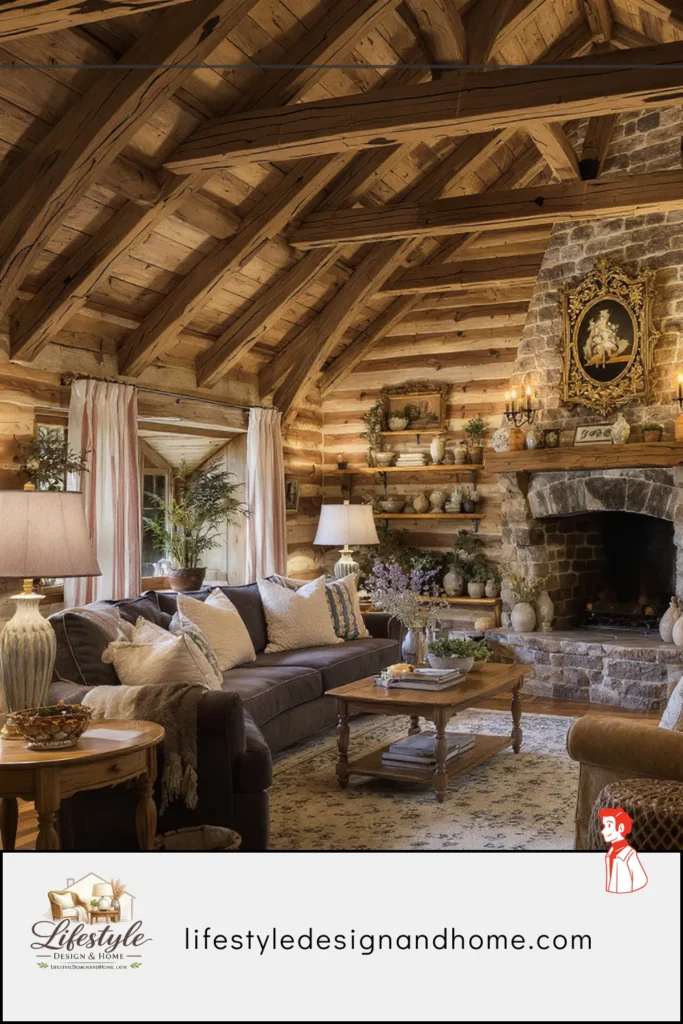
The objects in a rustic living room should look like they arrived over years from different sources. The coffee table came from an estate sale in a different decade than the lamp beside the sofa. The pottery on the shelf was made by three different potters at different points in the owner’s life. The blanket in the basket by the fireplace is from a trip someone took somewhere cold.
When every object in a room was purchased in the same six-month decorating push from the same three stores, the room looks assembled. The objects are all from the same moment in time — they share a stylistic era in a way that feels slightly artificial, like they were all chosen to look good together rather than accumulated because they were each genuinely wanted.
I realize collecting takes time that assembling does not, and that when you move into a new space, you don’t have years to fill it gradually. My practical recommendation: start with fewer, better things from varied sources. One excellent piece from an antique store is better than three matching pieces from a home goods retailer. Visit estate sales, farmers markets, salvage yards, and antique fairs. Buy things that have actual provenance — a story, a past, a reason they look the way they do — even if you learn that provenance only partially.
The room will look slightly sparse for a while. That’s fine. Genuinely fine. A sparse room that has potential is more pleasant to live in than a full room that feels false.
Idea 4: Warm, Layered Lighting
Rustic living rooms and bright overhead lighting are fundamentally incompatible. This is not an aesthetic preference — it is a consequence of what rustic design is trying to do. Overhead lighting makes the room flat, evenly lit, contemporary in a way that works against every material and texture choice the room has made. Turn on a single overhead light in a room with beautiful exposed beams and worn leather and a stone fireplace, and watch all three recede behind the flatness of uniform illumination.
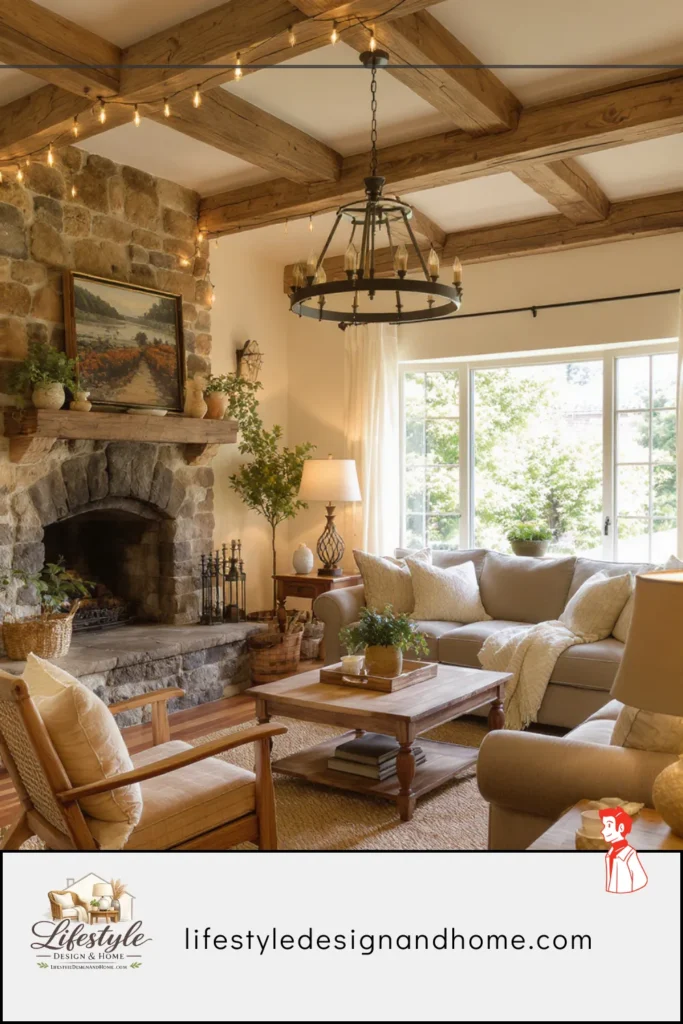
The lighting approach for rustic living rooms: multiple warm sources at floor and table level, overhead either off or very dimly supplemental, fire and candles where possible.
The must-haves: floor lamps with warm shades in the room’s corners, table lamps with ceramic or wooden bases in warm tones on side tables and console surfaces. All bulbs at 2700K. All of them on dimmers if possible.
The fire-and-candle layer: when the fireplace is lit, it is the room’s primary light source. Several candles elsewhere in the room — on the mantle, on the coffee table, on any surface where they can safely burn — extend the warmth of the fire-lit atmosphere to the parts of the room the fire doesn’t directly reach.
What the right lighting does: it makes the wood grain visible by raking light across the surface at an angle rather than washing it flat from above. It makes leather look richer and darker. It makes the fireplace the brightest point in the room when it’s lit rather than competing with overhead light for attention. And it creates the specific amber warmth that makes people feel they could stay in a room indefinitely.
I once spent an entire evening in my friend’s rustic living room — the one that stopped me mid-sentence — without noticing until I left that I’d been there for four hours. The room had done its job completely: made staying feel like the obvious, comfortable, natural choice.
Idea 5: The Gallery of Honest Objects
The surfaces in a rustic living room — the mantle, the coffee table, the shelves, the console behind the sofa — should hold objects that are genuinely interesting rather than decoratively appropriate.
The difference: decoratively appropriate objects are chosen because they look right. Interesting objects are chosen because they are something, because they have a material story, a functional history, or a personal significance that makes them worth having ,regardless of how they photograph.
Interesting objects for rustic surfaces: found natural objects — driftwood, smooth river stones, seed pods, dried botanicals that have changed with the seasons and look more interesting for having done so. Handmade ceramics with the evidence of making visible — uneven rims, glaze variations, and the occasional mark from the kiln. Tools or implements with past lives as functional objects — an old wooden bowl that was actually used to mix dough, a hand-forged iron hook repurposed as a sculpture, a cast-iron vessel that spent decades in a kitchen.
What to avoid: the rustic accessory kit — the mason jar vases, the buffalo check ribbon, the “gather” sign, the lanterns that have never held candles. These are objects that look rustic without being anything. They exist purely as decoration and the room feels it. In a design aesthetic built on material honesty, objects that are purely decorative — that exist only to look like something — are the most incongruous things possible.
Idea 6: Mixing Periods and Provenance
The rustic living room that feels most genuine is usually the one with the most diverse timeline of objects. Pieces from different eras that share a material vocabulary — wood, leather, iron, stone, wool — rather than a stylistic period.
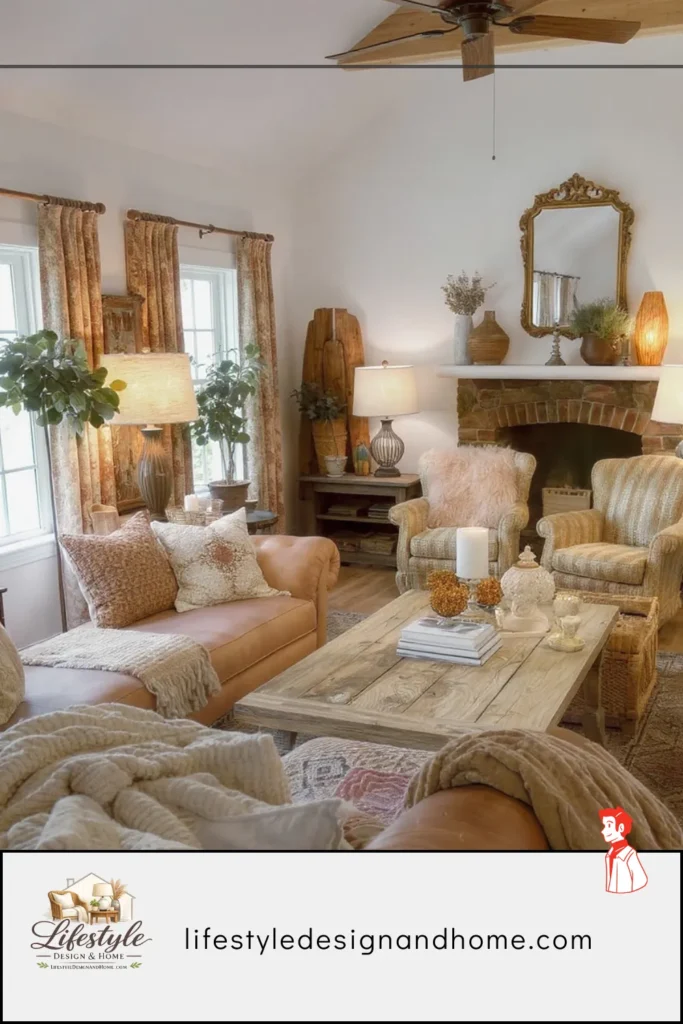
A mid-century wooden chair that belongs in a different design era altogether can feel completely at home in a rustic room if it is made of the right materials and has the right kind of wear. A Victorian-era iron candlestick can sit beside a contemporary ceramic lamp and make both look better for the contrast. An antique textile hung on the wall beside a very simple modern shelf creates a dialogue between periods that feels genuinely collected rather than theme-decorated.
The principle I use: rustic design is a material aesthetic, not a period aesthetic. If it is made of natural materials, uses honest construction, and has accumulated some quality of time — either actual age or genuine use — it probably belongs.
The Room Layout Considerations for Rustic Living Rooms
The furniture arrangement in a rustic living room follows different logic than a contemporary one, and getting it right matters for the same reason that getting the materials right matters: it determines whether the room feels like a place you want to be in for hours or a place you sit in for twenty minutes and feel slightly restless.
Orient everything toward the fireplace. If there is a fireplace, it is the room’s reason for existing. The sofa faces it. The armchairs angle toward it. The coffee table sits between the seating and the fire. The arrangement should communicate that gathering around the fire is the room’s primary purpose, and everything else is secondary.
Make the seating generous. Rustic rooms should feel like rooms where people settle in — where the seating is substantial and comfortable enough that leaving requires a decision rather than just a movement. Oversized sofas. Deep armchairs. A bench pulled up to the fire. Floor cushions for overflow. The room should comfortably hold more people than it typically does, and the excess seating capacity should feel like hospitality rather than over-furnishing.
Leave the floor visible. For all the layering and textile work and collected objects, the floor of a rustic living room should be substantially visible. Wide-plank wood floors with a large rug in the seating area, or stone floors with textile layering that reveals the stone at the edges — the floor is itself a material feature that contributes to the room’s character. Cover it entirely and you lose one of the room’s most important material notes.
Allow for negative space around significant objects. The stone fireplace needs air around it. The wooden coffee table needs visible floor between its legs and the rug beneath. The collected objects on the mantle need breathing room between them. Rustic design, for all its warmth and layering, is not maximalism. The objects should feel curated even when they look collected.
The Three Rustic Living Room Mistakes I’ve Made and Watched Others Make
Buying everything new. I spent money I didn’t really have on a leather sofa from a furniture retailer that was labeled “vintage-inspired” and looked like exactly what it was: a new sofa inspired by vintage sofas, which is completely different from an actual vintage sofa. The leather was perfect. The design was correct. The room never felt right, and I eventually understood why: the sofa had no past. It was new furniture pretending to be old furniture, and the room felt the difference even when I couldn’t name it. If I had spent the same money at an auction, I would have bought something with thirty years of actual leather aging that would have transformed the room.
Over-accessorizing with thematic objects. There was a period — I am embarrassed about this in retrospect — when my rustic living room had a “gather” sign, a set of mason jar candle holders, a wooden crate used as a side table, and a chalkboard with something written on it in careful cursive. The room looked like a theme restaurant. Every object was rustic-adjacent rather than rustic. Replacing all of them with a single piece of driftwood from a beach I’d visited and a handmade pot from a local ceramicist made the room look better immediately and feel more honest.
Neglecting the lighting. The overhead-only mistake I described in the lighting section above, but worth naming specifically in the context of rustic design, because the gap between a rustic room lit correctly and a rustic room lit with overhead fluorescent is enormous. I once visited a genuinely beautiful rustic living room in the middle of the day with all the lights off, and was struck by how good it was. The same room in the evening with the overhead on looked completely ordinary. The materials were identical. The light changed everything.
The Room That Accumulates
I asked my friend, eventually, how long the living room had taken to come together. I was expecting a decorating timeline — a season, a year, maybe two.
She thought about it for a moment. “The sofa I’ve had for maybe twelve years,” she said. “The rug I found at an estate sale about eight years ago. The coffee table my father made from a tree that fell in the backyard of the house I grew up in. The fireplace was here when I moved in twenty years ago.”
Twenty years. The room had taken twenty years.
I don’t tell this story to discourage anyone — a rustic living room does not require two decades to build. But it explains something about why that room stopped me mid-sentence and why catalog rustic rooms never quite do. The room had a timeline. The objects had relationships to each other that went beyond visual compatibility. The sofa and the rug had been in the same room for eight years, which is long enough that they look like they chose each other.
That quality of time is what rustic design is reaching for. You can approximate it in a weekend if you shop in the right places and make the right choices. You can come close by choosing materials that genuinely age rather than materials that look aged. You can get closer by resisting the thematic accessories and the matching sets and the new leather that hasn’t been anywhere yet.
And sometimes, if you’re patient and you keep acquiring things that are genuinely interesting rather than decoratively appropriate, the room starts to develop its own timeline. Objects arrive. Things get moved around. Something gets replaced and something else stays for another decade. The room accumulates.
That’s the version that stops people mid-sentence.gn, the mason jar candle holders, the chalkboard with careful cursive. These are specific enough to be real memories and specific enough to be funny in retrospect, which is a human tone AI doesn’t naturally produce.