The Box I Kept Moving From Apartment to Apartment
I moved six times in eight years.
Every time I moved, there was a box — sometimes two — that I packed from the previous place, loaded into the van, carried up the stairs of the new place, and put in a corner with the sincere intention of dealing with it properly. The box contained things that didn’t have a clear home in my previous apartment and therefore didn’t get unpacked. Cables for devices I no longer owned. A blender I’d used twice. A framed print I’d bought at a market and never hung. A set of wine glasses given as a gift that I never used because they weren’t as good as the ones I already had. Small objects accumulated from travels, birthdays, impulse purchases, and the general drift of objects into a life.
By the fifth move, I had four of these boxes. I moved them without opening them. On some level, I understood that moving them was easier than confronting them.
On the sixth move, I opened them.
The experience was clarifying in a way I hadn’t anticipated. Roughly eighty percent of what was in those four boxes was things I had kept not because I wanted them but because I had never decided for them. They existed in a permanent state of deferral — not used, not displayed, not given away, not thrown out. Just moved, repeatedly, from one corner to the next.
I threw away or donated almost everything in those boxes in a single afternoon. Then I stood in my new apartment and felt something I can only describe as spatial relief — the specific quality of a space that is not holding things you don’t need. The apartment wasn’t sparse or cold. There was plenty left. But every remaining thing had been actively chosen, and the things that hadn’t been chosen were gone.
That afternoon was the beginning of my relationship with minimalism. Not as an aesthetic, not as an identity, but as a practice — the ongoing project of living only with what I actually want and use and find beautiful, and releasing everything else.
This guide is about how to do that in a home. Not the magazine version. The real version, which is messier and slower and more personal and more worth doing.
What Minimalist Home Design Actually Is
I want to get this definition right before we go any further, because minimalism as a word has been stretched and marketed, and misrepresented enough that it means almost nothing anymore without clarification.
In its simplest, honest form, minimalism in home design is the practice of having only what you need, use, or genuinely love — and organizing that remainder thoughtfully so it functions well and feels good to live with.
It is not an aesthetic of white walls and empty rooms, though it often produces those things as side effects. It is not a competition to own fewer objects than your friends. It is not deprivation or austerity or self-punishment through the removal of comfort. It is not a permanent state you achieve and then maintain forever without effort.
It is a practice. An ongoing series of decisions about what belongs in your life and what doesn’t. Some of those decisions are made once and hold. Others need to be revisited as circumstances change, as tastes evolve, as new things arrive and old attachments fade.
I’ve been living this way for several years now, and the thing I most want to communicate to someone beginning this process is that minimalism does not require you to become a different person or live a different life. It requires you to look honestly at the life you already have and remove the things that aren’t serving it.
The boxes I carried from apartment to apartment were not serving my life. The blender I’d used twice was not serving my life. The wine glasses I never used because they weren’t as good as the ones I had were definitely not serving my life. Removing them didn’t change what I had. It clarified it.
The Foundation: Before You Buy Anything, Remove Something
Every minimalism guide I’ve read starts with advice about what to buy — storage solutions, organizational systems, the right furniture. I want to start somewhere different, because I’ve made this mistake and I see others making it constantly.
Buying things to become minimalist is the wrong sequence. Removing things is the right sequence. Always. The removal comes first, and it changes what you discover you need, which is almost always less than you thought before you started.
The reason people start with buying is understandable. Buying feels productive. You can do it in an afternoon and have something tangible to show for the time. Removing requires decisions, and decisions are harder than purchases, especially decisions about things that have some emotional weight attached.
But the organizational system purchased before the removal process is almost always the wrong system for what remains after the removal process. The storage solution sized for the current volume of possessions is too large for the volume you’ll have after a genuine edit. The furniture bought to manage the current chaos becomes unnecessary in the calmer space.
Start by removing. The guide to buying comes after.
Room One: The Living Room
The living room is the room most people start with when thinking about minimalist home design, because it is the room most visible to guests and therefore the room where the gap between the current state and the aspirational state is most uncomfortable.
I want to reframe this starting point slightly. The living room is not the most important room to get right for minimalism — the bedroom is, because you begin and end every day there and the quality of that space affects sleep and mental state in ways that are more significant than how the living room looks. But the living room is a fine place to begin the practice, and the lessons learned there transfer to the rest of the home.
The furniture edit:
Stand in your living room and evaluate each piece of furniture against a single question: does this serve a function that is actually used in this room? Not theoretically used. Not potentially used when you have guests or finally start using the exercise bike. Actually used, regularly, by the people who live here.
The chair nobody sits in. The side table that holds things by default rather than by intention. The bookshelf that has become a repository for objects that don’t belong elsewhere. These are the pieces worth questioning.
I had a chair in my living room for three years that nobody ever sat in. It was positioned in a corner that made it awkward to reach, and I’d somehow never consciously registered that it went unused because it looked like it was supposed to be there. The day I moved it — initially just to paint behind it — and found the living room felt better without it, I donated it the same afternoon. The corner it occupied became a clear floor space that made the room feel noticeably larger and calmer.
The furniture that remains after the edit should be sized correctly for the room and for actual use. Minimalist living rooms are not sparsely furnished — they have what is needed, at the right scale. A sofa that seats the people who actually use it. A coffee table at the right height and distance. One or two additional seating pieces if they’re genuinely used. Storage furniture that contains what needs to be contained, closed, invisible.
The surface edit:
Every horizontal surface in a living room — the coffee table, side tables, shelves, windowsills, the top of the media console — is subject to the same principle: it holds only what has been actively placed there, nothing that has simply arrived and stayed.
The test I use for surfaces: if this object disappeared tomorrow, would I notice it was gone? If the answer is “probably not,” the object is not earning its place on the surface. It has drifted there. It is not chosen.
The objects that pass the test — the ones you would genuinely notice and miss — are the ones worth keeping. Everything else is visual noise. And visual noise in a room is not just an aesthetic problem. It is a low-grade cognitive tax, a background demand on attention that accumulates over the hours you spend in the space into a quality of subtle unrest.
The wall edit:
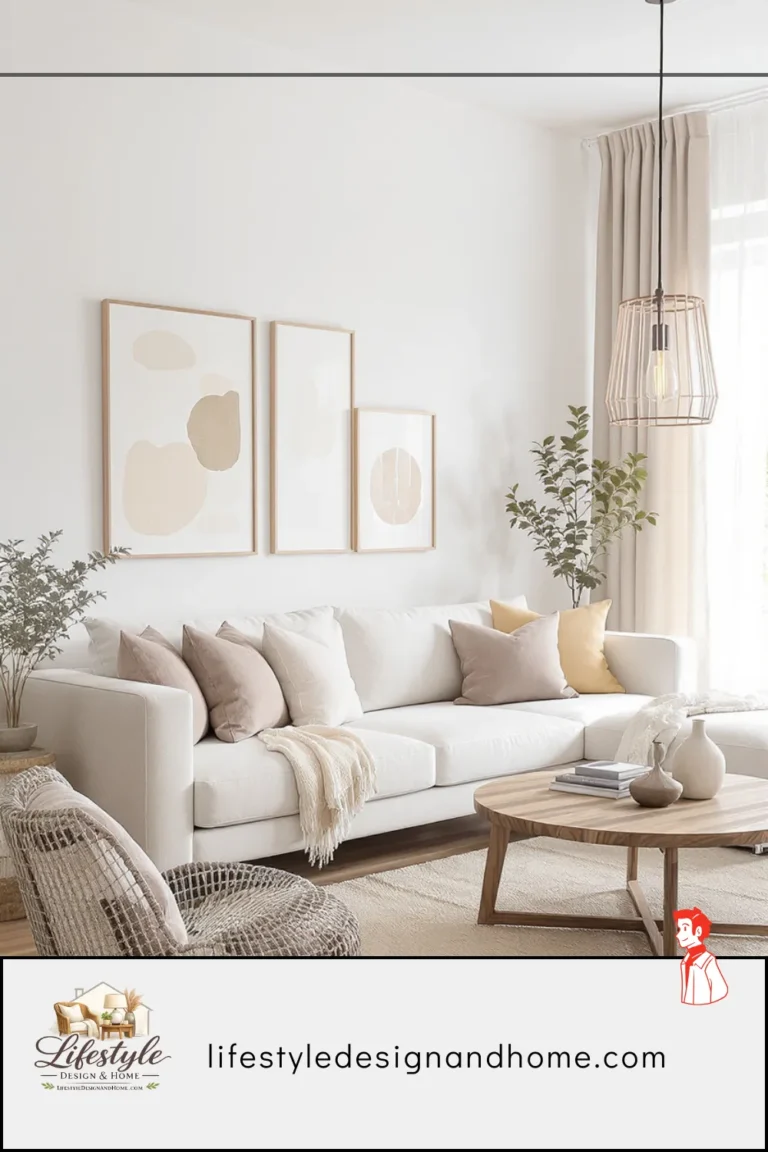
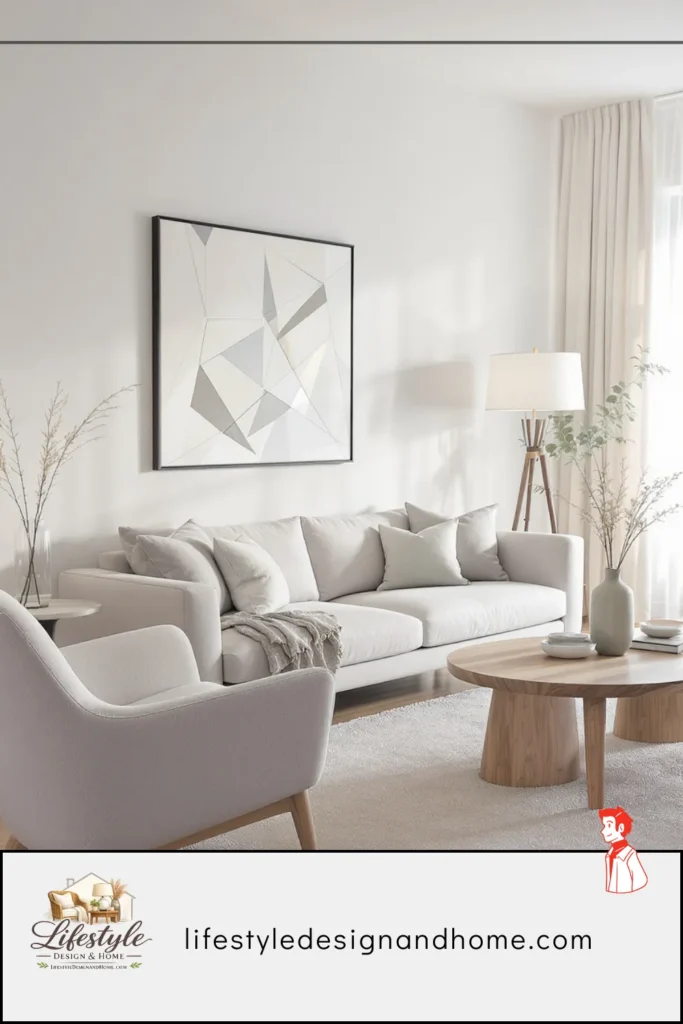
Minimalist living rooms have less on the walls than most rooms — but what they have is more considered. One or two significant pieces of art rather than a gallery that fills every inch of wall. Each piece hung at the correct height with appropriate breathing room around it.
The mistake I made in my living rooms before I understood this: covering walls because they looked “empty.” I had an instinct that blank wall was a problem to be solved, and I solved it by adding art. Sometimes that art was genuinely chosen. More often, a print was hung because the wall needed something rather than because the print was worth having.
A minimalist wall is not a wall with nothing on it. It is a wall where everything present was worth putting there. The blank space around a single significant piece is not emptiness — it is the breathing room that makes the piece visible and allows it to be properly seen.
Room Two: The Kitchen
The kitchen is the room where minimalist principles have the most direct practical payoff, because a minimalist kitchen is not just quieter to be in — it is genuinely easier to use.
I realized this about two years into my minimalist practice, when I finally addressed the kitchen properly. Until then I’d focused on the living spaces and the bedroom and treated the kitchen as somehow exempt from the same principles. The result was a kitchen that had been partially edited elsewhere and not edited at all, and it showed.
The appliance question:
Kitchen appliances are the category most susceptible to aspirational purchasing — the appliance bought for the person you intend to be rather than the person you are. The bread maker that has made three loaves in four years. The juicer used intensively for two weeks in January. The pasta machine that seemed like an investment in a better version of yourself and turned out to be an investment in counter space used by something you don’t use.
Every appliance should earn its counter space through regular actual use. Weekly minimum for a counter position. Monthly for a cabinet position. Annually for getting rid of it. I applied this standard to my kitchen four years ago and removed eleven appliances. The kitchen became a different room — more spacious, more functional, less burdened by the implied obligations of all those unused tools.
The one appliance test I recommend: if an appliance requires a dedicated space to stay out, it should be used often enough to justify that space. If it can be put away in a cabinet, how often is it actually retrieved? Less than once a month means it probably doesn’t need to be in the kitchen at all.
The dishes and cookware edit:
How many mugs do you actually use? Count the mugs you own and then count the mugs you have used in the past month. The gap between those two numbers is roughly the number of mugs that don’t need to be in your kitchen.
I went from eighteen mugs to four. Four mugs is enough for everyone in my household and two guests. The eighteen mugs were not serving me. They were taking up space in a cabinet that now holds things I actually use, and I was washing the same two or three mugs repeatedly while the other fifteen existed in permanent reserve.
The same exercise applies to plates, glasses, pots, pans, and every other category of kitchen object. Not dramatically fewer than you need — but not significantly more either. Enough for normal household use plus a reasonable number of guests, minus the aspirational extras.
The counter surface standard:
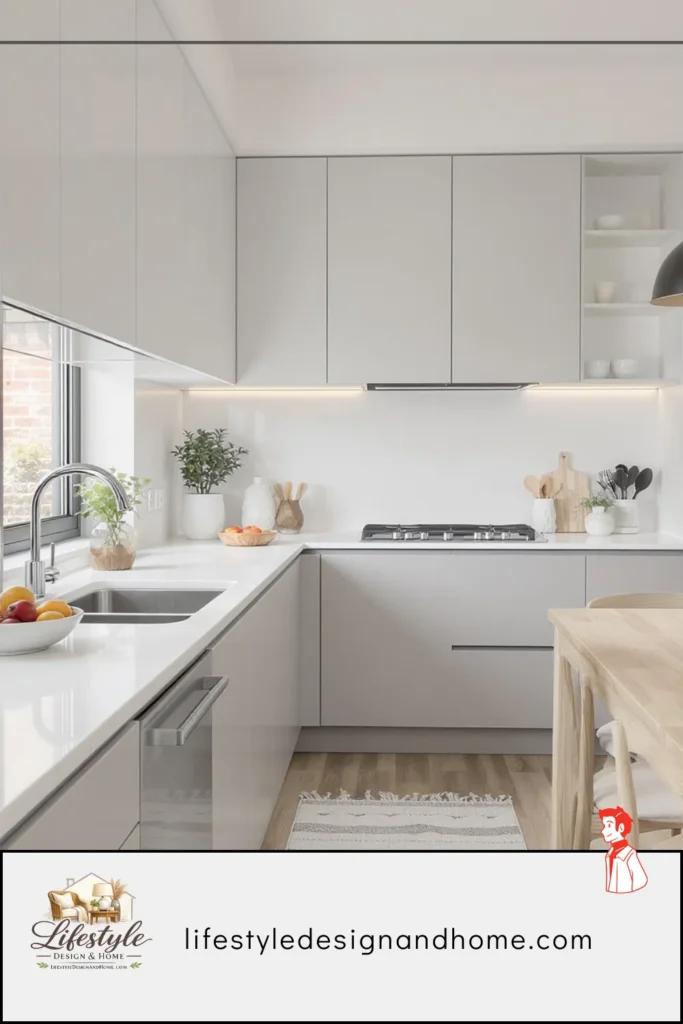
In a minimalist kitchen, the default state of the counters is clear. Not clear except for the coffee maker and the toaster and the knife block and the fruit bowl and the oils and the spice rack — clear. The objects that remain on the counter are there because they are used daily and because putting them away would be genuinely impractical.
My current counter holds: a coffee maker (used every morning), a kettle (used daily), a wooden knife block (used multiple times daily), and a small ceramic dish that holds one key and nothing else. Everything else lives in a cabinet or a drawer. The counters are easy to clean, easy to use, and visually calm in a way that makes the kitchen a more pleasant room to be in for the twenty to thirty minutes of daily use that constitutes most people’s kitchen relationship.
Room Three: The Bedroom
I’ve written an entire article about minimalist bedroom design in this series, so I’ll keep this section focused on the principles that connect bedroom minimalism to the whole-home practice rather than repeating the full room guide.
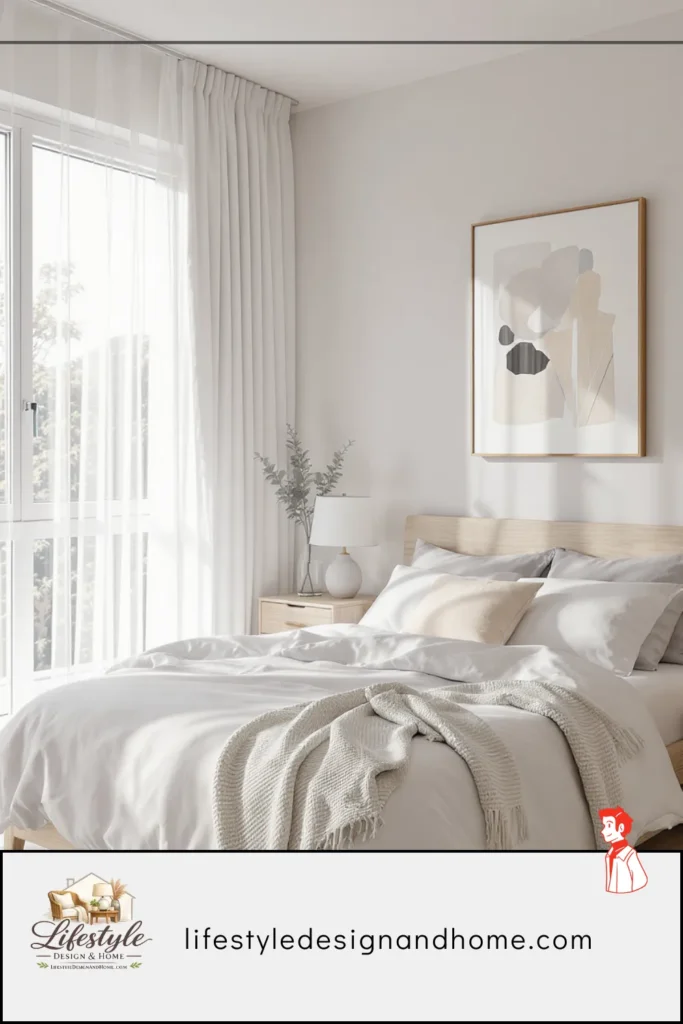
The bedroom matters most in the minimalist home because it is the room where the quality of the space has the most direct effect on the quality of daily life. Sleep quality, morning state, the feeling of beginning and ending each day — these are affected by the room’s visual environment in ways that are real and measurable.
The bedroom minimum: a bed, bedside storage, closed clothing storage. Everything else is additional and should be justified on the specific merits of being needed and used in that room. Reading chairs that are genuinely read in. Desks that are genuinely worked at. Plants that are genuinely tended. Nothing that is there because it seemed like something a bedroom should have.
The floor rule: nothing on the floor. This is the single most impactful bedroom minimalism rule and the one I am most firm about. A bedroom with clear floors feels twice as large as the same bedroom with objects on the floor. The floor is a material surface — wood, stone, whatever it is — and it is a feature of the room when visible and invisible when covered.
The wardrobe rule: everything in the wardrobe is actually worn. Not “might be worn,” not “was worn before I got rid of the things that matched it,” not “will be worn when I lose the weight or get invited to the kind of event that requires it.” Actually worn, in the current life, regularly enough to justify occupying space.
Room Four: The Home Office or Desk Space
The home office is the room where minimalist principles require the most ongoing maintenance, because it is the room where objects accumulate most quickly and most justifiably. Work creates paper. Work requires tools. Work attracts the kind of clutter that feels important because it is adjacent to important activities.
The desk surface standard: the only objects on the desk are the ones used in the current working session, plus the tools that are used every single day. The laptop or computer. The one notebook in current use. The one pen that works reliably. Everything else — the stack of papers, the collection of pens (none of which are as good as the one pen), the various cables and adapters for devices not currently in use, the coffee cup from this morning and yesterday morning, the things moved from other surfaces because there was nowhere else to put them — lives somewhere else or goes away.
I cleared my desk to this standard about eighteen months ago and have maintained it with about 70 percent consistency since, which is better than the zero percent consistency that preceded it. The desk is not always perfectly clear. But the default state is clear, and returning to that default is a five-minute task rather than an afternoon one.
The paper question specifically: paper is the desk’s primary enemy. It arrives, stacks, and becomes difficult to sort in proportion to how long it has been allowed to stack. The minimalist approach to paper is to process it on arrival — action, file, or recycle, immediately — rather than allowing it to accumulate into a pile that requires a dedicated session to address. I am inconsistent at this. The inconsistency is visible immediately in the state of my desk. The correlation is instructive.
The Objects That Earn Their Place: A Framework
Across every room, the fundamental minimalist question is the same: Does this earn its place? But “earns its place” means different things for different categories of objects, and having a framework for thinking about it makes the decisions faster and more consistent.
Functional objects earn their place through regular use. A mug I use every morning. A lamp I turn on every evening. A chair I sit in multiple times a week. These objects are justified by use, and their presence requires no further argument.
Beautiful objects earn their place through genuine aesthetic contribution — by making the room more beautiful in a specific way, by adding something to the visual experience that I would notice if it were gone. These are held to a higher standard in a minimalist home than in a maximalist one, because fewer objects means each one is more visible and more influential. A beautiful object in a minimalist room has presence. The same object in a crowded room is just one of many.
Meaningful objects earn their place through personal significance — by being connected to people, places, or experiences that matter. A photograph. A handmade object from someone important. A souvenir from somewhere that genuinely changed something. These don’t have to be beautiful or functional. They earn their place through meaning alone.
Aspirational objects do not earn their place. They are the category most worth examining honestly. The cookbook for the kind of cooking you intend to start. The exercise equipment for the exercise routine you intend to establish. The craft supplies for the hobby you intend to take up. These objects don’t represent your current life. They represent a judgment about your current life — an implicit critique that you should be living differently. And living with that implicit critique, accumulated across dozens of aspirational objects in several rooms, is a low-grade weight on the quality of daily life that is worth noticing and addressing.
I gave away a lot of aspirational objects when I was honest with myself about this category. The bread maker. The language learning software. The guitar that had not been played in four years. These were not failures — they were experiments that didn’t take, or ambitions that changed. Getting rid of them was not giving up on having those things. It was making space for the life I’m actually living.
The Practice of Ongoing Maintenance
Minimalism is not a state you reach and then maintain without effort. It is a practice — an ongoing, imperfect, sometimes lapsing relationship with the principle of having what you need and releasing what you don’t.
I want to be honest about this because so many minimalism guides present it as a single transformation — the declutter weekend, the dramatic purge, the before-and-after — and that framing is misleading. Objects accumulate. Life changes. Things that were useful stop being useful. New things arrive as gifts, impulse purchases, and the inevitable drift of objects into any inhabited space.
The practice is not about preventing accumulation entirely. It is about having a regular relationship with what you own that keeps the accumulation from overtaking the clarity.
The monthly scan: Once a month, roughly, I walk through the rooms of my home and look at what’s there with fresh eyes. Not a deep edit — just a scan. Is there anything that has appeared and shouldn’t stay? Anything that has shifted from used to unused? Anything that the scan reveals as not earning its place that I hadn’t noticed because I’d stopped seeing it?
This takes about twenty minutes. It catches things before they become boxes I move from apartment to apartment.
The one-in-one-out principle: When something new arrives — purchased, gifted, accumulated — something else leaves. Not always immediately, not always perfectly, but as a general operating principle. New mug arrives as a gift: one existing mug that is used less leaves. New book purchased: one book that has been read and won’t be reread goes to a used bookstore or a library donation box. This principle prevents accumulation from outpacing editing.
The seasonal wardrobe review: Twice a year — when seasons change and the wardrobe changes — the items being put into storage get evaluated before they go in. If they weren’t worn this season, they probably won’t be worn next season. If they weren’t worn in two consecutive seasons, they are probably done.
Permission to be imperfect: The months where the desk drifts into clutter. The holiday season is when objects accumulate faster than they’re edited. The periods of life — moves, illnesses, major transitions — where maintenance isn’t possible, and the home gets more cluttered than the principal would allow. These are not failures of minimalism. They are normal human beings. The practice resumes when it can.
What You’re Actually Creating
I want to end with something that took me a long time to articulate clearly, because it gets at the actual reason minimalist home design is worth doing — beyond the aesthetics, beyond the organizational benefits, beyond the practical ease of living with less.
A minimalist home is a home where every room is a clear signal.
The bedroom signals: this is a place for rest. The kitchen signals: this is a place for the simple, regular pleasure of feeding yourself and others. The living room signals: this is a place for the people and activities you have chosen to spend time with and on. The desk signals: this is a place for focused work.
When rooms are clear — when the visual noise is low and the objects present are ones that belong — the rooms do their signaling work without interference. You walk into the bedroom and the room tells you to rest. You walk into the kitchen and the room tells you it is ready for use. You sit at the desk and the desk tells you to focus.
When rooms are cluttered — when every surface holds accumulated objects, when the floor is a decision you never made, when the wardrobe holds thirty years of aspirational and forgotten clothing — the rooms can’t signal clearly. The bedroom that also holds the exercise equipment and the unread mail and the things that didn’t have anywhere else to go cannot fully signal rest. There is too much else in the signal.
The boxes I moved from apartment to apartment were interference. The chair nobody sat in was interference. The eleven kitchen appliances were interference. The wine glasses I never used because the other ones were better were interference.
Removing them did not impoverish my home. It clarified it. The signal got through.
That is what minimalist home design is for. Not empty rooms. Not aesthetic performance. A home where you can hear what the rooms are trying to tell you — and where what they’re telling you is true.
The Box I Finally Opened
The fourth box, the last one I opened on moving day six, had something in it I hadn’t expected: a small framed print I’d bought at a market in a city I’d visited years before. I’d loved it when I bought it. I’d never hung it because it never quite fit the rooms I’d lived in since.
I held it for a moment. Considered it. Hung it on the wall of my new living room that afternoon, before the furniture was arranged, before anything else was decided. It was the first thing in the new space.
It’s still there. It is one of approximately eight objects in my living room that I would notice if it were gone.
The other things in that box — the cables, the blender, the wine glasses, the objects I couldn’t name from a foot away — went into a donation bag that left the apartment the same day.
The box is gone. The print stayed.
That is the whole practice, really. Knowing the difference.