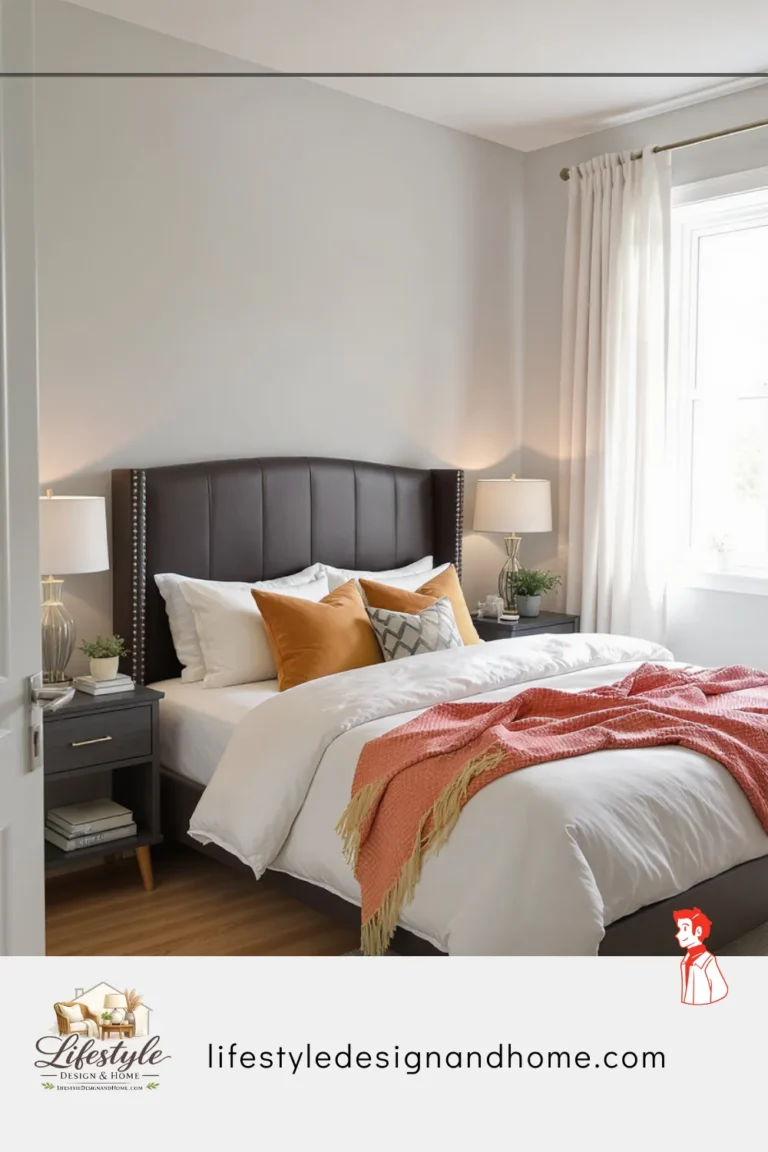
The Bedroom That Made Me Feel Claustrophobic Until I Understood Why
My smallest bedroom was 8 by 10 feet.
I know there are smaller. I have heard from people who have slept in rooms that were essentially closets with beds in them, and I respect their resilience. But 8 by 10 felt, to me, like a room that had been designed by someone who understood the concept of a bedroom but had never actually slept in one. The door opened inward and the swing arc consumed roughly a quarter of the usable floor space. The single window was positioned on the wall adjacent to where the bed had to go, which meant I could either have the window above me or beside me but never actually in my sightline. The ceiling was eight feet, which is fine in theory and felt lower than that because the room was narrow enough that the height-to-width ratio was wrong. The closet had a sliding door that required standing directly in front of it to open, which was also where you had to stand to get dressed, which was also roughly where the bed was.

I am describing this room in detail because I want you to understand: it was a genuinely difficult room. Not a small-but-charming room. Not a compact-but-cozy room. A room with real problems.
I lived in it for fourteen months. In the first two months I felt the ceiling every morning when I woke up — not literally, but in the way that a room too small for its contents presses on you. I felt like the room was the wrong shape for human habitation. I felt, some mornings, mildly claustrophobic in a space I was supposed to find restful.
Then I spent a weekend actually solving it.
Not renovating. Not buying new furniture. Understanding the specific reasons the room felt wrong — which were different from what I initially assumed — and addressing each of them with changes that cost, in total, less than $200 and took about two days to implement.
By the third morning after those two days, I woke up in the same 8-by-10-foot room and it felt different. Not large. Not spacious in any literal sense. But room-sized in a way it hadn’t been before. Like a room that knew what it was and had made peace with its dimensions rather than apologizing for them.
This guide is what I did and why it worked — applied to small bedrooms generally, not just mine.
The Problem Is Almost Never What You Think It Is
This is the thing I most want to say before we get to the practical changes, because getting this right changes how you approach everything else.
When a small bedroom feels cramped, the instinct is to blame the square footage. The room feels small because it is small. The solution is more square footage, which you don’t have, so the problem is unsolvable. This is the conclusion most people reach, and it is wrong.
Small bedrooms feel cramped for specific, identifiable reasons that almost always have nothing to do with the actual square footage. They feel cramped because:
The furniture is the wrong scale for the room. Not necessarily too large — sometimes too many pieces, or pieces at the wrong height.
The floor is covered in objects, which makes the room read as smaller than it is because visible floor space is what the brain uses to estimate room size.
The light is wrong — too uniform, too cool, too overhead-dependent — and wrong light reveals every boundary with equal clarity, making the room readable at its exact dimensions rather than at the slightly-generous impression that good lighting creates.
The color is wrong — too dark, or too many competing colors, or the specific cool grey that was fashionable for a decade and makes small rooms feel like holding cells.
The vertical plane is unused — everything in the room is at one height, nothing is drawing the eye upward, and the room therefore reads as wide and low rather than as proportioned and complete.
The storage is visible — open shelving, floor clutter, the chair that has become a second wardrobe — creating visual noise that the brain interprets as spatial chaos and spatial chaos as cramped.
These are all fixable. None of them require more square footage. All of them require understanding which specific problem is making your specific room feel the way it feels, and addressing that problem directly.
The most common mistake I see: applying solutions generically rather than diagnostically. A person whose bedroom feels cramped because the furniture is the wrong scale buys mirrors. The mirrors help slightly but don’t solve the core problem, and the room still feels slightly off, and the person concludes that nothing works for small bedrooms. Nothing works because they fixed the wrong thing.
Identify your room’s specific problem first. Then fix that.
Problem One: The Room Reads as Flat and Low
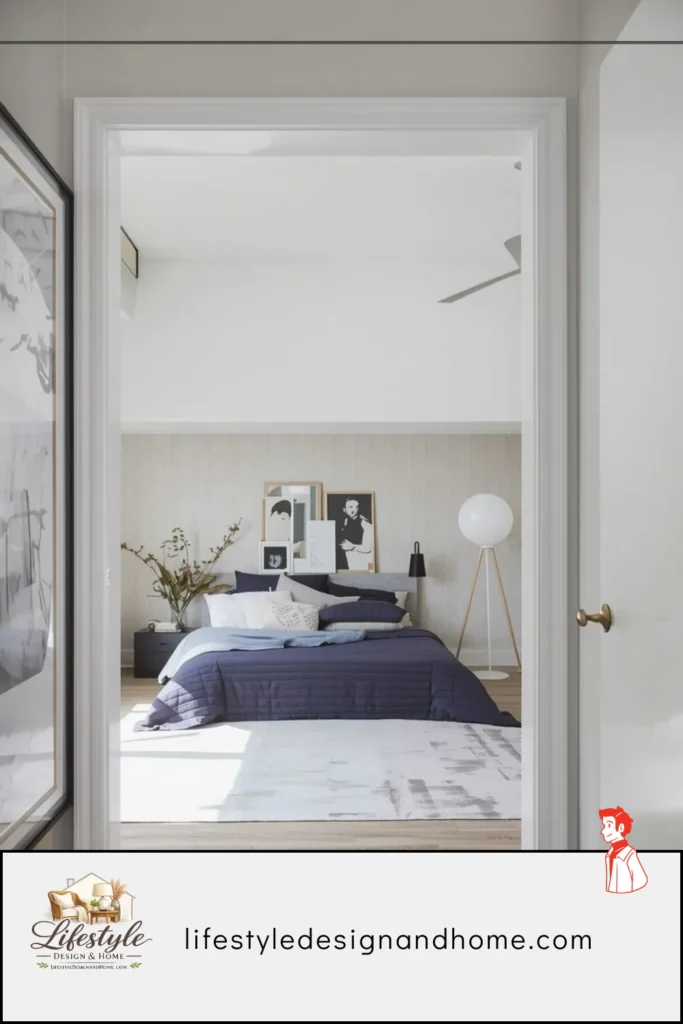
Diagnosis: When you stand in the doorway and look at the bedroom, your eye doesn’t travel upward. Everything in the room is at roughly the same height — bed, dresser, nightstands all between 24 and 36 inches, art hung at eye level, curtains at window height, nothing above that until the ceiling. The room looks like one horizontal band rather than a three-dimensional space.
Why this makes rooms feel smaller: Perceived room size is disproportionately influenced by perceived ceiling height. A room that reads as tall reads as spacious. A room that reads as a horizontal band reads as a box. The 8-foot ceiling in my small bedroom felt lower than 8 feet because the room was narrow and everything in it was low, which made the height-to-width ratio read as compressed. Adding vertical emphasis — drawing the eye upward — made the ceiling feel higher than it was and the room feel more proportioned.
What actually worked for me:
Rehung the curtains. This is the fastest and most dramatic of all the changes I made. The curtains were at window height — the rod mounted at the top of the window frame. I moved the rod to within four inches of the ceiling and bought longer panels. The curtains now ran from near the ceiling to the floor. The window appeared to be a floor-to-ceiling window. The room appeared to have eight-and-a-half feet of ceiling rather than eight feet. The effect was immediate and significant enough that I stood in the doorway for a minute just looking at it.
Added a tall narrow bookshelf. On the wall beside the door — the one surface I could add something to without blocking traffic or the window — I added a bookshelf that ran from floor to nearly ceiling height. Seventy-two inches tall, eighteen inches wide, three inches deep. It didn’t take meaningful floor space. It drew the eye from floor to ceiling on that wall and added a vertical element that gave the room height it had been missing. I put a handful of books on it and a small plant at the top. The wall went from blank to purposeful and the room went from horizontally compressed to vertically complete.
Hung one piece of art higher than felt comfortable. Art at standard eye level — 57 to 60 inches to center — is correct for most rooms. In a small room with low perceived ceiling height, one piece hung slightly higher — 65 to 68 inches to center — draws the eye upward in a way that makes the ceiling feel more distant. I hung a simple print above the bed at 66 inches to center. It felt slightly wrong when I hung it. It felt exactly right every morning for the fourteen months I lived there.
Problem Two: The Room Is Overwhelmed by One Large Piece
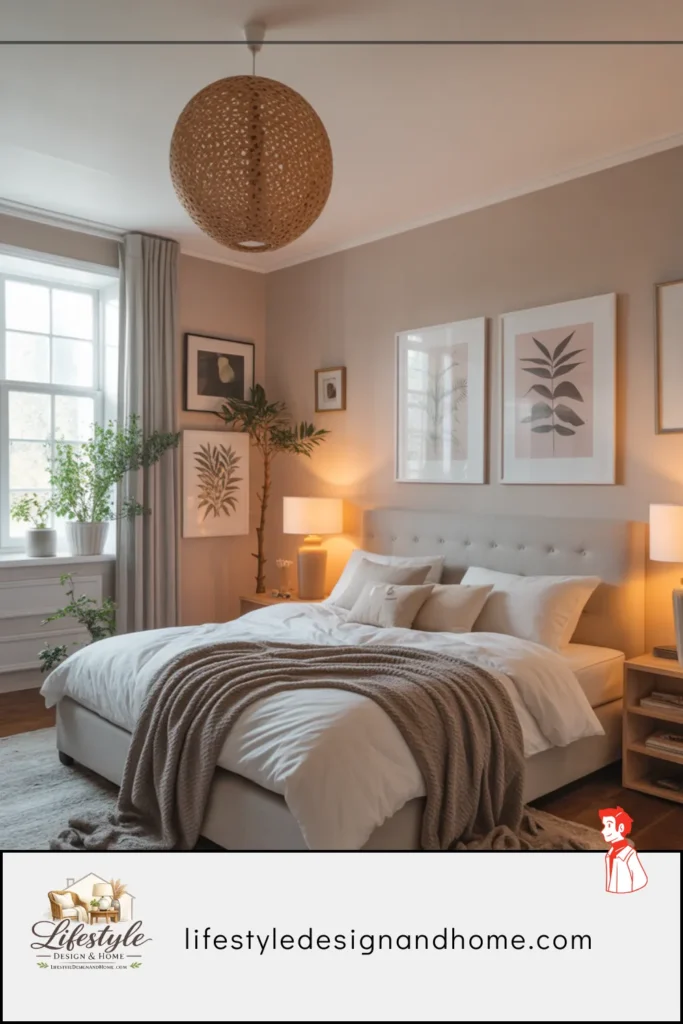
Diagnosis: The bed — or less commonly, the wardrobe — takes up a disproportionate percentage of the room’s floor space and visual field. The room feels like it exists to contain the bed rather than the bed existing within the room. Every path through the room is defined by navigating around the bed rather than by moving through a space.
Why this makes rooms feel smaller: Visual weight is the operative principle here. A large piece of furniture with significant visual weight — height, bulk, a prominent headboard, dark upholstery — creates a dominant presence in the room that crowds out everything else. The room reads as one large piece plus some space around the edges, which is a different and more cramped reading than a room that reads as a coherent space that happens to contain furniture.
What actually worked for me:
Replaced the headboard with nothing. My bed had a fairly substantial wooden headboard — nothing extreme, but tall enough and present enough to take up visual space on the wall behind the bed. I removed it. The bed became a low platform frame with a simple base. The wall behind the bed opened up. I hung art directly on that wall, which gave the wall a focal point without adding bulk. The bed stopped dominating the room and became one element within it.
I want to be honest: I was resistant to this change. The headboard felt like what made the bed a proper bed rather than a mattress on a frame. In practice, the headboard-free bed with a piece of art above it looked more considered and more intentional than the headboard had. It looked like a choice rather than a default.
Switched to a lower platform frame. The original bed frame sat at standard height — mattress top at approximately 25 inches. The replacement platform frame put the mattress top at 18 inches. Seven inches lower. The room gained perceived ceiling height. The wall above the bed became more significant. The room felt less dominated by the horizontal mass of the bed.
This change also had an unexpected practical benefit: the lower bed, with its longer sightline to the ceiling, made the ceiling feel genuinely further away when lying down. I’d been waking up with a mild sense of the ceiling pressing in. The lower bed resolved it.
Problem Three: The Floor Has Disappeared
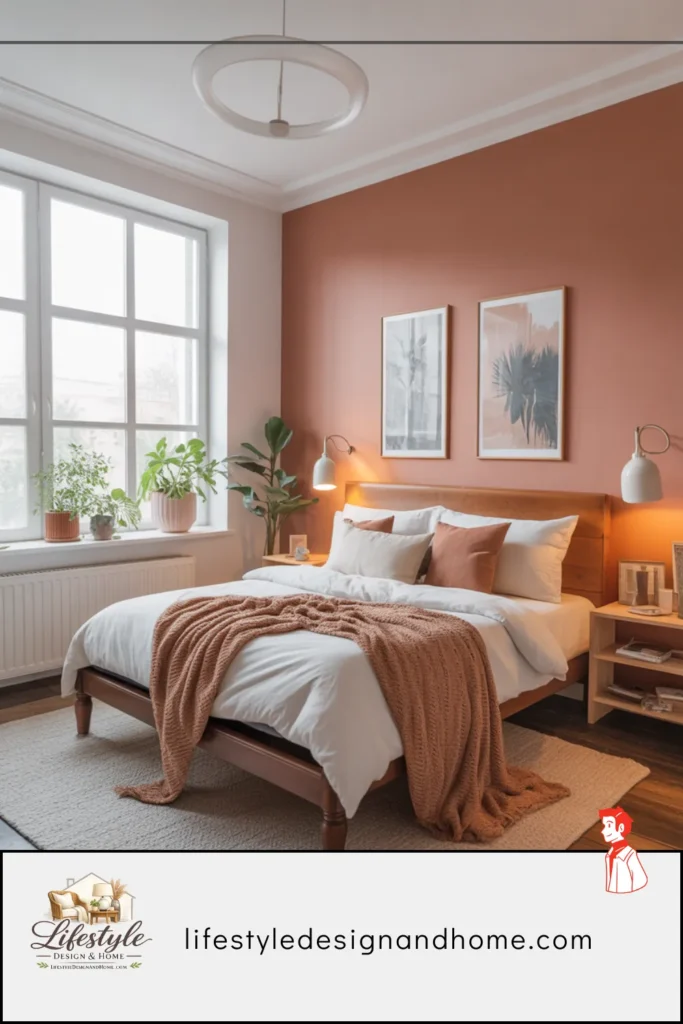
Diagnosis: Objects on the floor — laundry baskets, shoes, bags, books, the items that have accumulated over weeks of not quite putting things away — have reduced the visible floor to a series of clear patches between obstacles. Alternatively, the rug covers almost the entire floor; the furniture sits on the rug, and the floor as a material surface has been entirely replaced by the rug.
Why this makes rooms feel smaller: The brain estimates room size in part by the amount of visible floor space. Floor that is covered — by objects, by furniture footprints, by a rug that extends to the walls — cannot be used for that estimation. The room’s apparent floor size shrinks to the patches of visible floor, and a smaller apparent floor produces a smaller apparent room.
What actually worked for me:
Cleared the floor completely. Everything that did not have legs and did not need to be on the floor went elsewhere. The laundry basket was moved inside the closet. Shoes are stored vertically in a hanging organizer inside the closet door. Books that had migrated to the floor returned to shelves or left the room. The gym bag found a hook on the back of the door. The floor became floor.
This took about forty minutes and required no purchases. It was the single fastest change and the one with the most immediate visible effect. The room looked larger the moment the floor was clear. Not subtly larger. Noticeably, obviously larger — I stood in the doorway and said something out loud to the empty room because the difference was striking enough to produce involuntary commentary.
Replaced the large rug with a smaller one positioned as a bedside element. The original rug was 5-by-8 feet — sized to extend beyond the bed on all sides and cover most of the floor. This is correct rug guidance for larger rooms and wrong rug guidance for very small ones. In an 8-by-10 room, a rug that extends to within 18 inches of all walls is essentially wall-to-wall carpet. The floor disappears. I replaced it with two small runner rugs — one on each side of the bed, 2 by 4 feet each — that provided the soft landing for morning feet without consuming the floor. The hardwood between the bed, the walls, and the door became visible again. The room regained its floor.
Chose furniture with legs. This is the purchase-dependent version of the floor-clearing principle. Furniture that sits directly on the floor — upholstered bases, solid cabinet bases, a bed frame that goes to the floor — creates continuous surfaces between furniture and floor that the eye reads as floor consumed. Furniture with legs reveals floor beneath it. The floor continues under the bed, under the nightstands, under the dresser. The room has more apparent floor than it would if the same furniture sat flatly on it.
My nightstands have legs. My dresser has legs. They are in a room where visible floor is at a premium and every inch of visible floor contributes to the room’s perceived size.
Problem Four: The Light Is Revealing Every Edge

Diagnosis: The room has one overhead light — probably on a standard switch, probably a flush mount or recessed fixture — that is on when you’re in the room and off when you’re not. In the evening, the overhead is what you use for everything: getting into bed, reading, finding things in the dark. The light is uniform, the room is evenly illuminated, and every wall and corner is clearly defined.
Why this makes rooms feel smaller: I covered the full science of this in the lighting tricks article earlier in this series, but the short version is: uniform illumination makes every boundary equally visible and gives the brain the information it needs to accurately estimate the room’s dimensions. The room feels exactly as large as it is, which in a small bedroom is not large enough. Layered lighting from multiple sources at different heights creates shadow and depth — the corners become less precisely defined, the ceiling recedes slightly, the room feels larger because its boundaries are less clearly established.
What actually worked for me:
Added a warm bedside lamp on each side of the bed. Simple table lamps, cream shades, 2700K bulbs. When these were on and the overhead was off, the room was lit from two points at bed height rather than from one point on the ceiling. The ceiling went slightly darker. The upper walls receded. The lower half of the room — the half I actually occupied — was warm and well-lit. The room felt intimate rather than constrained.
Put the overhead on a dimmer. $25 dimmer switch, fifteen minutes of installation. The overhead went from binary — on or off — to adjustable. I used it at 60 percent during the day and 15 percent in the evening. The 15 percent provided just enough general illumination to navigate while allowing the bedside lamps to be the primary sources. The room stopped feeling like it was being examined by its own ceiling.
Added a small accent lamp in the corner. This was the corner beside the closet — the room’s least-used zone, the corner that always seemed slightly cold and undefined. A small table lamp on a low stool, 2700K, low-wattage bulb. The corner went from void to warm. The room’s boundary in that corner became less precise. The room felt like it extended to the corner rather than ending before it.
Problem Five: The Color Is Working Against the Space

Diagnosis: The walls are a color — or a non-color — that makes the room feel smaller. This is most commonly one of three things: a dark color that absorbs light and makes surfaces advance; a cool grey that reflects cool-spectrum light in a way that makes the room feel clinical and precisely bounded; or the specific landlord off-white that isn’t quite any color and hasn’t been chosen for any reason, which produces rooms that feel like the inside of a cardboard box.
Why this makes rooms feel smaller: Color affects perceived space through two mechanisms. The first is light reflection: light colors reflect more light, creating more secondary sources, distributing light further, and making rooms feel brighter and more spacious. Dark colors absorb light, creating surfaces that terminate rather than extend illumination. The second is psychological association: warm, light colors are associated with open, airy spaces — beaches, fields, well-lit interiors. Cool, dark colors are associated with enclosed, interior spaces — caves, cellars, small rooms. The association shapes the perception.
What actually worked for me:
In the 8-by-10 room, I was renting and could not paint. But I have painted small bedrooms in owned spaces and the change is significant enough to be worth describing. The specific change that works: from any cool-toned color or neutral grey to a warm off-white with a specific undertone — a slight pink, a slight yellow, a slight peach. Not enough to read as a color. Enough to be warm rather than cool. The room goes from feeling like it’s made of the same material as the outside of the building to feeling like it’s made of something that was chosen.
For renters: the curtains and the bedding can do much of the same work. A warm-toned linen bedding set in oatmeal or natural flax, combined with curtains in a warm cream or natural ivory, warm the room’s color story even when the walls are the landlord’s cool off-white. The surfaces you can control — the large fabric surfaces — shift the room’s overall color temperature toward warmth, and warmth reads as more spacious than cool.
Problem Six: The Room Has No Clear Organization
Diagnosis: The furniture is arranged without clear logic — not in response to a focal point, not creating clear traffic paths, not organized around the room’s architectural features. The bed might be in the right place but the other pieces feel randomly distributed. The room reads as furniture-in-a-room rather than as a designed space.
Why this makes rooms feel smaller: A room without organizational logic feels chaotic to the brain in the same way visual noise does. The brain works harder to read it, and rooms that require effort to read feel smaller and more uncomfortable than rooms that read easily. A clearly organized room — furniture in clear relationship to each other and to the room’s architectural features, traffic paths clear and logical — reads as intentional, and intentional spaces always feel more generous than accidentally assembled ones.
What actually worked for me:
Identified the room’s one focal point and organized everything around it. In my 8-by-10 room, the focal point was the window — the only architectural feature with genuine visual interest. The bed went on the wall adjacent to the window rather than opposite it, so the window was in my sightline when lying in bed. Not above me, not directly beside me — visible, as a small rectangle of the outside world, from the bed’s most-used position.
Everything else was organized around the bed: nightstands flanking it, dresser on the wall opposite, the tall bookshelf beside the door. The organization was simple and logical, and the room immediately read as more spacious because the logic was visible. A room with a clear reason for why each piece is where it is feels larger than a room where pieces are where they are because they fit.
Ensured every traffic path was clear and logical. From the door to the bed: clear. From the bed to the closet: clear. From the closet to the dresser: clear. No path required navigating around a piece of furniture. No path required sideways movement or deliberate stepping. The floor was clear and the paths were clear and the room communicated that it knew how to be used.
The Changes That Cost Almost Nothing
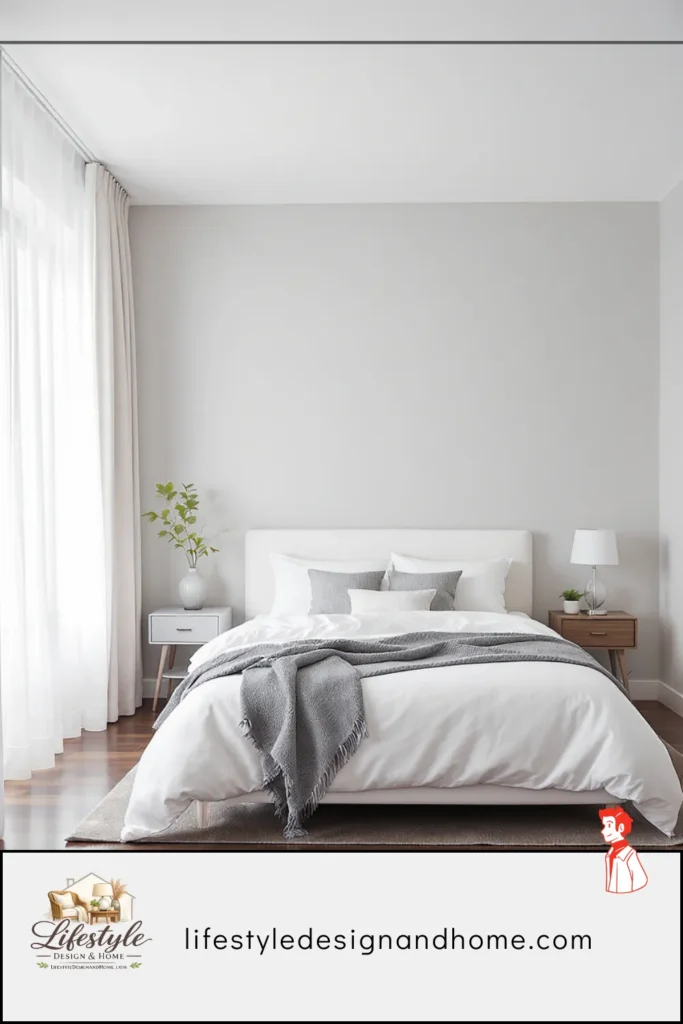
I want to be specific about what the two-day transformation in my 8-by-10 room actually involved, because I find that the most useful information is not the most dramatic — it is the most honest.
Free changes:
Cleared the floor of all objects. Moved the laundry basket inside the closet. Reorganized shoes onto the back of the closet door. Returned floor-level books to shelves or donated them.
Rehung the art three inches higher than it had been.
Repositioned the bed to face the window rather than being parallel to it.
Removed the headboard.
Changes under $50:
Dimmer switch for the overhead fixture: $25.
New curtain rod at ceiling height: $18.
Two small bedside runner rugs replacing the large floor rug: $32 for both.
Changes between $50 and $200:
Two warm bedside lamps: $65 each, so $130 total.
The tall narrow bookshelf: $45 secondhand.
Replacement 2700K bulbs for all fixtures: $22.
Total: approximately $270 for the purchased items. The free changes — the floor clearing, the art rehang, the bed repositioning, the headboard removal — were the ones that produced the most immediate visible change.
This matters because the temptation when a room feels wrong is to solve it with purchasing. New furniture, new decor, new organizational systems. Before any purchasing, the free changes should be made first — because they reveal what the room actually needs and because they frequently solve the problem without the purchased solution being necessary.
The Third Morning
The third morning after those two days I woke up in the 8-by-10-foot bedroom and lay there for a moment before getting up.
The ceiling was eight feet away. Not pressing. Just ceiling — at its correct distance, in its correct relationship to the rest of the room. The window was in my sightline: a rectangle of grey morning sky that I hadn’t been able to see from bed in the previous two months because the bed had been on the wrong wall. The floor on both sides of the bed was clear. The warm light from the bedside lamp I’d switched on was hitting the curtains and making them glow slightly against the pale wall.
The room was 8 by 10 feet. It was always going to be 8 by 10 feet. The walls hadn’t moved. The ceiling hadn’t risen. The window hadn’t grown.
But the room felt different in the specific way that rooms feel different when they have been understood rather than just inhabited. When the problems have been diagnosed and addressed rather than accepted as the nature of small bedrooms. When the space knows what it is and does it without apology.
I stayed in that bedroom for another twelve months and never felt the ceiling again.
That is what this is for. Not to trick you into believing your bedroom is larger than it is. To stop the room from tricking you into believing it is smaller.