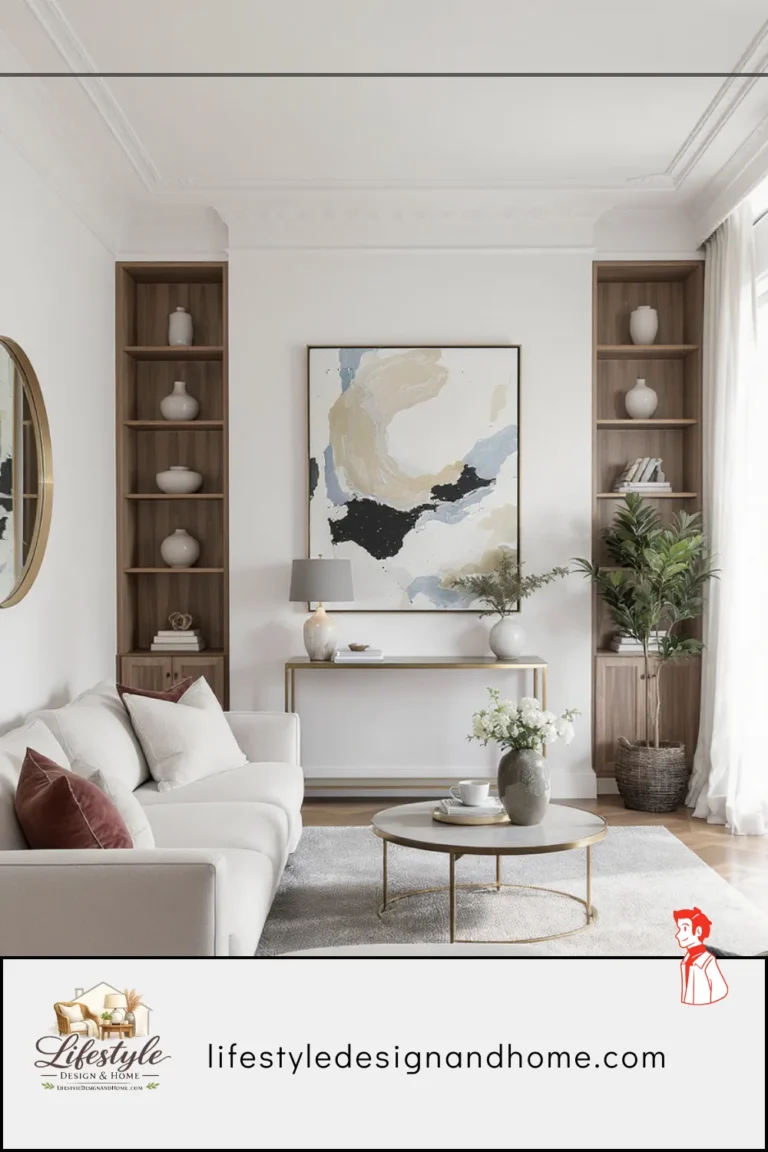
The Room Isn’t the Problem. You Are.
That’s not an insult. It’s actually the most hopeful thing anyone could tell you.
Because if the problem were your square footage — if the room were just physically, irredeemably too small — there would be nothing to do. You’d be stuck. But that’s almost never the reality. The reality is that most small living rooms feel cramped, claustrophobic, and chaotic not because of how many square feet they contain, but because of a series of very specific, very fixable mistakes that their owners keep making.
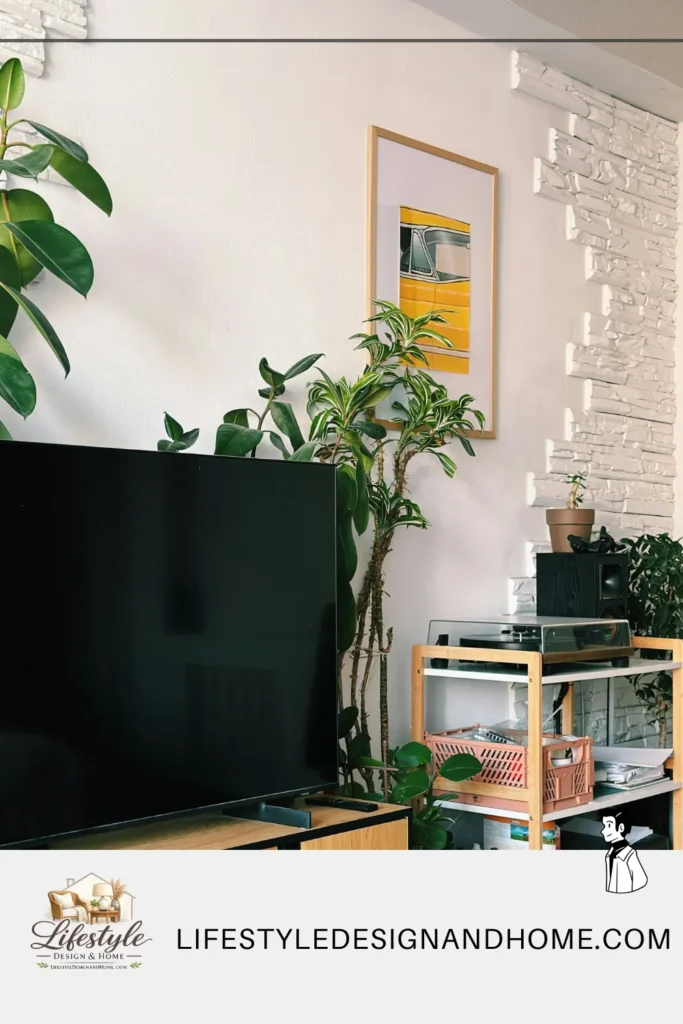
And here’s the part that stings a little: these mistakes feel like the right decisions. They follow a logic that sounds reasonable. Push the sofa against the wall to open up the middle of the room. Buy a smaller coffee table so it doesn’t overwhelm the space. Keep things simple with one light overhead. Every single one of these choices makes complete intuitive sense — and every single one of them makes the room feel smaller.
Interior designers understand something that most people don’t: the human brain doesn’t experience a room by measuring it. It reads it. It picks up visual cues and translates them into emotional responses — expansive or cramped, inviting or awkward, calm or chaotic. When you understand how those cues work, you can manipulate them. You can make a 12-by-14-foot box feel like something you actually want to live in.
The mistakes below are the ones I see most consistently — in apartments, in starter homes, in rooms where someone clearly tried hard and still ended up with a space that feels wrong. They’re ranked roughly by impact, starting with the ones that do the most damage. Fix even three or four of them and you’ll be stunned by how different the same room can feel.
Mistake 1: Pushing All the Furniture Against the Walls
This is the big one. It’s the layout instinct so deeply ingrained that it feels like a law of physics, and it is the single most reliable way to make a small living room feel smaller, emptier, and more awkward than it actually is.
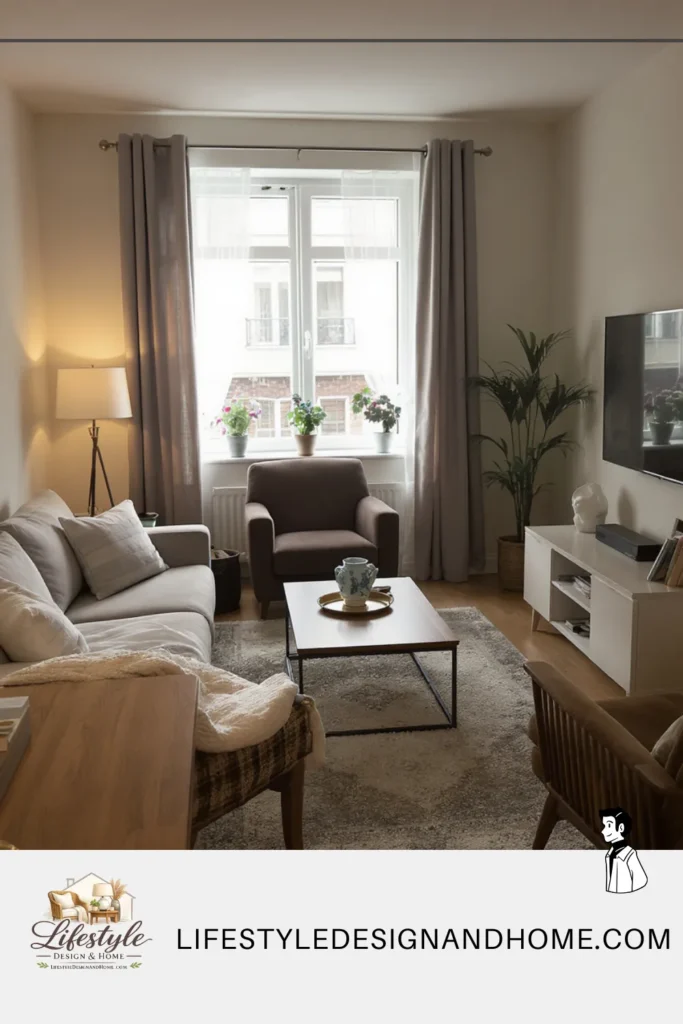
The logic goes: if the furniture is against the walls, the center of the room is open, and the room feels bigger. This is wrong in almost every scenario that involves an actual living room with actual furniture.
Here’s what actually happens when you push everything to the perimeter. The furniture looks like it’s huddled defensively around the edges, waiting for something to happen in the middle. The center of the room becomes a vast, uncommitted void — not open and airy, just empty and purposeless. There’s no focal point. No place the eye wants to rest. Conversation becomes physically awkward because your guests are basically sitting at opposite ends of a tennis court. And paradoxically, the room reads as larger in footprint — which in a small space only emphasizes how much of it is wasted.
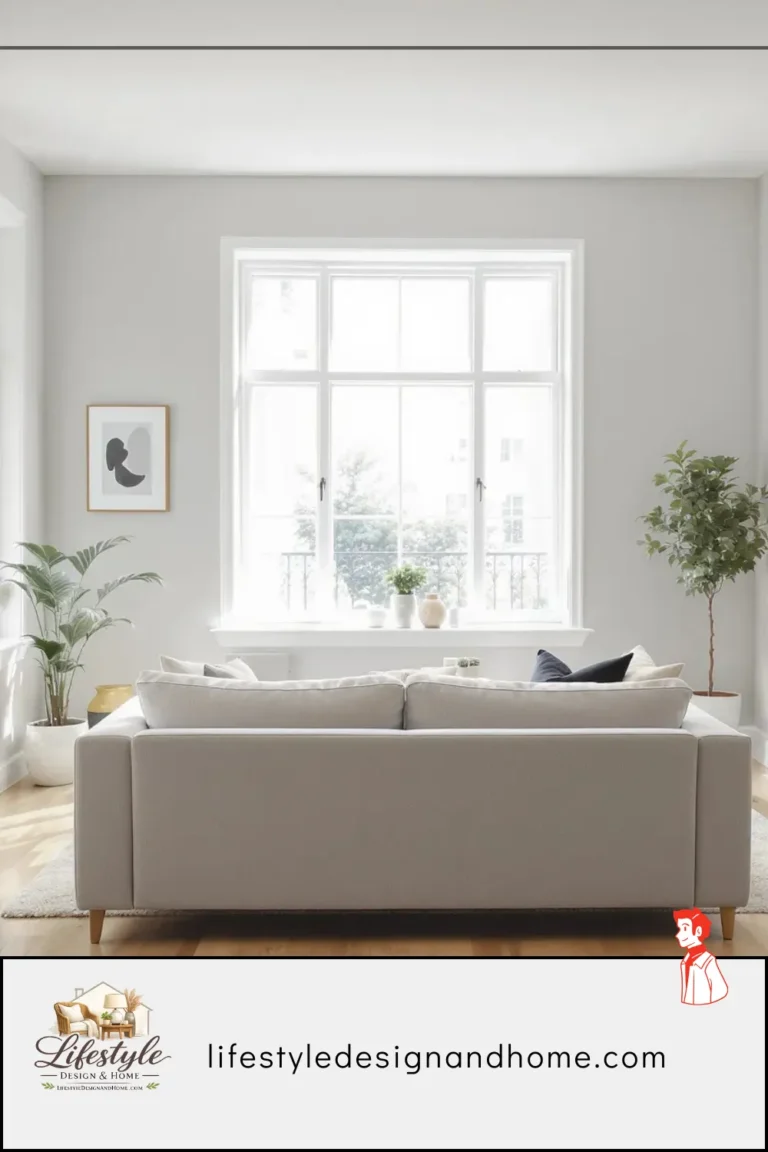
When you float furniture — pulling the sofa away from the wall by even 8 to 12 inches, grouping pieces into a cohesive conversational cluster — you create a defined zone. A room within a room. And here’s the psychological magic: a well-defined zone reads as intentional and complete, and intentional spaces always feel more generous than disorganized ones. The furniture looks like it belongs to each other. The room has a center of gravity. That gap between the back of the sofa and the wall creates a sense of depth that makes the room feel longer, more layered, more considered.
The floor you “lose” by pulling furniture inward is invisible. The depth you gain is everywhere.
Mistake 2: Buying a Rug That’s Too Small
Walk into almost any small living room and you’ll find it: a rug the size of a welcome mat sitting under the coffee table, completely detached from every piece of furniture in the arrangement. The sofa’s legs are on bare floor. The chairs might be half-on, half-off. The rug floats there like a lonely island in the middle of the room.
This mistake has a clear origin story: people are afraid of going too big. They see a large rug in a small room and their instinct screams that it’s going to overwhelm the space, make it feel even more crowded. So they play it safe and buy something small. And then the room looks worse.
A rug that’s too small doesn’t protect the space. It fragments it. Every piece of furniture becomes a separate visual object floating on the floor with no connection to the others, and a room full of disconnected objects always reads as smaller and more chaotic than a room where the elements are unified.
A large rug does the opposite. It creates a floor plane — a defined territory that the furniture lives within. The eye reads the rug as the boundary of the “room,” and that containment, counter-intuitively, makes the space feel more expansive because it feels organized and complete. It’s the same reason a well-composed photo of a small space looks bigger than a carelessly framed one: it’s not the subject, it’s the framing.
The rule: your rug should be large enough that the front two legs of every major seating piece can sit on it. If you can get all four legs on the rug, better still. For most living rooms, an 8-by-10 is the floor, and 9-by-12 is frequently the right answer even when it sounds too large. When in doubt, buy bigger. You can always return it. You can’t un-shrink a room that’s been visually broken up by a rug the size of a bath mat.
Mistake 3: Hanging Curtains at Window Height
Your curtains are probably hanging in the wrong place.
Not wrong in the sense of aesthetically misguided — wrong in the sense that they’re actively working against the perceived size of your room every single day. If your curtain rod is mounted at the top of the window frame and your panels end at the sill or the floor but start too low, you’ve drawn a horizontal line across the middle of your wall that the eye reads as a ceiling. The room looks shorter, heavier, and more constricted — not because it is, but because you’ve given the brain a visual instruction that reads: the room ends here.
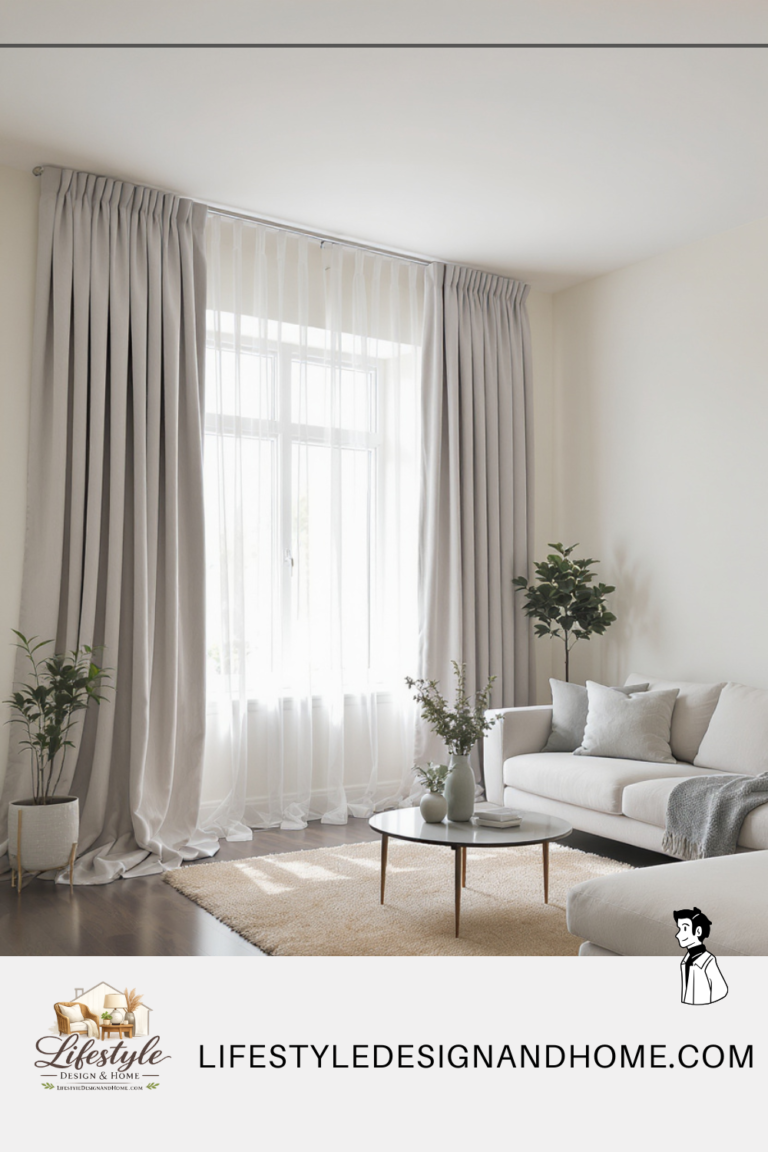
Ceiling-height curtains are one of the cheapest, most impactful changes you can make to a small room. Mount the rod four to six inches below the actual ceiling — or even closer if you can manage it — and let the panels fall all the way to the floor. If your existing panels aren’t long enough, buy longer ones. The difference in cost between standard-length and floor-to-ceiling curtains is usually minimal. The difference in how the room reads is enormous.
What ceiling-height curtains accomplish is vertical emphasis. The eye follows the fabric from floor to ceiling and interprets the full height of the room. The window appears larger — sometimes dramatically so. The ceiling feels higher. And a room that reads as taller always reads as less cramped, regardless of its actual floor plan.
One additional detail that most people miss: hang the rod wider than the window. Extend it six to eight inches beyond the window frame on each side so that when the curtains are open, the fabric stacks on the wall rather than over the glass. This reveals the full window, lets in more light, and makes the window look significantly wider than it is. Three small adjustments — higher rod, longer panels, wider spread — and you’ve visually added a dimension to your room that didn’t exist before.
Mistake 4: Using Too Many Small Pieces Instead of One Statement Piece
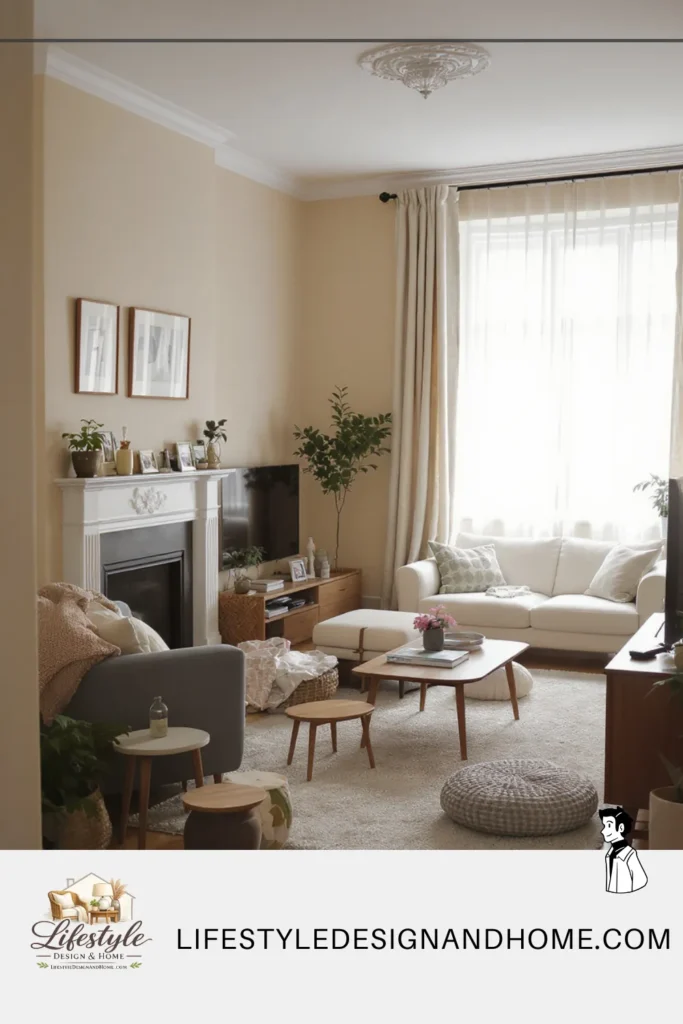
Small room, small furniture. It sounds right. It’s one of those interior design “rules” that gets passed around enough that it starts to feel like common sense. Don’t overwhelm a small space with large pieces. Keep the scale modest. Use smaller items so the room doesn’t feel crowded.
The problem is that this rule, applied literally, produces rooms full of tiny, fussy, competing furniture pieces — and a room full of small competing things always reads as more chaotic and smaller than a room with one or two anchor pieces surrounded by breathing room.
The actual principle designers use is selective scale. This means choosing one or two pieces that are genuinely sized for comfort and function — a sofa that can actually seat people, a coffee table that can hold a drink and a book without feeling like a postage stamp — and then being ruthless about what else enters the room. One substantial sofa reads as confident and comfortable. Three small chairs jammed in to “save space” reads as cluttered. One well-sized coffee table creates a natural anchor. Four tiny accent tables scattered around the room create visual chaos.
The emphasis is on fewer, better pieces rather than many, smaller ones. This is also a financial lesson: spending more on one quality, correctly-scaled sofa and removing two undersized chairs you don’t need is almost always a better use of money than buying five “small” pieces that collectively overwhelm the room and none of which quite work.
When you’re choosing furniture for a small room, the question isn’t will this piece fit? — it’s does this piece earn its place? Measure, yes. But also edit ruthlessly. Every piece that doesn’t serve a clear purpose is borrowing visual space from the pieces that do.
Mistake 5: Lighting the Room with a Single Overhead Light
This mistake is so common it’s practically universal, and it’s one of the most invisible — because the problem isn’t what people see, it’s how the room makes them feel. A single overhead light provides flat, even, directionless illumination that spreads uniformly across every surface, every corner, every edge of the room simultaneously. The brain processes this and reads the complete footprint of the space all at once. Every boundary is visible. Every corner is defined. The room is exactly as big as it is — no more, no less.
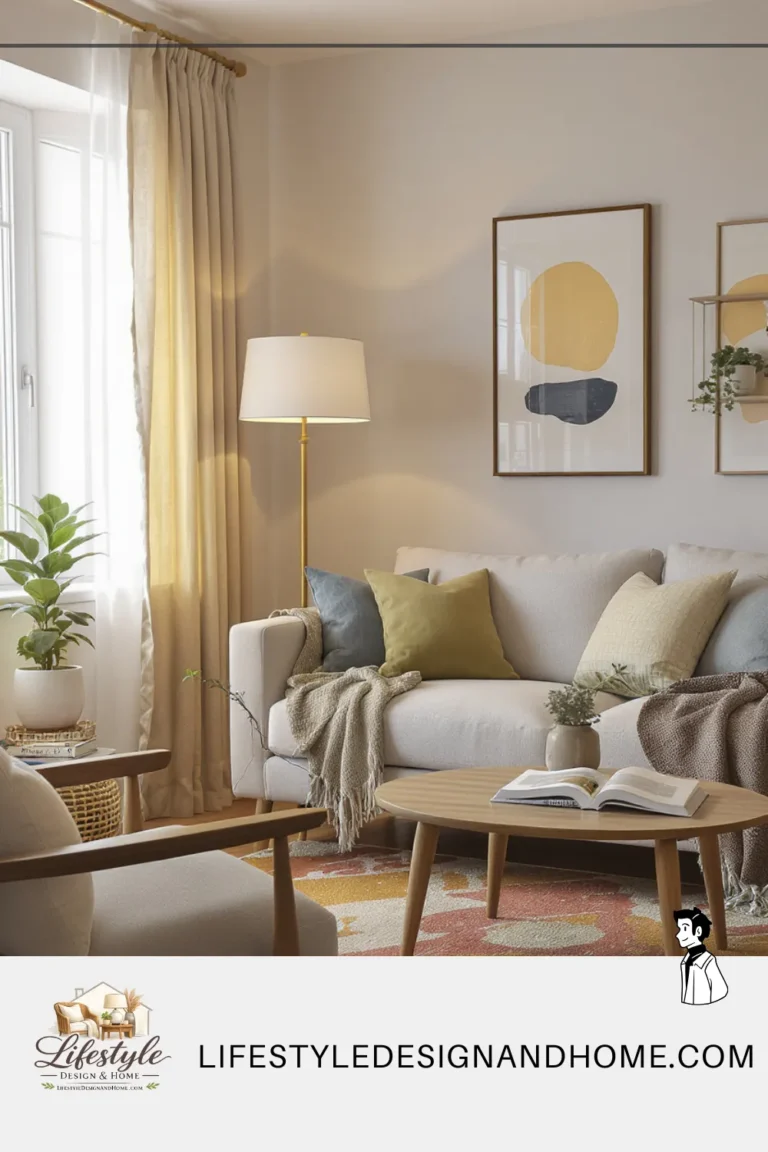
Layered lighting does something completely different. When you have light sources at different heights — a floor lamp in the corner, table lamps flanking the sofa, perhaps a small accent light tucked under a shelf — the room is no longer uniformly illuminated. Some areas are bright. Some are in soft shadow. And a room where you can’t quite see where the corners end reads as potentially larger than one where every boundary is equally visible. The corners feel like they could extend further than they do. The room gains depth it doesn’t technically possess.
This is not a subtle effect. Turning off an overhead light and switching on two or three warm-toned lamps instead is one of the most dramatic instant transformations you can make in a living room — and it requires zero rearranging of furniture.
Practical guidance: aim for at least three light sources in a small living room. One overhead on a dimmer (not at full brightness — dimmers are worth every penny), one floor lamp in a corner that would otherwise fall flat, and one or two table lamps that put light at sofa-height where people actually sit. Use warm bulbs — 2700K to 3000K is the sweet spot that reads as comfortable and inviting rather than clinical.
Mistake 6: Decorating Without a Visual Hierarchy
Open a design magazine. Look at a room you find beautiful. Now look at it again and notice what your eye does: it lands somewhere first. Then it moves somewhere else. Then somewhere else again. There’s a sequence — a hierarchy — and that hierarchy is completely intentional. Designers create it deliberately, and it’s one of the primary reasons designed spaces feel so different from decorated ones.
Most small living rooms fail at this, not because they lack beautiful objects, but because every object is asking for equal attention at equal volume. The gallery wall fights with the patterned throw, which fights with the sculptural lamp, which fights with the colorful pillows, which fights with the textured rug. Everything is interesting. Nothing is dominant. The eye has no idea where to start, so it scrambles around the room trying to process everything simultaneously — and a room the brain is working hard to read always feels more chaotic and more cramped than one it can scan smoothly.
The solution is deliberate hierarchy. One thing should be the dominant visual element in the room — the focal point. In most living rooms this is the sofa, or a piece of art above it, or the television wall if it’s designed well. Everything else should support this focal point without competing with it. Accessories should be curated, not collected. The rule of odd numbers — grouping objects in threes or fives rather than pairs — creates arrangements that feel natural rather than symmetrical and static. Varying heights within a grouping — a tall vase next to a medium candle next to a low bowl — creates the kind of visual rhythm that reads as interesting without being chaotic.
The simple test: stand in the doorway of your living room. Where does your eye go first? If it doesn’t go anywhere specific — if it just skitters around trying to find a landing point — you don’t have a focal point. Find one and design toward it.
Mistake 7: Ignoring the Vertical Plane Entirely
Most people design their living rooms horizontally. They think about where to put the sofa, where the coffee table goes, how to arrange objects on surfaces. The walls above eye height, the ceiling, the vertical potential of the room — all of it sits empty and unused. And in a small room with limited floor space, the vertical plane is practically free real estate.
Using vertical height does two things simultaneously: it stores things without consuming floor space, and it draws the eye upward — which is the visual equivalent of raising the ceiling. A room where your eye naturally moves up feels taller and more spacious. A room where everything is at the same height feels squashed.
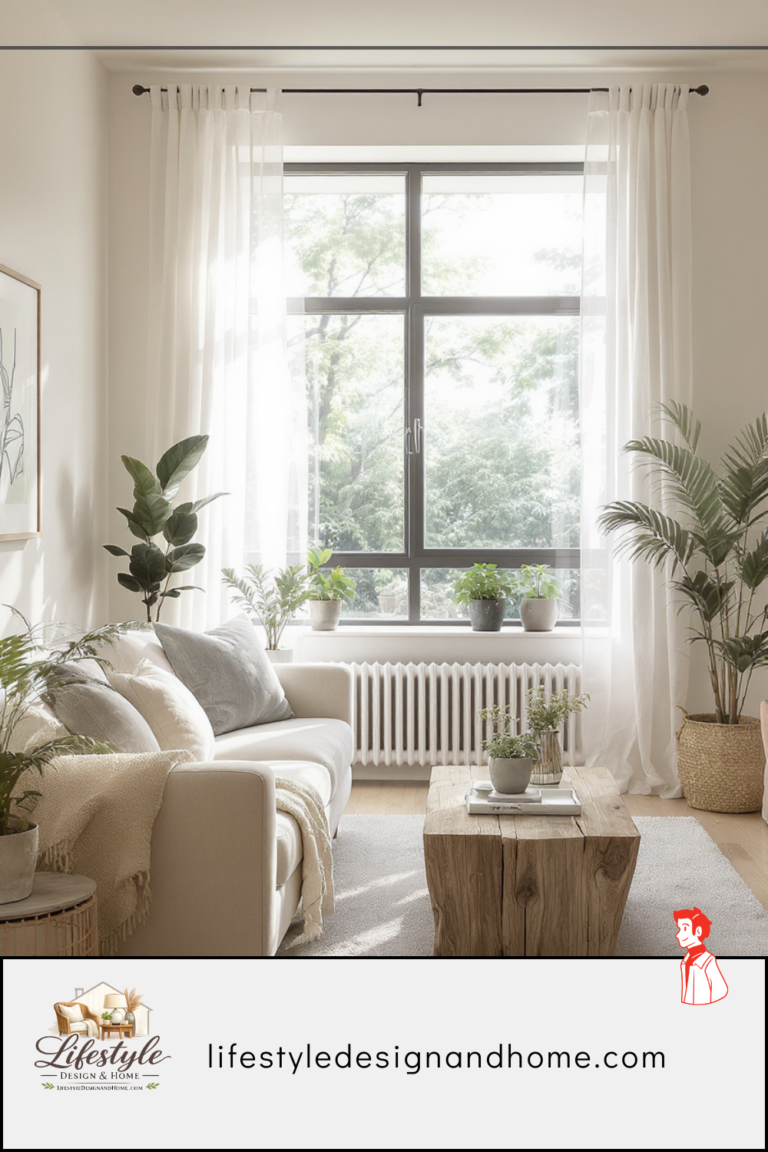
Tall bookshelves are one of the most effective tools in a small room. A floor-to-ceiling bookshelf doesn’t just hold books — it turns an entire wall into a visual element that draws the eye from floor to ceiling, making the room feel both taller and richer. Floating shelves do the same. Art hung high — higher than feels instinctive, usually above eye level — encourages the eye to travel upward. A tall, dramatic plant in the corner does the same job with less commitment.
The floor, meanwhile, should be treated as a resource to be protected. Every item on the floor — the stack of magazines, the decorative basket, the extra side table that isn’t quite doing anything — is consuming visual floor space. The more open floor you can reveal, the larger the room reads. This means choosing furniture with visible legs wherever possible (sofas, chairs, tables — anything that shows floor underneath it reads as less heavy), using wall-mounted options instead of floor-standing ones where you can, and editing ruthlessly anything that’s sitting at floor level without a clear purpose.
The Honest Truth About Small Rooms
None of these mistakes are the result of bad taste. They’re the result of design instincts that haven’t been updated with the actual science of how the brain reads space. You were doing what felt logical — and what felt logical happened to work against you.
The good news is that every single mistake on this list is reversible, and most of them are reversible for free or close to it. Moving furniture doesn’t cost money. Rehinging curtain rods costs an afternoon and maybe fifteen dollars for longer hardware. Turning on a floor lamp and turning off an overhead light costs nothing. Adding a larger rug is the most expensive item on the list — and even then, you’re looking at a one-time investment that changes how the room feels every single day.
Start with Mistake #1. Pull your sofa off the wall and see what happens. Create a conversational grouping even if it feels strange. Stand in the doorway and look at it for a full thirty seconds. Notice whether the room already feels different.
Then work through the list. Each fix builds on the others, and the cumulative effect is the kind of transformation that makes people walk into your living room and say, “This feels so much bigger than I expected” — and mean it.
Quick-Reference: The 7 Mistakes and Their Fixes
Mistake 1: Furniture against the walls
Fix: Float all major pieces at least 8–12 inches from the wall. Create a conversational grouping with a clear center.
Mistake 2: Rug that’s too small
Fix: Upgrade to a rug where at least the front two legs of all seating pieces fit on it. Start at 8×10; consider 9×12.
Mistake 3: Curtains at window height
Fix: Mount rods 4–6 inches from the ceiling. Use floor-length panels. Extend rods 6–8 inches past the window frame on each side.
Mistake 4: Too many small pieces
Fix: Edit ruthlessly. Invest in fewer, correctly-scaled anchor pieces. Every piece should earn its place.
Mistake 5: Single overhead light
Fix: Add a floor lamp and two table lamps. Put overhead on a dimmer. Use warm bulbs (2700–3000K).
Mistake 6: No visual hierarchy
Fix: Identify one focal point. Design toward it. Curate accessories — three objects at varying heights beat five objects at the same height.
Mistake 7: Ignoring vertical space
Fix: Go tall with shelving and art. Choose furniture with legs. Clear the floor of anything that doesn’t earn its place.
Fix the mistakes. Keep what works. The room you want is already there — you just need to stop working against it.